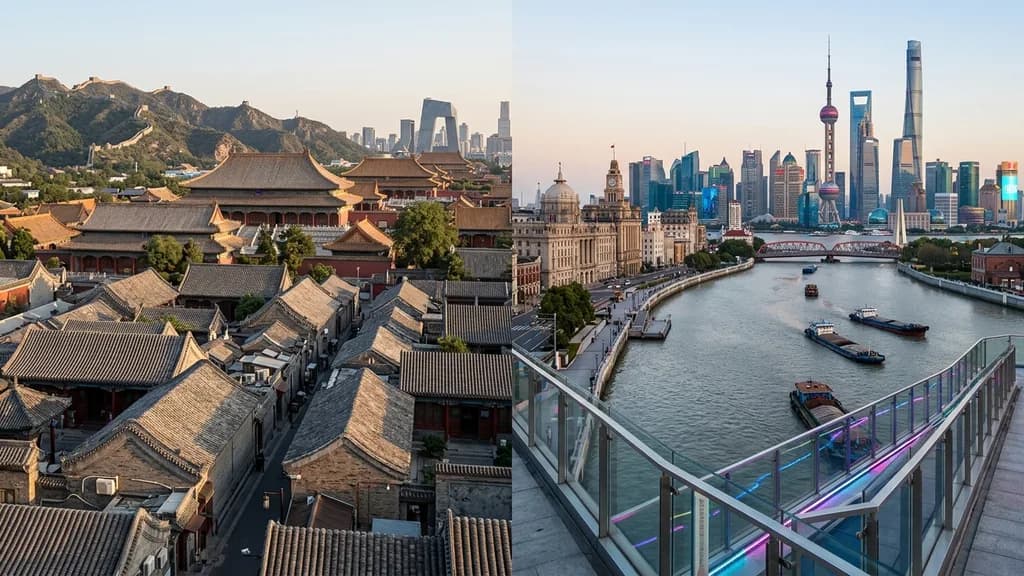
Beijing or Shanghai for your 2026 China trip? Honest 10-dim comparison - imperial history vs modern skyline, cost, air quality, food, and which fits your trip.
Beijing vs Shanghai for Tourists: Honest 2026 Comparison
If you only have one week in China and you are deciding between Beijing and Shanghai, this guide is written for you. We are not going to pretend both cities are equally good at everything, because they are not. Beijing is the imperial capital, the political heart, the place where the Forbidden City sits on a 600-year-old axis and the Great Wall climbs the mountains an hour north. Shanghai is the financial showcase, the skyline city, the eastern port where Art Deco villas sit next to 632-meter towers and you can eat Michelin-starred Jiangsu food within sight of neon dumpling stalls.
After comparing them across 10 dimensions that actually matter for travelers, one ends up a better fit for first-timers, one wins on history, one wins on food polish, and the honest answer is that most people should visit both if they have the time. Here is the full breakdown.
TL;DR: The 10-Dimension Verdict
| Dimension | Beijing | Shanghai | Winner |
|---|---|---|---|
| Imperial history | Forbidden City, Temple of Heaven, Summer Palace | Limited | Beijing |
| Modern skyline | Limited, mostly CBD | Pudong, Bund, Shanghai Tower | Shanghai |
| Food depth | Peking duck, northern staples | Xiaolongbao, Jiangsu, international | Tie |
| English / ease | Moderate | Noticeably easier | Shanghai |
| Cost per day | $70 to $100 USD | $90 to $130 USD | Beijing |
| Air quality | Winter issues, improving | Generally better | Shanghai |
| Day trips | Great Wall, Ming Tombs | Water towns, Hangzhou | Beijing |
| Family attractions | History-heavy | Disneyland, aquarium, SWFC | Shanghai |
| Nightlife / bars | Limited, local | Dense, international | Shanghai |
| First-time friendliness | Challenging but iconic | Smoother entry | Shanghai |
So if you are a first-timer worried about culture shock, Shanghai eases you in. If you came to China specifically for ancient dynasties and the Great Wall, do not overthink it, fly into Beijing. Everyone else: both, in that order.
Decision Matrix: Which City Fits Your Trip
Rather than argue in abstract, here is a quick-pick table based on what you actually want from your China trip.
| Your priority | Pick |
|---|---|
| My first time in Asia, I want it easy | Shanghai |
| I am obsessed with the Great Wall | Beijing |
| I have small kids | Shanghai (Disney) |
| I want neon, skylines, shopping | Shanghai |
| I want temples, hutongs, imperial palaces | Beijing |
| Budget backpacker, under $50 USD / day | Beijing |
| Business traveler with one free weekend | Shanghai |
| Food tourist hunting authenticity | Beijing |
| Food tourist hunting polish and variety | Shanghai |
| Winter trip (December to February) | Shanghai (air quality) |
| 7 to 10 days in China total | Both, split 3 to 4 days each |
If two or more of your answers land in one column, fly there first. If you are torn, keep reading.
Imperial History: Beijing Wins, and It Is Not Close
Beijing has been a capital for roughly 800 years, serving as the seat of the Yuan, Ming, and Qing dynasties. That density of imperial architecture is something Shanghai simply cannot match because Shanghai was still a fishing town when Beijing was laying out the Forbidden City.
What you actually see in Beijing:
- Forbidden City (Palace Museum): 9,000 rooms across 72 hectares. Entry is 60 CNY ($8.30 USD) in peak season. Plan 3 to 4 hours minimum. Book tickets 7 days ahead through the official WeChat mini program because same-day tickets are almost never available.
- Temple of Heaven: Ming-era ceremonial complex where emperors prayed for good harvests. Locals do tai chi and play cards in the surrounding park in the morning. Entry is 34 CNY ($4.70 USD).
- Summer Palace: Imperial garden retreat built around Kunming Lake. The walk along the Long Corridor with 14,000 hand-painted scenes takes 30 minutes alone. Entry is 30 CNY ($4.20 USD).
- Hutongs: The gray-brick alleys north of the Forbidden City, especially around Nanluoguxiang and the Drum Tower, are the single best place in China to experience pre-revolutionary urban life. Walking them is free.
Shanghai has the Yu Garden, the Jade Buddha Temple, and the Shanghai Museum, which is genuinely world-class. But none of that is imperial, and the Yu Garden is a 16th-century private merchant garden, not a palace. If you came for dragons carved into marble ramps that emperors walked over, only Beijing has that.
Modern Skyline and International Feel: Shanghai Wins
Pudong, across the Huangpu River from the Bund, is one of the most recognizable skylines on Earth. The Shanghai Tower at 632 meters is the second-tallest building in the world, and from its observation deck on floor 118 you see the entire city curve out to the horizon.
What Shanghai delivers that Beijing does not:
- The Bund at night: 1.5 kilometers of 1920s Art Deco banks and customs houses, lit up and staring across at neon Pudong. This is the single most photographed spot in China after the Great Wall.
- French Concession: Plane-tree-lined streets with brunch cafes, indie bookstores, wine bars, and low-rise 1920s villas. This is where Western expats cluster and where you can legitimately forget you are in China for an afternoon.
- International dining: Shanghai has more Michelin stars than any Chinese city outside Hong Kong, serious Italian, real French, good Mexican, high-end Japanese. Beijing has some of this but a fraction of the density.
- Nightlife: Found 158 in Jing'an, rooftop bars on the Bund, speakeasies tucked behind unmarked doors in the Former French Concession. Beijing nightlife exists but it is sparser and more local.
Beijing has the CBD around Guomao with its twisted CCTV tower and new-build towers, but it feels corporate and empty after dark. Shanghai feels like a proper 24-hour international city.
Food Head-to-Head: Peking Duck vs Xiaolongbao
This one is a tie because they compete in different weight classes, but the styles are so distinct that your food preference probably decides your city preference.
Beijing: Northern, Heavier, Meat-Forward
- Peking duck: The dish. Roast it over fruitwood until the skin shatters, carve it at the table, wrap it in thin pancakes with scallion, cucumber, and sweet bean sauce. Best at Siji Minfu (around 298 CNY / $41 USD for a whole duck for two) or Da Dong for a modern take.
- Zhajiangmian: Hand-pulled wheat noodles topped with fermented soybean paste and pork, a true Beijing local dish.
- Jianbing: The crepe-like street breakfast folded around egg, crispy wonton, and chili sauce. 10 to 15 CNY ($1.40 to $2.10 USD).
- Lamb hot pot: Copper pot, charcoal, thin slices of lamb, sesame dipping sauce. The Mongolian-influenced classic.
- Donghuamen night market: Scorpions on sticks exist for the photo, but the hand-pulled noodles and lamb skewers are the real draw.
Shanghai: Sweeter, More Refined, More International
- Xiaolongbao: The soup dumpling. Jia Jia Tang Bao and Din Tai Fung are the safe bets, 20 to 60 CNY ($2.80 to $8.30 USD) for a basket of 8.
- Shengjianbao: Pan-fried pork buns with crispy bottoms. Yang's Fry Dumpling near People's Square serves them by the thousand.
- Drunken crab: Hairy crab soaked in Shaoxing wine, eaten cold, seasonal from September to December.
- Hongshao rou: Red-braised pork belly, Mao Zedong's reported favorite, sweet and dark from rock sugar and soy.
- Jiangsu fine dining: Fu He Hui and Yong Foo Elite are among the best Chinese restaurants on Earth.
Verdict: Beijing is better if you want authentic, hearty, unmistakably regional food. Shanghai is better if you want variety, refinement, and international options on the same trip.
Language Barrier: Shanghai Is Meaningfully Easier
Both cities run the Chinese metro playbook: bilingual signage on lines, English announcements on trains, English ticket machines. That is the floor.
Above the floor, Shanghai is easier:
- Hotel front desks in the 3-star and up range almost always handle basic English in Shanghai.
- Restaurant waiters in the Bund, Xintiandi, French Concession, and Jing'an areas frequently have English menus and rudimentary service English.
- Shanghai taxi drivers are slightly more used to foreigners. Still, always have the destination written in Chinese characters in your phone.
In Beijing you lean on Pleco and Google Translate more. Outside the Forbidden City, Wangfujing, and Sanlitun, English speakers thin out fast. This is not a dealbreaker. It is a friction difference. For anxious first-timers it matters.
Both cities accept WeChat Pay and Alipay everywhere, and both now allow foreign credit cards to be linked to those wallets, which is the single biggest travel quality-of-life upgrade for 2026.
Air Quality Reality: Beijing Winter Is Still an Issue
We are going to be honest because the internet is full of either outdated horror stories or dishonest tourism-board hand-waving.
The truth in 2026:
- Beijing's annual average PM2.5 has fallen from around 90 micrograms per cubic meter in 2013 to about 32 in recent years. That is a 60-plus percent drop.
- Spring (April to May) and autumn (September to October) in Beijing are often genuinely clear, with AQI under 100.
- Winter (November to February) still produces bad days. Coal heating in surrounding Hebei province and stagnant cold air combine to push AQI above 150, occasionally above 200.
- Shanghai's PM2.5 averages around 25 to 30, slightly better than Beijing. But Shanghai has more humidity and more haze, which can feel worse than it measures.
- Both cities are fine for healthy adults with a quality KN95 or N95 mask on bad days.
If you have asthma or you are traveling with young kids in December or January, Shanghai is the safer pick. For everyone else, check the AQI forecast the week before and do not panic either way.
Great Wall Access: Beijing Wins By Default
The Great Wall is the single most famous thing in China, and the accessible, restored, hike-worthy sections are all within a 1.5 to 2.5 hour drive of Beijing.
| Section | Drive from Beijing | Crowd level | Best for |
|---|---|---|---|
| Badaling | 1 hour | Very high | Quick visit, limited mobility |
| Mutianyu | 1.5 hours | Medium | First-timers, families |
| Jinshanling | 2.5 hours | Low | Photographers, hikers |
| Jiankou | 2.5 hours | Very low | Experienced hikers only |
| Simatai | 2.5 hours | Low | Night visits |
Shanghai is 1,200 kilometers from the nearest restored Great Wall section. You are not doing a Great Wall day trip from Shanghai. If the Wall is a non-negotiable, Beijing is your city. For itineraries and full section comparisons check our Great Wall hiking routes guide.
Day tours to Mutianyu with round-trip transfer and skip-the-line tickets start around $55 to $85 USD on Klook and GetYourGuide. Booking ahead in high season (April, May, September, October) is worth it because small groups fill up.
Shanghai-Specific Attractions (Beyond the Bund)
Shanghai is not just the skyline. Things Beijing cannot offer:
- Shanghai Disneyland: Opened 2016, the only Disney park in mainland China, with a unique Tron ride and a Pirates of the Caribbean that is arguably better than the Orlando version. Single-day tickets 399 to 719 CNY ($55 to $99 USD) depending on season.
- Shanghai Tower observation deck: Floor 118, 180 CNY ($25 USD). On a clear evening the best skyline view in China.
- Former French Concession walking: The blocks around Wukang Road and Anfu Road are a whole afternoon of tree-lined streets, cafes, and 1920s villas.
- Water towns: Zhujiajiao, Qibao, Wuzhen, Tongli, and Suzhou are all within 1 to 2 hours, giving you canal-town China without leaving the region. See our full water towns guide for details.
- Shanghai Museum: Free, world-class bronzes, ceramics, and calligraphy on People's Square.
Beijing has Ming Tombs, the 798 Art District, and Peking opera, but the balance tips toward Shanghai for non-history attractions.
Cost Differences: Beijing Is 15 to 25 Percent Cheaper
Prices are in USD with CNY in brackets, based on a mid-range traveler in April 2026.
| Category | Beijing | Shanghai |
|---|---|---|
| 4-star hotel per night | $85 to $130 (610 to 930) | $110 to $170 (790 to 1,220) |
| Mid-range dinner for two | $25 to $40 (180 to 290) | $35 to $55 (250 to 395) |
| Taxi across town | $8 to $15 (55 to 110) | $10 to $18 (70 to 130) |
| Top attraction entry | $4 to $9 (30 to 65) | $8 to $25 (55 to 180) |
| Coffee at a good cafe | $4 to $6 (28 to 45) | $5 to $8 (35 to 60) |
| Metro ride | $0.40 to $1.00 (3 to 7) | $0.40 to $1.40 (3 to 10) |
| Daily mid-range total | $70 to $100 (500 to 720) | $90 to $130 (650 to 940) |
Budget backpackers can do Beijing on $40 to $55 USD a day if they use dorms and eat street food. Shanghai's true floor is closer to $55 to $70 USD because even basic hostels are pricier and street-food districts are fewer. For a full breakdown, see our budget travel guide.
Transport Between Them: The Bullet Train Is the Move
You have two realistic options for the 1,318-kilometer trip:
High-Speed Rail (Recommended)
- Train: G-class bullet train
- Duration: 4 hours 18 minutes to 6 hours depending on service
- Cost: 553 CNY ($76 USD) second class, 933 CNY ($129 USD) first class, 1,748 CNY ($242 USD) business class
- Stations: Beijing South to Shanghai Hongqiao
- Frequency: 40-plus trains per day, roughly every 20 minutes in peak hours
- Booking: Trip.com or the 12306 app, 7 to 14 days ahead for holiday periods
The bullet train is our clear recommendation. City center to city center, no airport security theatre, 1.5 meters of legroom in second class, and the countryside is genuinely scenic on a clear day.
Flight
- Duration: 2 hours 10 minutes nominal
- Real door-to-door: 5 to 6 hours with airport transfers, security, and boarding
- Cost: $50 to $120 USD depending on airline and season
- Best for: Connections to international flights, or if you specifically need Shanghai Pudong (PVG) rather than Hongqiao
Unless you are connecting to an onward international flight, take the train.
Both-in-One-Trip Itinerary: 7 to 8 Days
This is the itinerary we recommend to 80 percent of first-time visitors with about a week.
| Day | Location | Focus |
|---|---|---|
| 1 | Beijing | Arrive, hutong walk, Peking duck dinner |
| 2 | Beijing | Forbidden City, Tiananmen, Jingshan Park sunset |
| 3 | Beijing | Great Wall at Mutianyu, Ming Tombs optional |
| 4 | Beijing to Shanghai | Morning Summer Palace, afternoon bullet train |
| 5 | Shanghai | Yu Garden, Bund walk, Pudong river cruise |
| 6 | Shanghai | French Concession, Shanghai Museum, Xintiandi dinner |
| 7 | Shanghai | Water town day trip (Zhujiajiao) or Shanghai Tower |
| 8 | Shanghai | Departure, late flight ideally |
If you have 10 to 14 days, add Xi'an and Chengdu or Guilin between them. Our full China itinerary guide breaks down those extensions.
Season matters here. April, May, September, and October are the sweet spots for both cities. See our best time to visit China guide before locking dates. July and August are hot and humid in both; December and January push air quality risks in Beijing and cut Shanghai down to gray drizzle.
Final Verdict: Which Should You Pick
If forced to one city:
- Pick Beijing if: history is your primary reason for coming to China, you want the Great Wall, you are on a tighter budget, you are visiting in April, May, September, or October.
- Pick Shanghai if: this is your first time in Asia, you are traveling with kids, you want skyline and shopping, you have limited time and want a smooth experience, you are visiting in winter.
- Pick both if: you have 7 or more days and any flexibility. It is the single best decision most travelers make.
The bullet train collapses the choice. 4.5 hours and roughly $75 USD buys you both ancient and modern China on the same trip. Most people regret skipping one more than they regret rushing both.
Whatever you choose, pack a VPN before you land, install WeChat and Alipay, link a foreign card, and download Pleco for offline translation. China in 2026 is more tourist-friendly than it has been in a decade, and between these two cities you get 90 percent of what makes the country remarkable.

关于作者
Go2China Team
Go2China编辑团队结合第一手旅行经验和深厚的文化知识,为您带来准确、最新的中国旅行指南——从长城和故宫到远离游客路线的隐藏宝地。
- ✓在中国各地长期生活和旅行
- ✓团队中有母语级普通话使用者
- ✓信息经官方中国旅游来源验证