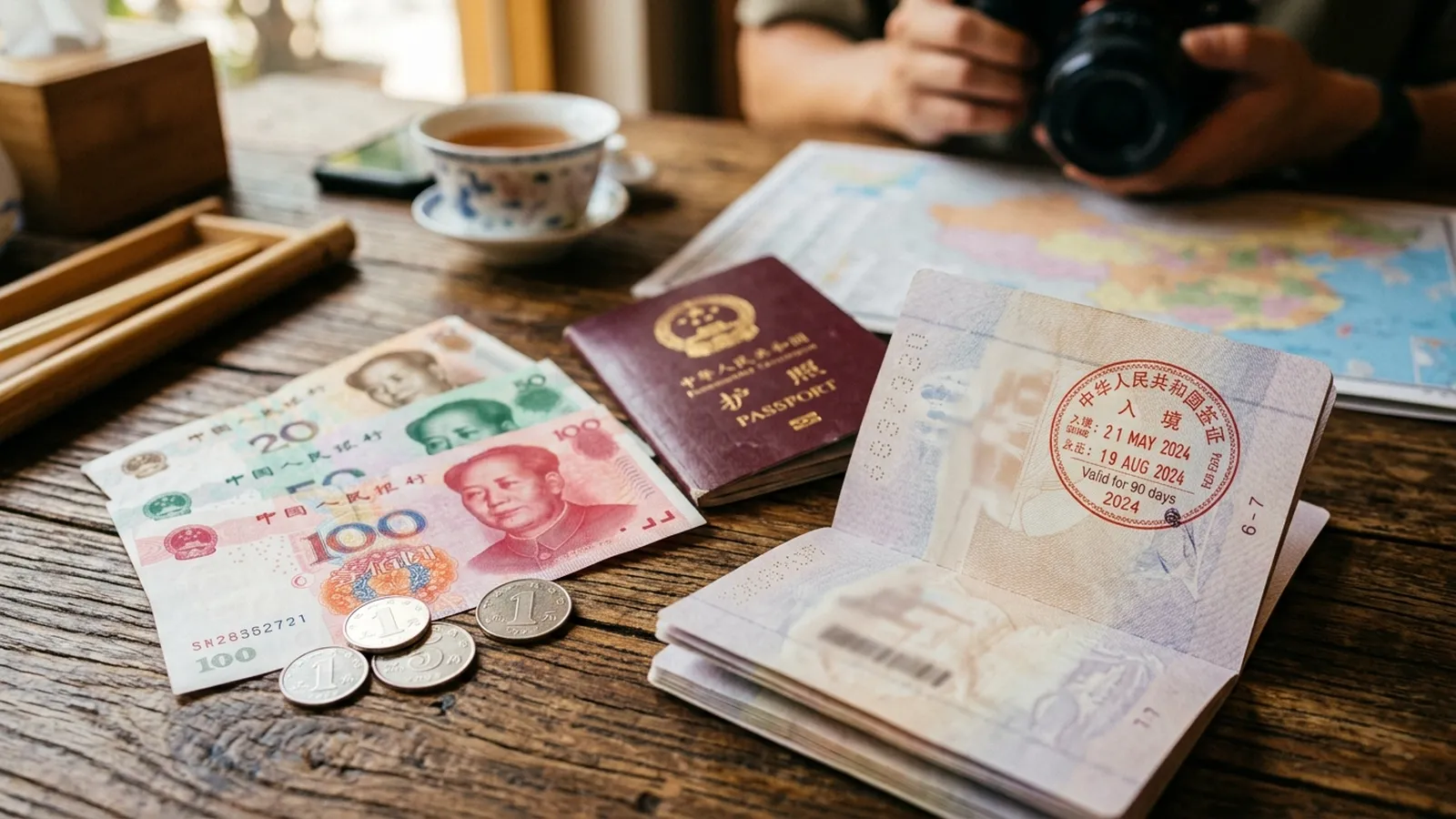
Complete 2026 guide to China visa costs by country and type. Compare fees for US, UK, Canada, Australia, EU & more. Includes reduced fees, service center charges, visa-free options & money-saving tips.
Planning a trip to China in 2026? Before you start mapping out the Great Wall hike or booking that bullet train to Chengdu, there is one essential question to answer: how much will your visa actually cost? The answer depends on your passport, your travel plans, and whether you even need a visa at all. China has rolled out some of the most generous visa-free policies in its history, slashed consular fees by 25%, and expanded transit privileges to cover 24 provinces. For many travelers, visiting China has never been cheaper or easier.
But for those who do need a visa, the pricing landscape can be confusing. American travelers pay a flat $140 regardless of entry type, while citizens of most other countries pay as little as $30 for a single entry. Service center fees, express surcharges, and photo costs can add up quickly if you are not prepared. This guide breaks down every cost you will encounter, country by country and visa type by visa type, so you can budget accurately and avoid surprises.
Key Takeaways
| Question | Answer |
|---|---|
| How much does a China visa cost? | From $30 to $185 USD depending on nationality, entry type, and processing speed |
| Are fees reduced in 2026? | Yes -- China extended a 25% fee reduction through December 31, 2026 |
| Do I even need a visa? | Maybe not -- 50+ countries qualify for 30-day visa-free entry; 55 countries can use 240-hour transit |
| What about service center fees? | CVASC centers charge $25-$65 on top of consular fees depending on location |
| Can I get a 10-year visa? | US, UK, Canada, Brazil, Argentina, and Israel citizens are eligible |
| What is the cheapest option? | Visa-free entry (free), 240-hour transit (free), or standard single-entry visa ($30 for most nationalities) |
Understanding China Visa Fees: How Pricing Works
China visa costs are not uniform. They are determined by three main factors, and understanding each one will save you from overpaying or being caught off guard at the application center.
Factor 1: Your nationality. China sets visa fees based on the principle of reciprocity. If your country charges Chinese citizens $140 for a visa, China charges your citizens the same. This is why Americans pay significantly more than, say, Australians or Japanese citizens.
Factor 2: Number of entries. For most nationalities, the price increases with each tier: single entry is cheapest, followed by double entry, then six-month and twelve-month multiple entry. However, some countries -- including the US, UK, and Canada -- pay a flat fee regardless of entries.
Factor 3: Where and how you apply. Applying directly at a Chinese embassy is cheaper than going through a Chinese Visa Application Service Center (CVASC), which adds a mandatory service fee. Express processing adds another surcharge on top of that.
Here is the formula for your total cost:
Total = Consular visa fee + CVASC service fee (if applicable) + Express surcharge (if applicable)
Both the visa fee and service fee are non-refundable, even if your application is rejected.
China Visa Fees by Country: 2026 Rates (With Fee Reduction)
China extended its 25% fee reduction through December 31, 2026, making this an excellent time to apply. The discount applies to consular fees for single-entry, double-entry, and multiple-entry visas across all visa types.
United States Citizens
American travelers pay the highest visa fees due to reciprocal pricing. The upside: you pay the same flat rate whether you request single entry or a 10-year multiple-entry visa.
| Visa Type | Fee (USD) |
|---|---|
| All entry types (L, M, F, G, Q, S, X, etc.) | $140 |
| J1/J2 journalist visa | $171 |
| Express processing surcharge | +$25 |
US citizens are not included in China's 30-day visa-free program, though they do qualify for the 240-hour transit visa-free policy when traveling through China to a third country.
Canadian Citizens
Canadians benefit from much lower fees than Americans and are also eligible for 30-day visa-free entry through December 31, 2026 -- meaning most Canadian tourists will not need a visa at all.
| Entry Type | Fee (CAD) | Approx. USD |
|---|---|---|
| Single / Double / Multiple entry | CAD $100 | ~$73 |
| 10-year multiple entry | CAD $100 | ~$73 |
If applying through the Ottawa CVASC, the total including service fees is approximately CAD $137 for regular processing.
United Kingdom Citizens
UK passport holders pay a flat fee regardless of entry type. Like Canadians, British citizens qualify for 30-day visa-free entry through December 2026.
| Entry Type | Fee (GBP) | Approx. USD |
|---|---|---|
| Single / Double / Multiple entry (up to 2 years) | £85 | ~$108 |
| 5-year multiple entry | £170 | ~$215 |
| 10-year multiple entry | £255 | ~$322 |
Australian Citizens
Australians enjoy some of the most affordable visa fees. Australia is also included in the 30-day visa-free program.
| Entry Type | Fee (AUD) | Approx. USD |
|---|---|---|
| Single entry | AUD $94.50 | ~$62 |
| Double entry | AUD $117.50 | ~$77 |
| 6-month multiple entry | AUD $140 | ~$92 |
| 12-month multiple entry | AUD $210 | ~$137 |
Standard Fees for Most Other Countries
For the majority of nationalities (those without special reciprocal agreements), China applies a tiered fee structure. These figures reflect the reduced 2026 rates:
| Entry Type | Fee (USD) |
|---|---|
| Single entry (3 months) | $30 |
| Double entry (3 months) | $45 |
| 6-month multiple entry | $60 |
| 12-month multiple entry or longer | $90 |
Country Comparison Table
Here is a side-by-side comparison for popular tourist nationalities:
| Country | Single Entry | Multiple Entry | Flat Fee? | 30-Day Visa-Free? |
|---|---|---|---|---|
| United States | $140 | $140 | Yes | No |
| Canada | CAD $100 (~$73) | CAD $100 (~$73) | Yes | Yes |
| United Kingdom | £85 (~$108) | £85-£255 (~$108-$322) | Partly | Yes |
| Australia | AUD $94.50 (~$62) | AUD $140-$210 (~$92-$137) | No | Yes |
| France | ~$30 | ~$60-$90 | No | Yes |
| Germany | ~$30 | ~$60-$90 | No | Yes |
| Japan | ~$23 | ~$47-$70 | No | Yes |
| New Zealand | NZD $105 (~$63) | NZD $160+ (~$96+) | No | Yes |
| India | INR 2,900 (~$35) | INR 5,900-8,800 (~$71-$106) | No | No |
| Singapore | SGD $80 (~$60) | SGD $87+ (~$65+) | No | Yes* |
| Brazil | ~$30 | ~$60-$90 | No | Yes |
*Singapore has a separate permanent mutual visa exemption with China.
CVASC Service Center Fees vs. Embassy Direct
Here is where many travelers get surprised. In most countries, you cannot walk into a Chinese embassy and submit your visa application directly. Instead, you are required to use the Chinese Visa Application Service Center (CVASC), which acts as an intermediary and charges its own fee on top of the consular visa fee.
What You Pay at a CVASC
The CVASC service fee varies by country but typically falls between $25 and $65 USD equivalent. This fee covers document handling, biometric collection (fingerprints), and application forwarding to the consulate.
| Country | CVASC Service Fee (approx.) |
|---|---|
| United States | $60-$70 USD |
| Canada | Included in total (~CAD $37) |
| United Kingdom | £45-£65 |
| Australia | AUD $55-$70 |
| India | INR 2,018 (~$24) |
| Most EU countries | EUR 25-45 |
Real-World Total Cost Examples
Here is what you will actually pay out of pocket for a standard single-entry tourist (L) visa:
An American applying through a CVASC in the US:
- Consular visa fee: $140
- CVASC service fee: ~$65
- Total: ~$205 USD
A Canadian applying through the Ottawa CVASC:
- Consular visa fee: CAD $100
- CVASC service fee: ~CAD $37
- Total:
CAD $137 ($100 USD)
An Indian citizen applying in New Delhi:
- Consular visa fee: INR 2,900
- CVASC service fee: INR 2,018
- Total: INR 4,918 (~$59 USD)
An Australian applying through a CVASC in Sydney:
- Consular visa fee: AUD $94.50
- CVASC service fee: ~AUD $60
- Total:
AUD $154.50 ($101 USD)
Applying Directly at an Embassy
In some locations, particularly in the US, you can apply directly at a Chinese consulate and skip the CVASC service fee entirely. The Chinese Consulate in San Francisco, for example, accepts walk-in applications. If you live near a consulate, this can save you $50-$70.
Express and Rush Processing Surcharges
Standard visa processing takes 4 to 6 working days. If you need your visa faster, express options are available at most CVASCs and some consulates -- but they come at a premium.
| Processing Speed | Timeframe | Additional Cost (approx.) |
|---|---|---|
| Regular | 4-6 working days | No surcharge |
| Express | 2-3 working days | +$20-$30 USD |
| Rush / Urgent | 1 working day | +$30-$50 USD |
For US citizens, the express surcharge at Chinese consulates is a flat $25. In Canada, express Level 2 (4 days) adds approximately CAD $67, while express Level 1 (3 days) adds approximately CAD $112 to the total.
In India, express service adds INR 1,800 to INR 2,700 depending on the level of urgency.
Pro Tip: Regular processing is almost always sufficient if you apply 3 to 4 weeks before travel. The $25-$50 express surcharge is entirely avoidable with basic planning.
Free Options: When You Do Not Need to Pay Anything
This is the most important section of this guide. Thanks to China's dramatic visa liberalization in 2024-2026, a huge number of travelers can visit China without paying a single dollar in visa fees.
30-Day Visa-Free Entry (50+ Countries)
China has extended its unilateral visa-free policy through December 31, 2026. Citizens of the following countries can enter China for up to 30 days without a visa for tourism, business, family visits, or cultural exchanges:
Europe (35 countries): France, Germany, Italy, Netherlands, Spain, Switzerland, Ireland, Hungary, Austria, Belgium, Luxembourg, Poland, Portugal, Greece, Cyprus, Slovenia, Denmark, Slovakia, Norway, Finland, Iceland, Andorra, Monaco, Liechtenstein, Bulgaria, Romania, Croatia, Montenegro, North Macedonia, Malta, Estonia, Latvia, Czech Republic, Sweden, and the United Kingdom.
Asia-Pacific (7 countries): Brunei, South Korea, Japan, Saudi Arabia, Oman, Kuwait, and Bahrain.
Americas (6 countries): Brazil, Argentina, Chile, Peru, Uruguay, and Canada.
Oceania (2 countries): Australia and New Zealand.
Russia is also included, with visa-free entry valid through September 14, 2026.
Notable exclusion: The United States is not included in the 30-day visa-free program as of April 2026. American citizens still need a visa or must use the 240-hour transit option.
240-Hour (10-Day) Visa-Free Transit
Even if your country is not on the 30-day list, you may qualify for the 240-hour transit visa-free policy. This covers citizens of 55 countries, including the United States, and allows stays of up to 10 days when transiting through China to a third country or region.
Key requirements:
- Hold a valid passport with at least 3 months validity
- Have a confirmed onward ticket to a third country/region within 240 hours
- Enter through one of the 65 designated ports of entry
- Stay within the 24 approved provinces/regions
Eligible provinces (24): Beijing, Tianjin, Hebei, Liaoning, Shanghai, Jiangsu, Zhejiang, Anhui, Jiangxi, Shandong, Henan, Hubei, Hunan, Guangdong, Guangxi, Hainan, Chongqing, Sichuan, Guizhou, Yunnan, Shaanxi, Shanxi, Fujian, and Inner Mongolia (covering the vast majority of China's top tourist destinations).
This is an outstanding deal for American travelers. You can spend 10 full days exploring Beijing, Shanghai, Chengdu, or Guangzhou -- completely free of charge -- as long as you are traveling onward to a third destination.
Permanent Bilateral Visa-Free Agreements
Several countries have permanent visa-free agreements with China that are not subject to the December 2026 expiry. These include: Singapore, Thailand, Malaysia, Georgia, Kazakhstan, United Arab Emirates, Qatar, Serbia, Bosnia and Herzegovina, Albania, Belarus, Azerbaijan, Uzbekistan, and a number of small island nations.
Hainan Province Special Policy
The tropical island province of Hainan has its own visa-free entry policy that covers citizens of 59 countries, including the United States. Visitors can stay up to 30 days in Hainan for tourism, medical treatment, exhibitions, and commercial activities -- though they must remain on the island.
Hidden Costs You Should Budget For
The visa fee and service fee are not the only expenses. Here are the additional costs that catch travelers off guard:
Visa Photos
China requires a specific photo format: 33mm x 48mm with a white background, head occupying 70-80% of the frame, ears visible. If you use the COVA online system and upload a digital photo, you may not need a physical copy. But having prints ready is always safer.
- Pharmacy or post office (US): $10-$15 for a set
- Professional photo studio: $15-$25
- Online photo tools / DIY: Free to $5
- CVASC on-site photo service: $5-$15
Document Translation
If any supporting documents (invitation letters, bank statements, employment proof) are not in English or Chinese, you may need certified translations. These can cost $20-$50 per document.
Travel to the Consulate or CVASC
Unless you live in a major city with a Chinese consulate, you may need to budget for travel. In large countries like the US, Canada, and Australia, the nearest CVASC could be hours away. Consider:
- Round-trip fuel or transit costs: $20-$100+
- Parking near consulates in city centers: $10-$30
- Potential hotel stay if the CVASC is far away: $80-$200
Postal/Courier Fees
Some CVASCs offer a mail-in service so you do not have to visit in person. Expect to pay $25-$40 for secure return shipping of your passport. In Canada, the mail service fee is approximately CAD $32.
Visa Agent Services
If you use a third-party visa agent or service (such as CIBTvisas, VisaHQ, or iVisa), their service fees typically range from $100 to $200 on top of all government and CVASC fees. Total costs through agents can reach $300-$400 for US citizens.
Visa Types and What They Cost
All standard visa types share the same consular fee structure for your nationality. The difference lies in required documentation, not the price tag.
| Visa Type | Purpose | Same Fee as L Visa? |
|---|---|---|
| L (Tourist) | Tourism, sightseeing | Base rate |
| M (Business) | Commercial activities, trade fairs | Yes |
| F (Non-commercial visit) | Exchanges, lectures, research | Yes |
| G (Transit) | Transiting through China | Yes |
| Q1/Q2 (Family Reunion) | Visiting Chinese relatives | Yes |
| S1/S2 (Private Visit) | Visiting foreigners residing in China | Yes |
| X1/X2 (Student) | Study at Chinese institutions | Yes |
| Z (Work) | Employment in China | Yes |
| J1/J2 (Journalist) | Media and press | Higher (US: $171) |
The 10-Year Multiple-Entry Visa
Only citizens of six countries are eligible for the 10-year multiple-entry visa, which offers outstanding long-term value:
| Country | Cost | Cost Per Year |
|---|---|---|
| United States | $140 USD | $14/year |
| United Kingdom | £255 (~$322 USD) | ~$32/year |
| Canada | CAD $100 (~$73 USD) | ~$7/year |
| Brazil | ~$30-$90 USD | ~$3-$9/year |
| Argentina | ~$30-$90 USD | ~$3-$9/year |
| Israel | ~$30-$90 USD | ~$3-$9/year |
For US citizens especially, the 10-year visa is excellent value. At $140 for a decade of unlimited entries, frequent travelers pay less than $14 per year for access to China.
The COVA Online Application System
China launched the China Online Visa Application (COVA) system in 2025, modernizing what used to be a fully paper-based process. Here is what you need to know about costs:
- Using COVA is free -- there is no charge for completing the online application form
- You still need to submit your passport and biometrics in person at a CVASC or consulate
- The COVA system accepts digital photo uploads, potentially saving you the cost of printed photos
- Processing times have improved, with standard applications typically taking 4 to 7 working days after in-person submission
The COVA portal is available at cova.mfa.gov.cn.
Visa Extension Fees Within China
Already in China and want to extend your stay? You can apply at a local Public Security Bureau (PSB) office.
- Extension fee: CNY 160 (~$22 USD) for most nationalities
- Processing time: 5-15 working days
- Apply: At least 7 working days before your current visa or visa-free stay expires
- What you need: Passport, completed application form, recent photo, proof of accommodation
Extensions are available at PSB offices in major cities including Beijing, Shanghai, Guangzhou, and Chengdu. The fee is the same for all nationalities, making it one of the most straightforward costs in the entire visa process.
Money-Saving Tips
Here are proven strategies to minimize your visa costs:
1. Check visa-free eligibility first. Before paying anything, verify whether your country qualifies for 30-day visa-free entry, the 240-hour transit policy, or a bilateral agreement. This is the single biggest money-saver -- it could save you $100-$300.
2. Apply directly at a consulate when possible. If you live near a Chinese consulate that accepts walk-in applications, you can skip the CVASC service fee entirely and save $50-$70.
3. Use regular processing. Express fees are pure waste if you plan ahead. Submit your application 3 to 4 weeks before travel and pocket the $25-$50 surcharge.
4. Get a multi-entry or 10-year visa if eligible. If you plan to visit China more than once, the marginal cost of upgrading from single to multiple entry is minimal for most nationalities -- and some countries pay nothing extra.
5. Take your own visa photos. Use a free online tool to create compliant 33x48mm photos and print them at a pharmacy for under $1 instead of paying $15-$25 at a studio.
6. Apply in your home country. Visa fees are typically lowest and processing is most straightforward when you apply through the Chinese embassy or CVASC in your country of citizenship.
7. Consider the 240-hour transit route. If you are a US citizen planning a trip under 10 days, you can structure your itinerary to fly into China and onward to Hong Kong, Macau, South Korea, or Japan. This gives you a completely free 10-day stay in China without any visa costs.
Processing Times and What to Expect
| Service Level | Timeframe | Best For |
|---|---|---|
| Regular | 4-6 working days | Travelers who plan 3+ weeks ahead |
| Express | 2-3 working days | Somewhat urgent needs |
| Rush | 1 working day | Emergency situations only |
| Mail-in | 5-7 working days + shipping | Applicants far from a CVASC |
Add 2-5 days on each end for document preparation and mailing if using postal service. The COVA online system does not speed up the consular review but does reduce the time spent on form-filling and document preparation.
Frequently Asked Questions
Can I get a refund if my visa is rejected?
No. Both the consular visa fee and the CVASC service fee are non-refundable, regardless of the outcome. This is why accurate preparation matters -- a rejection means losing your entire investment. Double-check all documents before submitting.
I qualify for visa-free entry. Should I still get a visa?
For most tourists staying under 30 days, visa-free entry is the best option. However, you should get a visa if you plan to stay longer than 30 days, if you need to work or study, or if you want the flexibility to enter and exit China multiple times over a longer period.
Are there any hidden fees at the CVASC?
The main fees are transparent: consular fee plus service fee. However, some CVASCs charge extra for on-site photos ($5-$15), photocopying ($1-$3), and SMS notification of application status ($2-$5). Bringing your own photos and copies eliminates these small charges.
Do children pay the same visa fees?
In most countries, yes. Children require their own visa and pay the same consular and service fees as adults. There is no standard child discount, though some bilateral agreements may have different terms.
Can I apply for a China visa online without visiting a CVASC?
You can complete the application form online through the COVA system, but you must still submit your passport and provide biometrics (fingerprints) in person. There is no fully remote application option for most nationalities. The mail-in option at some CVASCs is an exception, but only if you have a valid fingerprint record on file from a previous application.
How long is the 10-year visa actually valid?
The 10-year visa is valid for 10 years from the date of issue, or until your passport expires -- whichever comes first. Each entry typically allows a 60 to 90 day stay. If your passport expires before the 10 years are up, you will need to apply for a new visa in your new passport.
What payment methods are accepted?
This varies by location:
- US consulates: Credit card (Visa/Mastercard), money order, cashier's check -- no cash
- Canadian CVASCs: Debit card in person, e-transfer for mail-in applications
- Indian CVASCs: Cash, demand draft
- Most European CVASCs: Credit/debit card, bank transfer
Always confirm accepted payment methods with your specific application center before visiting.
Your China Trip Budget: Putting Visa Costs in Perspective
The visa is one of the smaller expenses in your China travel budget. Here is how it fits into the bigger picture:
| Expense | Typical Range |
|---|---|
| Visa (if needed) | $0-$205 |
| Return flights | $400-$1,500 |
| Accommodation (per night) | $15-$120 |
| Food (per day) | $5-$25 |
| Local transport (per day) | $1-$8 |
| Major attractions | $5-$40 per site |
| eSIM / data plan | $10-$30 for the trip |
For travelers from the 50+ visa-free countries, the visa line goes to zero. Even for Americans paying the full $205 (with CVASC fee), the visa cost is a fraction of what you will spend on flights and accommodation. The key is to plan ahead, apply early, and take advantage of the reduced fees while they last through December 2026.
Ready to start planning? Check the official COVA application portal for your country-specific requirements, or browse our city guides to start building your itinerary.

关于作者
Go2China Team
Go2China编辑团队结合第一手旅行经验和深厚的文化知识,为您带来准确、最新的中国旅行指南——从长城和故宫到远离游客路线的隐藏宝地。
- ✓在中国各地长期生活和旅行
- ✓团队中有母语级普通话使用者
- ✓信息经官方中国旅游来源验证