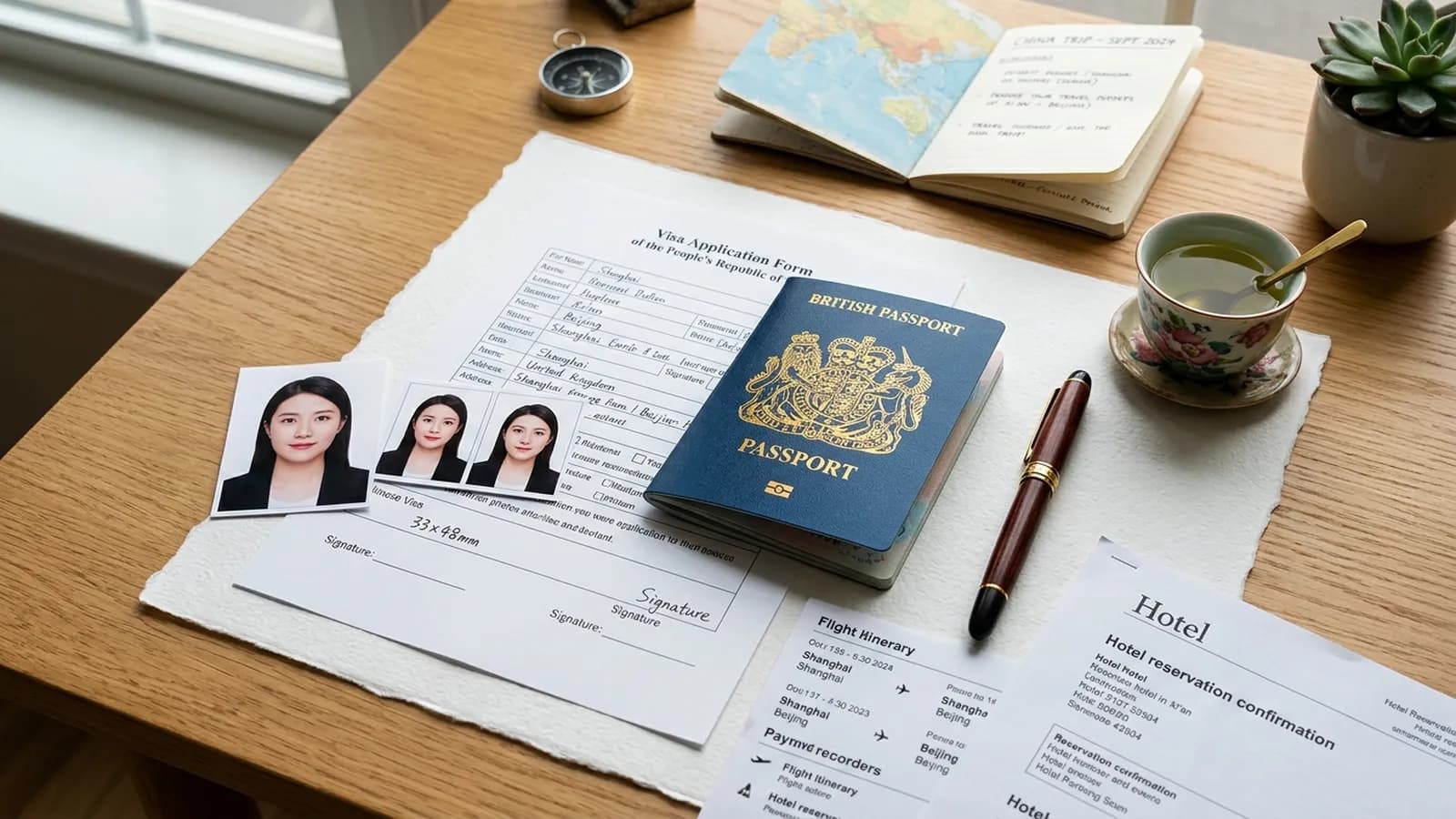
Step-by-step guide to getting a 10-year multiple-entry China visa for US citizens — requirements, costs ($185), application process, and tips.
If you travel to China more than once every decade, the 10-year China visa is one of the best deals in international travel. Instead of applying for a new visa before every trip, US citizens can secure a single multiple-entry visa that remains valid for up to ten years --- allowing you to hop on a flight to Beijing, Shanghai, or Chengdu whenever the mood strikes.
This arrangement between the United States and China has been in place since November 2014, when both governments agreed to extend short-term visa validity from one year to ten. For frequent travelers, business professionals, and anyone with family ties in China, this visa eliminates the repetitive paperwork and fees that used to accompany every visit. But the application process still requires attention to detail. Miss one document or fill out one form incorrectly, and you could face delays or even denial.
In this guide, we walk through everything US citizens need to know about obtaining a 10-year China visa --- from eligibility requirements and document checklists to the exact steps at the visa application center, current fees, processing times, and the most common mistakes that trip people up.
Key Takeaways
| Question | Answer |
|---|---|
| Who is eligible? | US citizens with a passport valid for more than 1 year |
| Which visa types qualify? | L (tourist) and M (business) are most common for the 10-year term |
| How much does it cost? | $185 standard / $140 reduced rate (through December 31, 2026) |
| How long does processing take? | 4--5 business days for regular; 2--3 days for express |
| Maximum stay per entry? | Typically 60 or 120 days per visit (not 10 years continuous) |
| Can I renew it? | You apply for a new visa; there is no formal renewal process |
What Exactly Is the 10-Year China Visa?
The 10-year China visa is a multiple-entry visa that allows US citizens to enter China as many times as they wish over a period of up to ten years. It was established under a reciprocal agreement announced on November 10, 2014, when the United States and China agreed to extend visa validity for short-term business travelers and tourists from one year to ten years --- the maximum duration permitted under US law.
This is not a residency permit. Each entry allows you to stay for a fixed period, typically 60 days for tourist (L) visas or 60 to 120 days for business (M) visas. Once your permitted stay expires, you must leave China or apply for an extension through the local Public Security Bureau. The 10-year validity simply means you do not need to reapply for a new visa each time you want to visit.
The visa stamp in your passport will display the validity period, the number of entries (usually marked "M" for multiple), and the duration of each permitted stay. As long as you enter China before the visa expires and stay within the allowed duration per visit, you can travel freely.
Who Benefits Most?
The 10-year visa is particularly valuable for:
- Frequent business travelers who attend trade fairs in Guangzhou or meet suppliers regularly
- Families with relatives in China who visit during holidays like Chinese New Year
- Repeat tourists drawn back by China's depth --- from the Great Wall to the Silk Road
- Professionals in education, research, or cultural exchange who visit periodically
Eligibility Requirements for US Citizens
Not every US citizen will automatically receive a 10-year visa. The Chinese consulate evaluates each application individually, but meeting the following criteria gives you the strongest possible case.
Passport Validity
Your US passport must have more than one year of remaining validity at the time of application. If your passport expires in less than a year, the consulate will typically issue a shorter-duration visa (often a 6-month double-entry visa instead). This is the single most common reason applicants do not receive the full 10-year term, so check your passport expiration date before you begin.
Your passport must also have at least two blank visa pages available for the visa sticker.
Purpose of Travel
The 10-year multiple-entry option is available for the following visa categories:
- L Visa (Tourist): For sightseeing, visiting friends, or general tourism
- M Visa (Business): For commercial and trade activities, attending business meetings, or visiting trade fairs
- S2 Visa (Short-term Family Visit): For visiting family members who are Chinese citizens or foreign nationals with Chinese residency
- Q2 Visa (Family Reunion): For short-term visits to Chinese relatives
The L and M visas are by far the most commonly issued 10-year visas for US citizens.
Additional Factors
The consulate considers your overall profile, including previous travel history, the completeness of your application, and the purpose of your visit. While there is no strict income requirement, you should be prepared to demonstrate that you have ties to the United States (employment, property, family) that ensure you will return after your visit.
Required Documents Checklist
As of January 1, 2024, the Chinese Embassy and Consulates-General in the US no longer require tour itineraries, round-trip flight tickets, hotel bookings, or invitation letters for standard tourist visa applications. This significantly simplified the process. Here is what you do need:
For an L Visa (Tourist)
- Original passport --- valid for more than 1 year, with at least 2 blank pages
- Photocopy of passport data page --- the page with your photo and personal details
- Completed visa application form --- filled out online at visaforchina.cn and printed
- Recent passport photo --- one 2x2 inch (48mm x 33mm) color photo against a white background, taken within the last 6 months. See our China visa photo requirements guide for detailed specifications
- Photocopy of previous Chinese visas (if applicable) --- especially useful if you are renewing an expired 10-year visa
- Proof of legal status in the US (for non-US-born citizens) --- such as a Green Card or naturalization certificate
For an M Visa (Business)
All of the above, plus:
- Invitation letter from a Chinese business partner --- this should include the company's name, address, and registration number, as well as your personal details and the purpose of your visit
- Letter from your US employer --- confirming your employment status and the business purpose of your travel
For Previous Passport Holders
If your previous Chinese visa was in an expired passport, bring both the old and current passports. The consulate needs to verify your visa history.
Step-by-Step Application Process
Step 1: Determine Your Jurisdiction
China maintains an embassy in Washington, D.C., and consulates-general in New York, Chicago, San Francisco, Los Angeles, and Houston. You must apply at the office that serves your state of residence. Visit visaforchina.cn to find the correct jurisdiction based on your home address.
Most US applications are processed through the Chinese Visa Application Service Center (CVASC), which handles submissions on behalf of the embassy and consulates.
Step 2: Complete the Online Application Form
Go to visaforchina.cn and select "Online Application." Fill in all required fields, including your personal information, passport details, travel history, employment information, and the purpose of your visit.
When prompted for visa type, select L (Tourist) or M (Business) as appropriate. For the number of entries, select "Multiple" --- and when asked about validity, check the box for "10 Years." This signals your preference, though the final decision rests with the consulate.
Print the completed form and sign it by hand.
Step 3: Prepare Your Photo
Your photo must meet strict specifications:
- Size: 48mm x 33mm (roughly 2x2 inches)
- Background: Plain white
- Recency: Taken within 6 months
- Expression: Neutral, mouth closed, both ears visible
- Format: Color, no hats or sunglasses (religious headwear may be permitted)
Many applications are delayed because of non-compliant photos. Use a professional passport photo service or carefully follow the specifications if taking your own.
Step 4: Submit Your Application
Visit the appropriate CVASC location in person or send your application by mail. Walk-in appointments are available at most centers, but scheduling an appointment online can save waiting time.
At the service center, the staff will:
- Review your documents for completeness
- Collect your passport and application materials
- Issue a pick-up receipt with your expected collection date
- Collect the visa fee
Step 5: Pay the Fee
Fees are collected at the time of submission. Payment methods vary by location but typically include money orders, cashier's checks, or credit/debit cards. Personal checks and cash are generally not accepted.
Step 6: Collect Your Passport
Return to the CVASC on or after the date printed on your receipt to pick up your passport with the visa. You can also opt for mail-back service (for an additional fee) when submitting your application.
Inspect the visa immediately upon receipt. Verify the validity dates, number of entries, permitted stay duration, and the spelling of your name. Report any errors before leaving the center.
Costs and Fees: What US Citizens Pay
China visa fees for US citizens are higher than for citizens of most other countries due to the reciprocal fee structure between the two nations. Here is the current breakdown:
| Service | Fee |
|---|---|
| Standard visa fee (US citizens) | $185 (regular) / $140 (reduced, through Dec 31, 2026) |
| Express processing (2--3 business days) | Additional $20--$25 |
| Rush processing (next business day) | Additional $30--$40 |
| Mail-back service | $8--$15 (varies by location) |
| Third-party visa agency fee | $100--$250 (optional convenience service) |
The reduced fee of $140 was introduced in December 2023 as part of China's initiative to encourage international travel and people-to-people exchanges. This reduced rate has been extended twice and currently runs through December 31, 2026. After that date, the standard $185 fee may be reinstated unless another extension is announced.
For context, citizens of most other countries pay between $30 and $80 for a Chinese visa. The higher US fee reflects the reciprocal principle --- China charges US citizens roughly what the US charges Chinese citizens for equivalent visas.
Processing Times
| Service Level | Processing Time | Additional Fee |
|---|---|---|
| Regular | 4--5 business days | None |
| Express | 2--3 business days | $20--$25 |
| Rush | 1 business day | $30--$40 |
Processing times are measured from the day after your application is accepted, not the day you submit it. During peak travel seasons --- particularly before Chinese New Year, Golden Week, and summer --- processing may take longer. Submit your application at least 3--4 weeks before your intended departure to allow margin for any complications.
Mailed applications add transit time in both directions. Budget an additional 5--7 business days total for shipping.
L Visa vs. M Visa: Understanding the Difference
Both the L (tourist) and M (business) visa can be issued with 10-year validity to US citizens, but they serve different purposes and come with different requirements.
L Visa (Tourist)
- Purpose: Tourism, sightseeing, visiting friends
- Documentation: Simpler --- no invitation letter required since January 2024
- Stay per entry: Typically 60 days (some applicants receive 30 days)
- Best for: Leisure travelers, those visiting friends, repeat tourists
M Visa (Business)
- Purpose: Commercial activity, trade meetings, visiting business partners
- Documentation: Requires an invitation letter from a Chinese company and a letter from your US employer
- Stay per entry: Typically 60 to 120 days
- Best for: Entrepreneurs, importers/exporters, professionals attending industry events
Choosing the wrong visa type can cause problems at the port of entry. If you are traveling primarily for tourism, apply for an L visa even if you plan to attend a casual business lunch. If your primary purpose is commercial activity, the M visa is appropriate even if you also plan some sightseeing.
Do not work on an L visa. Employment in China requires a separate Z (work) visa and a work permit.
Common Mistakes That Cause Delays or Denials
After researching hundreds of visa application experiences from US travelers, these are the errors that come up again and again:
1. Passport with less than one year of validity. This is the number one reason applicants receive a shorter visa instead of the 10-year term. Renew your passport first if it expires within 14 months.
2. Non-compliant photos. Photos that are too old, have the wrong background color, or do not meet size requirements will cause your application to be returned. This is an easy problem to avoid with a professional photo service.
3. Incomplete application forms. Leaving fields blank, providing inconsistent dates, or forgetting to sign the form are common issues. Double-check every field before printing.
4. Applying at the wrong consulate. You must submit your application to the consular district that covers your state of residence. Applying at the wrong one will result in rejection.
5. Not disclosing previous Chinese visas. If you have had a Chinese visa before, list it on your application. The consulate has this information and inconsistencies raise red flags.
6. Mismatch between visa type and travel purpose. Applying for a tourist visa when your real purpose is business (or vice versa) can lead to denial or problems at immigration.
7. Forgetting to bring your old passport. If your previous Chinese visa is in an expired passport, you must bring that passport along with your current one.
8. Applying too late. Last-minute applications during peak season can result in not receiving your visa before your departure date.
What Happens When Your 10-Year Visa Expires
There is no formal renewal process for a Chinese visa. When your 10-year visa expires, you simply apply for a new one following the same process described above. The good news is that having a previous 10-year visa generally works in your favor --- it demonstrates a clean travel history and makes the consulate more likely to issue another 10-year term.
When applying for a new visa after your old one expires:
- Bring your old passport containing the expired visa (if it was in a different passport)
- Include a photocopy of the expired visa with your application materials
- Follow the same document checklist --- there are no shortcuts for "renewals"
- Expect the same fees and processing times as a first-time application
If your visa is still valid but your passport is expiring, you have two options: apply for a new visa in your new passport, or carry both your new passport and old passport (with the valid visa) when traveling. Many travelers prefer to get a fresh visa in their new passport for simplicity.
Tips for a Smooth Application
Apply during off-peak periods. The quietest months at visa centers are typically February (after Chinese New Year), April, and September. Avoid the weeks before major Chinese holidays.
Use a visa agency if you value convenience. Third-party agencies like CIBT, VisaHQ, and iVisa handle the entire process for you, including form review, document verification, and submission. They charge a service fee ($100--$250) on top of the government visa fee, but they can catch errors before submission and save you a trip to the visa center.
Make photocopies of everything. Before submitting your application, photocopy your passport data page, any previous Chinese visas, and your completed application form. Keep these copies for your records.
Set up WeChat before you travel. Once you have your visa, start preparing for your trip. Setting up WeChat and Alipay before arrival saves significant hassle when you land.
Consider travel insurance. While not required for the visa application, comprehensive travel insurance is strongly recommended for any trip to China. Medical costs for uninsured foreigners can be substantial.
Frequently Asked Questions
Can I stay in China for 10 years with this visa?
No. The 10-year validity refers to how long the visa itself is valid for entry purposes. Each time you enter China, you are permitted to stay for a fixed period --- usually 60 days for tourist visas. You must leave China before your permitted stay expires or apply for an extension at a local Public Security Bureau office. The 10-year visa simply means you can enter and exit China multiple times over 10 years without reapplying.
What if my passport expires before my 10-year visa?
You have two options. First, you can carry both your old passport (containing the valid visa) and your new passport when traveling --- Chinese immigration will accept this combination. Second, you can apply for a new visa in your new passport. Most travelers find the second option more convenient, though it does require paying the visa fee again.
Do I need to register with EVUS like Chinese citizens do for US visas?
No. The Electronic Visa Update System (EVUS) is a US program that requires Chinese nationals with 10-year B1/B2 visas to update their information every two years before traveling to the United States. There is no equivalent requirement for US citizens holding 10-year Chinese visas. Once your Chinese visa is issued, it remains valid for the stated period without additional registration.
Can I work in China on a 10-year tourist or business visa?
No. The L (tourist) and M (business) visas do not permit employment in China. Working in China requires a Z (work) visa and a valid work permit issued by the Chinese authorities. Violating this can result in fines, detention, and deportation, along with a ban on future entry.
How many days can I stay per visit?
The permitted stay duration is printed on your visa and is typically 60 days for L visas and 60 to 120 days for M visas. This is decided by the consulate at the time of issuance and cannot be changed after the visa is issued. If you need more time, you can apply for a one-time extension (usually 30 additional days) at the Exit-Entry Administration of the local Public Security Bureau in China.
What happens if I overstay my permitted duration?
Overstaying is taken seriously in China. Penalties include fines of 500 RMB per day of overstay (up to a maximum of 10,000 RMB), detention, and potential deportation. An overstay record will also negatively affect future visa applications. Always track your permitted stay dates and leave with time to spare.
Will current US-China political tensions affect my application?
The 10-year visa arrangement has remained in place through various periods of diplomatic tension since its establishment in 2014, including its suspension and reinstatement during the COVID-19 pandemic. As of early 2026, the reciprocal arrangement is active and US citizens continue to receive 10-year multiple-entry visas. However, visa policies can change, so always check the latest information at visaforchina.cn before applying.
Can I apply for a 10-year visa if I have never been to China before?
Yes. First-time visitors are eligible for the 10-year visa. There is no requirement for prior travel to China. However, first-time applicants should pay extra attention to providing complete and accurate documentation, as the consulate may scrutinize these applications more closely than those from repeat visitors.
Is the reduced $140 fee permanent?
No. The reduced fee of $140 (down from the standard $185) is a temporary measure that has been extended several times. It currently runs through December 31, 2026. After that date, the fee may return to $185 unless the Chinese government announces another extension. Apply before the deadline to take advantage of the lower rate.
Final Thoughts
The 10-year China visa remains one of the most practical travel documents available to US citizens. Once you have it, a decade of effortless entry awaits --- whether you are exploring the misty peaks of Zhangjiajie, sampling street food in Chengdu, or closing deals in Shanghai. The application process is straightforward if you prepare your documents carefully and avoid the common pitfalls outlined above.
Start by checking your passport expiration date. If it has more than a year of validity, you are ready to begin. Gather your documents, fill out the online application at visaforchina.cn, and submit everything to your local Chinese Visa Application Service Center. In less than a week, you will have a visa that keeps the door to China open for the next ten years.

About the Author
Go2China Team
The Go2China editorial team combines first-hand travel experience with deep cultural knowledge to bring you accurate, up-to-date guides for exploring China — from the Great Wall and Forbidden City to hidden gems off the tourist trail.
- ✓Lived and traveled extensively across China
- ✓Native & bilingual Mandarin speakers on team
- ✓Verified info from official Chinese tourism sources