Discover the best season to visit China's Great Wall. Compare weather, crowds, and costs across spring, summer, fall, and winter.
The Best Time to Visit the Great Wall: Season by Season Guide
Standing atop the Great Wall of China on a crisp autumn morning, with golden light washing across the ancient stones and visibility stretching for kilometers, you understand why this monument has captivated travelers for centuries. But timing is everything—visit during peak summer crowds, and you'll be shuffling shoulder-to-shoulder with thousands of others. Choose wisely, and you'll experience one of the world's most iconic structures in conditions that feel almost sacred.
Key Takeaways
| Question | Answer |
|---|---|
| What is the best time to visit? | Autumn (September-October) and spring (April-May) offer ideal weather, clear skies, and manageable crowds |
| How much does it cost? | Great Wall entrance fees range from CNY 40-65 ($5.50-9 USD); tours from CNY 200-500+ ($28-70+ USD) depending on section |
| How do I get there? | From Beijing, take the high-speed rail, organized tours, or hire a driver (2-3 hours to most sections) |
| Is it safe? | The Great Wall is very safe; main concerns are physical fitness for steep sections and sun exposure |
| What should I book in advance? | Hotels in Beijing during peak seasons (Sept-Oct, April-May); guided tours 1-2 weeks ahead |
1. Autumn: The Golden Window (September to October)
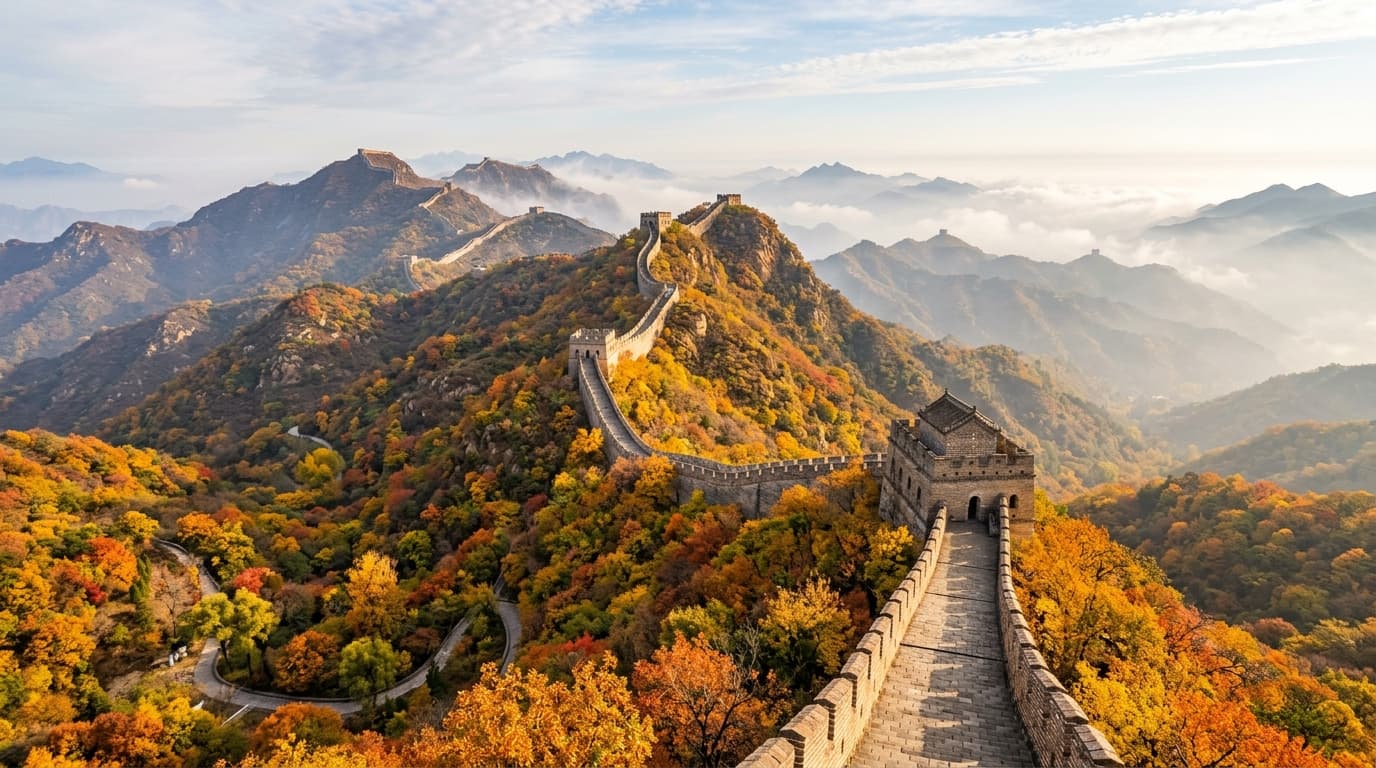
Autumn is unequivocally the best time to visit the Great Wall. When our team spent a week exploring various sections in late September, we experienced what locals call "qingkong"—clear skies—with temperatures hovering around 15-20°C (59-68°F). The light is soft and golden, the humidity has vanished, and the crowds, while present, are far more manageable than summer.
The autumn season transforms the Wall into a photographer's paradise. Visibility extends for 20+ kilometers on clear days, allowing you to see the Wall snaking across distant ridges. The vegetation around the Wall shifts from green to amber and rust, creating stunning natural contrast against the grey stone.
Why Autumn Dominates
Peak visibility and photography conditions: September and early October offer the clearest air quality of the year. The summer haze that obscures distant views has dissipated, and the angle of the sun creates dramatic shadows on the ancient stonework. This is when professional photographers and serious travelers plan their visits.
Comfortable hiking temperatures: Unlike summer's oppressive heat (often 30°C/86°F+), autumn temperatures allow you to hike the steeper, more rewarding sections without exhaustion. The Jinshanling and Simatai sections—which require genuine climbing—become accessible to a broader range of fitness levels. You'll work up a sweat, but you won't be dangerously overheated.
Booking and Crowds During Autumn
Autumn is peak season, which means:
- Hotel availability in Beijing: Book accommodations 4-6 weeks in advance. Mid-range hotels near Beijing's attractions fill quickly during September-October.
- Tour pricing: Expect to pay CNY 300-600 ($42-85 USD) for small-group or private tours. Solo travelers can join group tours at CNY 200-350 ($28-50 USD).
- Crowds: The Wall sees 50,000-100,000+ daily visitors during peak weekends. Weekday visits (Tuesday-Thursday) are noticeably quieter.
Compare hotels across China with free cancellation on most bookings.
Search Hotels on Booking.com → Scan me
2. Spring: The Second-Best Season (April to May)
Spring rivals autumn in appeal, though with one caveat: late April and May can bring occasional dust storms from the Gobi Desert. When we visited in mid-April, we experienced one such storm—visibility dropped to a few hundred meters, and the air turned a hazy yellow. It passed within hours, but it's a real consideration.
That said, spring offers genuine magic. Wildflowers bloom across the hillsides surrounding the Wall, temperatures range from 12-22°C (54-72°F), and the sense of renewal in the landscape is palpable. The Wall feels alive in spring in a way it doesn't in other seasons.
Spring's Unique Advantages
Compare hotels across China with free cancellation on most bookings.
Search Hotels on Booking.com →
Scan me
Wildflower blooms and lush vegetation: April and May bring peonies, wild roses, and native shrubs into bloom. The Wall, often photographed against barren stone and grey sky, becomes framed by color. This is particularly striking at sections like Badaling and Mutianyu, where the surrounding hills are less developed.
Fewer crowds than autumn: While still busy, spring sees fewer international tourists than autumn. Chinese domestic tourism peaks during the May 1st holiday (Labor Day), so avoid May 1-5 if possible. April and late May are sweet spots.
Spring Challenges
Dust storms (April-May): The Gobi Desert's spring winds occasionally carry dust across northern China. These typically last a few hours and are not dangerous, but they reduce visibility and air quality. Check air quality forecasts (AQI) before booking.
Variable weather: Spring weather can be unpredictable. Pack layers—mornings can be cool (10°C/50°F), afternoons warm (20°C/68°F), and rain is possible.
Book Great Wall tours, cooking classes, and experiences in advance with instant confirmation.
Browse Activities on Klook → Scan me
3. Summer: Hot, Crowded, but Accessible (June to August)
Summer is the worst time to visit the Great Wall, yet it's when most casual tourists arrive. Temperatures regularly exceed 30°C (86°F), humidity is high, and the Wall becomes a river of humanity—particularly at Badaling, the most accessible section, where daily visitor counts can exceed 150,000 during peak weekends.
Our experience in July was instructive: we arrived at Badaling at 7 AM and still encountered dense crowds by 9 AM. The experience felt more like a crowded shopping mall than a historical monument. That said, if summer is your only option, there are strategies to make it work.
Why Summer Attracts Crowds
School holidays: Chinese students have two-month summer breaks (July-August), and many families visit the Wall. International tourists also concentrate their China trips during summer vacation.
Accessibility for families: Badaling and Mutianyu offer cable cars and chair lifts, making the Wall accessible to young children and elderly visitors. Summer's longer daylight hours (sunrise ~5 AM, sunset ~8 PM) extend visiting windows.
Surviving Summer Visits
Start early: Arrive at the Wall by 6:30-7:00 AM, before tour buses. You'll have 2-3 hours of relative solitude before crowds peak.
Choose less-visited sections: Avoid Badaling entirely during summer. Instead, visit Jinshanling (less crowded, more authentic), Simatai (requires more effort, so fewer casual visitors), or Juyongguan (rarely visited, excellent views).
Hydration and sun protection are critical: Carry at least 2 liters of water per person. The Wall offers minimal shade, and the sun reflects intensely off stone. Sunscreen (SPF 50+), a wide-brimmed hat, and lightweight, long-sleeved clothing are essential.
4. Winter: Solitude and Stark Beauty (November to March)
Winter transforms the Great Wall into a place of austere beauty. Temperatures drop to 0-5°C (32-41°F), snow occasionally dusts the Wall, and crowds evaporate. During our February visit to Jinshanling, we encountered fewer than 50 other visitors across an entire day—a stark contrast to summer's chaos.
Winter is ideal for photographers seeking dramatic, minimalist compositions. The bare landscape emphasizes the Wall's engineering and the sheer scale of the structure. The air is crisp and clear, though haze can return on some days.
Winter's Appeal
Unparalleled solitude: Winter visitor numbers drop 70-80% compared to summer. You can walk sections of the Wall for hours without encountering other tourists. This is the experience many travelers seek but rarely find.
Dramatic photography: The stark, snow-dusted landscape and low-angle winter sun create striking images. The Wall's architecture—watchtowers, crenellations, ramps—becomes more visually prominent without summer's vegetation and crowds.
Lowest prices: Hotels and tours offer winter discounts. Expect CNY 150-300 ($21-42 USD) for private tours, compared to CNY 400-600+ ($56-85 USD) in autumn.
Winter Challenges
Cold and physical demands: Steep sections become treacherous with ice or snow. Hiking fitness requirements increase significantly. Bring insulated, waterproof hiking boots, thermal layers, and a windproof jacket.
Shorter daylight: Sunset occurs around 5 PM in December-January. Plan accordingly—you'll have limited hours for exploration.
Reduced services: Some restaurants and facilities near the Wall operate on limited hours or close entirely during winter.
Book accommodations with heated rooms and reliable heating. Winter temperatures can drop below freezing at night, and some budget hotels have inadequate heating systems.
5. Comparing the Seasons: A Practical Table
| Season | Best For | Temperature | Crowds | Cost | Rating |
|---|---|---|---|---|---|
| Autumn (Sept-Oct) | Photography, hiking, comfort | 15-20°C (59-68°F) | High (weekends), moderate (weekdays) | CNY 300-600 tours | ⭐⭐⭐⭐⭐ |
| Spring (Apr-May) | Wildflowers, mild weather, fewer crowds than autumn | 12-22°C (54-72°F) | Moderate (except May 1-5) | CNY 250-500 tours | ⭐⭐⭐⭐⭐ |
| Summer (Jun-Aug) | Families, accessibility, long daylight | 25-32°C (77-90°F) | Very high (100,000+ daily) | CNY 200-400 tours | ⭐⭐⭐ |
| Winter (Nov-Mar) | Solitude, minimalist photography, budget travel | 0-5°C (32-41°F) | Very low | CNY 150-300 tours | ⭐⭐⭐⭐ |
6. Choosing Your Great Wall Section by Season
Book Great Wall tours, cooking classes, and experiences in advance with instant confirmation.
Browse Activities on Klook →
Scan me
The Great Wall spans 13,000+ kilometers, but most international visitors explore sections within 2-3 hours of Beijing. Each section has different characteristics and seasonal considerations.
Badaling: The Most Accessible (Not Recommended in Summer)
Badaling is the most visited section, with cable cars and well-maintained paths. It's ideal for families and those with limited mobility. However, it's also the most crowded. In summer, avoid it entirely. In spring and autumn, visit on weekdays before 9 AM. Entrance fee: CNY 40 ($5.50 USD).
Mutianyu: The Scenic Middle Ground
Mutianyu offers excellent scenery, cable cars, and toboggan descents. It's less crowded than Badaling but more developed than remote sections. It's suitable for all seasons, though summer crowds are still significant. Entrance fee: CNY 65 ($9 USD).
Jinshanling: The Authentic Choice
Jinshanling is our team's preferred section. It's less developed than Badaling or Mutianyu, offers genuine hiking challenges, and provides stunning views. It's excellent in autumn and spring; winter requires more experience; summer is hot but manageable on weekdays. Entrance fee: CNY 65 ($9 USD).
Simatai: For Experienced Hikers
Simatai is the most dramatic and challenging section, with steep climbs and narrow passages. It's closed to independent visitors after dark (night hikes require special permits). Autumn and spring are ideal; winter is dangerous for inexperienced hikers; summer is extremely hot. Entrance fee: CNY 65 ($9 USD).
Discover guided tours in Beijing, Shanghai, Xi'an and beyond.
Browse Tours on GetYourGuide → Scan me
7. Seasonal Weather Patterns and What to Pack
Understanding Beijing's weather patterns helps you prepare appropriately. The Great Wall, located 50-100 km north of Beijing, experiences more extreme conditions—colder in winter, sometimes warmer in summer.
Spring (April-May) Packing List
- Layers: t-shirt, light sweater, windproof jacket
- Dust mask (for potential dust storms)
- Sunscreen and sunglasses
- Hiking boots with good ankle support
- 2+ liters of water
- Hat or cap
Summer (June-August) Packing List
- Lightweight, breathable, long-sleeved shirt (sun protection)
- Shorts or lightweight pants
- High-SPF sunscreen (reapply every 2 hours)
- Wide-brimmed hat
- 3+ liters of water (or hydration pack)
- Insect repellent (mosquitoes near water sources)
Autumn (September-October) Packing List
- Light jacket or sweater
- Long pants (protection from sun and brush)
- Comfortable hiking boots
- Sunscreen and hat
- 2+ liters of water
- Camera with extra batteries (cold reduces battery life)
Winter (November-March) Packing List
- Insulated, waterproof jacket
- Thermal base layers
- Insulated, waterproof hiking boots
- Warm hat, gloves, and scarf
- Hand warmers
- 2 liters of water (less needed; cold reduces dehydration)
Did You Know? The Great Wall experiences temperature swings of 10-15°C between Beijing city center and the Wall itself, due to elevation and exposure. A pleasant 20°C day in the city can feel like 10°C on the Wall.
8. Getting to the Great Wall: Transportation by Season
Most visitors base themselves in Beijing and make day trips to the Wall. The journey typically takes 1.5-3 hours depending on the section.
Public Transport Options
Compare car rental prices across China. Pick up at airports or city locations with flexible cancellation.
Compare Car Rentals →
Scan me
Beijing subway + shuttle bus: Take the subway to Huairou District or Yanqing District, then catch local shuttle buses to the Wall. This is the cheapest option (CNY 10-30 total) but requires Mandarin skills and flexibility.
Organized tours: Most Beijing hotels offer day tours (CNY 200-500+). These include transportation, entrance fees, and sometimes lunch. Quality varies widely; book through reputable operators.
Private driver or car rental: Hire a driver for the day (CNY 400-800 / $56-113 USD) or rent a car if comfortable driving in China. This offers maximum flexibility and is ideal for autumn and spring when you'll want to spend 6-8 hours on the Wall.
Seasonal Transportation Considerations
Spring and autumn: Roads are clear; all transport options operate normally. Book tours 1-2 weeks in advance.
Summer: Roads are busy with tour buses. Organized tours may feel rushed. Private drivers offer more flexibility.
Winter: Snow or ice occasionally closes mountain roads. Check conditions before traveling. Public transport is reliable but less frequent.
Book trains, buses across China easily online. Compare routes and prices.
Book Transport on 12Go → Scan me
9. Booking Accommodations Near the Great Wall
Most travelers stay in Beijing and day-trip to the Wall. However, a few guesthouses operate near popular sections like Jinshanling and Juyongguan, offering a more immersive experience.
Beijing-Based Accommodation Strategy
Beijing hotels range from budget hostels (CNY 80-150 / $11-21 USD per night) to luxury properties (CNY 1,000+ / $140+ USD per night). For Great Wall visits, location matters less than quality and amenities. Choose a hotel with reliable heating (winter), air conditioning (summer), and a helpful concierge who can arrange tours.
Guesthouses Near the Wall
Jinshanling and Juyongguan have small guesthouses (CNY 200-400 / $28-56 USD per night) that cater to hikers and photographers. These offer authentic experiences and early-morning access to the Wall before tour buses arrive. Book these directly via WeChat or email 2-3 weeks in advance.
10. Practical Tips for Every Season
Booking Strategy
Autumn (peak season): Book flights to Beijing 6-8 weeks in advance. Reserve hotels 4-6 weeks ahead. Book tours 2 weeks in advance.
Spring: Book 4-6 weeks in advance, but with slightly more flexibility than autumn.
Summer: Book 3-4 weeks in advance. Last-minute deals are rare, but availability is higher.
Winter: Book 2-3 weeks in advance. Winter offers the most flexibility and best prices.
Visa and Entry Requirements
Ensure your tourist visa is valid for your entire stay. Most visitors obtain a 30-day single-entry visa. If combining the Great Wall with other regions (e.g., Shanghai or Guangzhou), plan your itinerary accordingly.
Internet and Communication
The Great Wall has no cellular coverage on most sections. Download offline maps before visiting. Consider purchasing a Chinese SIM card or eSIM for your stay in Beijing to stay connected between hikes.
Health and Safety
The Great Wall is safe, but physical fitness matters. Steep sections like Simatai and Jinshanling require genuine hiking ability. Bring a first-aid kit for minor injuries (blisters, scrapes). Sunburn and dehydration are the most common issues.
Did You Know? The Great Wall's most visited section, Badaling, receives approximately 10 million visitors annually—making it one of the world's most-visited monuments. Yet sections just 20 km away see fewer than 10,000 annual visitors.
11. Festival Calendar and Special Events
Spring Festivals (March-May)
Qingming Festival (April 4-6): Chinese families visit ancestral graves and travel. The Wall sees moderate crowds; avoid these dates if seeking solitude.
Labor Day (May 1-5): Major domestic tourism spike. Avoid if possible.
Autumn Festivals (September-October)
Mid-Autumn Festival (September): Family-oriented holiday; moderate crowds.
National Day (October 1-7): Massive domestic tourism surge. The Wall is extremely crowded; avoid these dates.
Winter Holidays (December-January)
Winter Solstice Festival (December 21): Minimal tourism impact.
New Year Period (Dec 31-Jan 2): Moderate crowds; book in advance.
Frequently Asked Questions
What's the single best day to visit the Great Wall?
A Tuesday or Wednesday in mid-April or mid-September. You'll experience excellent weather, manageable crowds, and clear skies. Avoid weekends and holiday periods entirely.
Can I visit the Great Wall in a day trip from Beijing?
Yes. Most sections are 1.5-3 hours from Beijing by car. A typical day trip involves 4-6 hours on the Wall, plus 3-4 hours of travel. Early starts (6-7 AM) maximize your time.
Is the Great Wall accessible for elderly visitors or those with mobility issues?
Badaling and Mutianyu offer cable cars and well-maintained paths suitable for most fitness levels. Jinshanling and Simatai require genuine hiking ability. Discuss specific sections with your tour operator.
What's the best time for photography?
Autumn (September-October) offers the clearest skies and best light. Spring (April-May) provides colorful wildflowers. Winter offers dramatic, minimalist compositions. Summer is least ideal due to haze and crowds.
How much time should I spend on the Great Wall?
A minimum of 4-5 hours allows you to hike 5-8 km and experience the Wall meaningfully. Full-day visits (8-10 hours) let you explore multiple sections or tackle more challenging terrain.
Do I need a guide?
No, but guides enhance the experience. They provide historical context, navigate safely, and help you avoid crowds. Guides cost CNY 200-400 ($28-56 USD) per day.
Conclusion
The Great Wall of China is magnificent in every season, but timing dramatically affects your experience. Autumn (September-October) and spring (April-May) offer the ideal combination of weather, visibility, and manageable crowds. Summer delivers accessibility and long daylight but comes with oppressive heat and overwhelming tourism. Winter rewards solitude-seekers with stark beauty and budget-friendly prices.
Start planning your Great Wall visit by considering what matters most to you: photography quality, comfortable hiking conditions, solitude, or accessibility. Then align your travel dates accordingly. Book accommodations and tours 4-6 weeks in advance for peak seasons, and don't hesitate to visit during shoulder seasons—the crowds thin dramatically, and the experience becomes profoundly more rewarding.
For comprehensive planning, explore our Beijing attractions guide and Beijing weather information to optimize your entire trip. The Great Wall awaits—choose your season wisely.

About the Author
Go2China Team
The Go2China editorial team combines first-hand travel experience with deep cultural knowledge to bring you accurate, up-to-date guides for exploring China — from the Great Wall and Forbidden City to hidden gems off the tourist trail.
- ✓Lived and traveled extensively across China
- ✓Native & bilingual Mandarin speakers on team
- ✓Verified info from official Chinese tourism sources