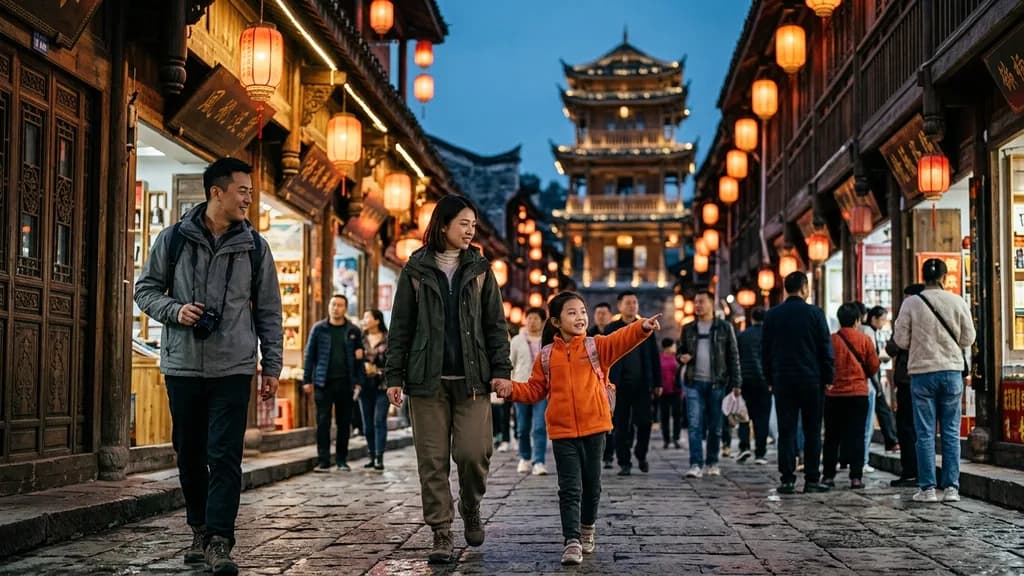
Planning China with kids? Real 2026 family guide - Shanghai Disneyland, Great Wall stamina, Chengdu pandas, squatty toilet reality, and picky-eater food wins.
China with kids sounds intimidating until you go. Then you realize it is one of the easiest family destinations on earth in some ways (kids are adored, food is cheap, trains are spotless) and one of the hardest in others (language, squatty toilets, 40C summers). This 2026 guide is written for real parents: what works, what breaks down, and what will make your 8-year-old talk about this trip for the next decade.
TL;DR: Top 5 Family Wins in China
| Rank | Win | Why It Works |
|---|---|---|
| 1 | Chengdu Giant Panda Base | Live pandas at arm's length, kids lose their minds. Best at 8am |
| 2 | Shanghai Disneyland | Tallest Enchanted Storybook Castle in the world, TRON coaster |
| 3 | Great Wall at Mutianyu | Cable car up + toboggan slide down = instant family legend |
| 4 | Beijing Hutongs by rickshaw | Kids dig the bicycle-powered tour through old alleys |
| 5 | Harbin Ice Festival (Jan) | A literal frozen Disneyland; the most magical winter scene on earth |
If you only have 10 days and want a sure thing, do Beijing + Shanghai + Chengdu. That trio covers history (Great Wall), modernity (Shanghai skyline + Disney), and wildlife (pandas). It is the classic family triangle and it works every single time.
Is China Really a Good Family Destination?
Short answer: yes, and often better than Europe for a certain type of family. Here is why.
Kids are celebrities. The cultural residue of the one-child policy (1980 to 2015) means every child was doted on, and that hasn't faded. Chinese grandmothers (called ayi) will approach you in parks, stroke your kid's hair, offer snacks, and ask for photos. If you have a blonde, redheaded, or curly-haired child, prepare for a low-level celebrity tour. Some families love it, some find it intrusive, but it is always well-meant. Teach your kids to politely wave or pose, and to say "bu yao xie xie" (no thank you) if they want space.
Infrastructure is world-class. High-speed trains hit 350 km/h and run on time to the minute. Metros in Beijing, Shanghai, Guangzhou, and Chengdu are cleaner than most Western equivalents. Hotels are affordable and big (family rooms for $80 to $150 in 4-star properties). Airports are modern. Taxis and Didi (the Chinese Uber) are cheap.
Food is cheap and abundant. A family of four eats dinner for $15 to $30 at a local restaurant. Western chains exist everywhere if picky eaters revolt.
Safety is excellent. China has extremely low violent crime rates, and pickpocketing in tourist zones is far less common than in Rome or Barcelona. You can walk around at 11pm with kids in most cities and feel completely fine.
The real challenges are the three L's: language, logistics, and loos. Let's work through each.
Best Age to Travel to China with Kids
Not every age is created equal for a China trip. Here is the honest breakdown.
| Age | Verdict | What to Know |
|---|---|---|
| 0 to 3 | Possible but punishing | Strollers struggle on the Great Wall, the Forbidden City is huge, naps clash with sightseeing |
| 4 to 6 | Workable | Shanghai Disney + pandas are magic. Skip Xi'an (Terracotta) for now |
| 7 to 9 | Sweet spot | Old enough to walk, young enough to still think everything is magic |
| 10 to 12 | Sweet spot | Can hike Mutianyu, appreciate history, eat anything, use chopsticks |
| 13 to 16 | Great if buy-in | Teens love the neon, street food, and skyscrapers once they arrive |
| 17+ | Bring the camera | They will thank you in 10 years |
The absolute sweet spot is 7 to 12. Kids in that window have the stamina for long days, the curiosity to actually care about the Terracotta Warriors, the stomach for adventurous food, and none of the phone-glued apathy that can surface in the teen years.
Shanghai Disneyland: The Biggest Family Magnet
Shanghai Disneyland opened in 2016 and is the youngest Disney park on earth, which means the rides, tech, and theming are cutting-edge. The Enchanted Storybook Castle is the tallest Disney castle in the world (197 feet), and TRON Lightcycle Power Run is widely considered one of the best Disney coasters ever built.
2026 pricing:
| Ticket Tier | CNY | USD |
|---|---|---|
| Regular adult (peak) | RMB 719 | ~$100 |
| Regular adult (off-peak) | RMB 475 | ~$66 |
| Child (3 to 11) | RMB 355 to 539 | ~$49 to $75 |
| Senior (65+) | RMB 355 to 539 | ~$49 to $75 |
| Under 3 | Free | Free |
Family strategy: book through Klook for discounted tickets (often 5 to 10% below gate price) and arrive 30 minutes before opening. Head straight to TRON Lightcycle or Soaring Over the Horizon, the two rides with the longest lines. Use the Disney app for Premier Access or standard queues. Pack snacks (outside food is allowed in sealed containers), and plan a mid-afternoon nap break at the nearby hotel if you have younger kids.
The park is a 20-minute metro ride from central Shanghai on Line 11 (terminal: Disney Resort station). Skip the taxi; traffic is brutal.
Chengdu Pandas: The Unskippable Experience
If you do one thing in China with kids, do this. The Chengdu Research Base of Giant Panda Breeding is not a zoo. It is a conservation center with 100+ pandas living in semi-natural bamboo forests, and you can walk the loop in 2 to 3 hours.
Go at opening (7:30am). Pandas are most active in the cool morning while eating breakfast. By 10am they are often asleep and look like oversized plush toys collapsed in trees. Kids want to see them moving, so early arrival is non-negotiable.
Red pandas too. The base also has red pandas (the actual small raccoon-fox things, not giant pandas). Kids often like these even more because they are close up and absurdly cute.
IPAO Sanctuary upgrade: if you want a premium experience, the Panda Valley / Dujiangyan facility (90 minutes outside Chengdu) offers a volunteer program where older kids (12+) can help prepare bamboo and clean enclosures for a day ($100 to $150 per person). Memorable, but the basic Panda Base is enough for most families.
Getting there: metro Line 3 to Panda Avenue station, then shuttle. Or grab a Didi for about RMB 40 ($5.50) from central Chengdu.
Great Wall with Kids: Mutianyu Every Time
Parents, hear this clearly: not all Great Wall sections are kid-friendly. Pick wrong and you will have a meltdown at 500 meters of elevation with no way down.
Mutianyu is the family section. Here is why:
- Cable car up. RMB 100 ($14) per adult, RMB 55 ($7.50) per child round trip. Saves 45 minutes of uphill hiking.
- Toboggan slide down. An actual metal toboggan track you ride solo or with a toddler in your lap. Total kid crack. RMB 100 ($14) adult, RMB 55 ($7.50) child one-way.
- Restored wall with handrails. Safer than the crumbly wild sections.
- Less crowded than Badaling. Smaller crowds mean kids do not get jostled.
Skip these sections with kids:
- Badaling: jammed, touristy, no toboggan
- Jinshanling: beautiful but steep and wild, best for teens and adults
- Simatai: similar to Jinshanling; add vertigo risk for some kids
Time budget: 4 hours round trip from central Beijing including driving. Leave your hotel by 8am, be back by 2pm for lunch and a nap. Strollers not recommended; carry toddlers in a framed backpack carrier if needed.
Beijing Family Hits Beyond the Wall
Beijing is the history capital, and several sites beyond the Great Wall are kid-friendly.
Temple of Heaven Park. The temple itself is photogenic, but the real magic is the park around it. Early mornings (7am to 9am) bring hundreds of locals doing tai chi, ballroom dancing, kite flying, and calligraphy on the pavement with water brushes. Kids can join in or just watch. Entry: RMB 15 ($2) park + RMB 20 ($2.75) for the temple.
Hutongs by rickshaw. The old alleyway neighborhoods of Beijing are best seen by bicycle rickshaw. A 1-hour tour through Nanluoguxiang or the Houhai lakes area runs RMB 150 to 200 ($20 to $27) and gives kids a taste of pre-skyscraper Beijing. Book through GetYourGuide for English-speaking guides.
Forbidden City. The scale is insane (180 acres, 9,000 rooms), but the sheer size can exhaust young kids. Strategy: enter from the north (Jingshan Park side) going south, and plan just 2 hours inside. Rent an audio guide for older kids; it makes the emperors' stories come alive.
Houhai Lakes. Paddle boats, hutong snacks, street performers. Perfect late-afternoon wind-down spot.
Xi'an and the Terracotta Warriors (Age 7+)
The Terracotta Warriors are one of the great wonders of the ancient world, but the experience can be slow for very young kids. The site is a vast aircraft-hanger-style pit with clay soldiers in the distance. You cannot get close, and there are no rides or toboggans here.
For kids age 7+ who have the patience to listen to a guide explain the story, it is gripping (a teenage emperor, 700,000 laborers, a hidden tomb with a river of mercury). For kids under 7, skip it or make it a quick 90-minute stop and prioritize Xi'an's Muslim Quarter for street food instead.
Kid-friendly Xi'an add-ons: ride bikes along the ancient city wall (2-hour loop, bike rental RMB 45), eat roujiamo (Chinese hamburgers, $1.50), watch the evening fountain show outside the Giant Wild Goose Pagoda.
Language: Apps, Phrase Sheets, and Survival Mandarin
English is not widely spoken outside major hotels and airports. You will need tools.
Must-have apps:
- Google Translate (download Mandarin offline pack before you land, Google is blocked in China without VPN)
- Pleco (the gold-standard Chinese dictionary with camera OCR for restaurant menus)
- Baidu Translate (works inside China without VPN)
Kid-friendly phrase sheet:
| English | Mandarin | Phonetic |
|---|---|---|
| Hello | Ni hao | Nee-haow |
| Thank you | Xie xie | Sheh-sheh |
| No spicy | Bu yao la | Boo-yaow-la |
| Where's the toilet? | Ce suo zai na li? | Tsuh-swor dzai na-lee |
| I'm vegetarian | Wo chi su | Wor-chur-soo |
| Too spicy! | Tai la le! | Tai-la-luh |
Teach your kids "ni hao" and "xie xie" before you go. Locals light up when foreign kids say even two words of Mandarin.
Food Strategy for Picky Eaters
The "but my kid won't eat Chinese food" fear is overblown. Chinese food in China is nothing like the sticky-sweet takeout at home, and there are always safe bets.
Universal kid wins:
- Plain white rice (mi fan). Literally every restaurant. Ask for "bai mi fan".
- Noodles. Chow mein (fried), lamian (hand-pulled in broth), dan dan noodles without chili.
- Baozi. Steamed buns stuffed with pork or vegetables. Breakfast staple, RMB 3 to 5 ($0.50) each.
- Jiaozi (dumplings). Boiled or fried, usually pork and cabbage. Kid crack.
- Fried rice (chao fan). Yangzhou fried rice with egg, peas, shrimp is the classic.
- Fresh fruit. Mangoes, lychees, watermelon, pineapple everywhere.
Safety net Western chains (every major city):
- McDonalds (often cheaper than Western prices)
- KFC (weirdly more popular in China than McDonalds)
- Pizza Hut (sit-down, not delivery)
- Starbucks (oat milk lattes, pastries)
- Subway
Food to avoid with kids:
- Sichuan hot pot (too spicy)
- Stinky tofu (self-explanatory)
- Century eggs (visual shock for Western kids)
- Street meat of unclear provenance
Hygiene golden rule: cooked hot > cold. Avoid salads, raw vegetables, ice cubes in drinks. Stick to bottled water only (no tap, not even for brushing teeth in some regions). Hand sanitizer on a carabiner clipped to your day bag.
Squatty Toilets: The Reality
Squatty toilets (basically a porcelain hole in the floor with footpads) are everywhere outside hotels, airports, and upscale restaurants. Your kids will encounter them. Here's how to survive.
The rules:
- Always carry toilet paper. Public bathrooms rarely stock it. Pack a roll in your day bag.
- Carry hand sanitizer. Soap is equally rare.
- Face the door. Legs shoulder-width apart, hold the waistband of pants down, squat low.
- For tiny kids: have them hold onto your arm for balance.
- Hotels, Starbucks, malls, McDonalds, and major attractions have Western toilets. Plan bathroom breaks around these.
Most kids find squatties weird on day one and an adventure by day three. It is rarely the disaster parents fear.
10-Day China with Kids Itinerary
This is the proven family route covering history, modern wow, and wildlife.
| Day | Base | Highlights |
|---|---|---|
| 1 | Beijing | Arrive, hotel, early dinner, Houhai Lakes evening walk |
| 2 | Beijing | Forbidden City (north to south), Jingshan Park, Peking duck dinner |
| 3 | Beijing | Great Wall at Mutianyu (cable car + toboggan), back by 3pm |
| 4 | Beijing | Temple of Heaven sunrise, hutong rickshaw, Olympic Park |
| 5 | Beijing to Shanghai | Morning high-speed train (4.5 hrs), Bund evening walk |
| 6 | Shanghai | Shanghai Disneyland full day |
| 7 | Shanghai | Yu Garden, Nanjing Road, Shanghai Tower observation deck |
| 8 | Shanghai to Chengdu | Flight (3 hrs), dinner on Jinli Ancient Street |
| 9 | Chengdu | Panda Base (7:30am), Wenshu Monastery, People's Park tea |
| 10 | Chengdu | Departure (or extend with Mount Emei / Leshan Giant Buddha) |
Pro tip: book the Beijing to Shanghai high-speed train (G-class) in advance via Trip.com. Second-class family of four: about $350 total. Shanghai to Chengdu: fly instead of train (the rail journey is 11+ hours).
WeChat and Alipay: The Parent's Must-Know
China is cashless. Cards (Visa, Mastercard, Amex) often do not work outside hotels and airports. Your lifeline is WeChat Pay + Alipay linked to a foreign Visa/Mastercard.
Before you leave home:
- Install WeChat and Alipay on your phone.
- Verify with passport (takes 24 to 48 hours).
- Link a Visa or Mastercard to both (they both now support foreign cards as of late 2024).
- Test with a small top-up.
Once landed, you pay for taxis, metro, McDonalds, baozi stalls, Disney snacks, pandas tickets, everything by scanning a QR code. Kids think it is sci-fi. You will love never fumbling for cash.
Visas for Minors
Minors need the same tourist visa (L visa) or e-visa as adults. China's e-visa (rolled out 2024) is the easiest route for most nationalities: apply online, pay about $30 to $140 depending on nationality, receive in 3 to 5 days.
144-hour transit. If your itinerary includes a third country (e.g. USA to China to South Korea), you may qualify for the 144-hour visa-free transit, which applies to kids too. Covers Beijing, Shanghai, Chengdu, and 50+ other cities.
Documents to bring for each child:
- Passport (valid 6+ months from entry)
- Visa or e-visa confirmation
- Original birth certificate or notarized copy. If traveling with one parent only, a notarized consent letter from the other parent is wise.
- Return flight booking
- Hotel reservations
Immigration sometimes asks questions when one parent travels alone with a kid. Having the birth certificate in a clear folder prevents awkward conversations at 2am after a 14-hour flight.
Summer vs Winter: When to Go with Kids
Avoid July and August. Central and southern China hits 40C (104F) with insane humidity. Kids wilt, tantrums spike, photos show sweaty miserable faces.
Best family windows:
- April to early June. Cherry blossoms, mild weather, lower crowds before summer peak.
- September to late October. Crisp autumn, perfect Great Wall weather (avoid Golden Week Oct 1 to 7, it's a national-holiday mob scene).
- Late December to February. Cold but magical. The Harbin Ice and Snow Festival (January) is the most spectacular winter event on earth, with ice castles you can walk through. Pack expedition-grade winter gear if heading north.
Final Word: You've Got This
China with kids is not the exotic nightmare your neighbor suggested. It is a logistical puzzle with clear solutions: Mutianyu not Badaling, Shanghai Disney for magic, pandas at dawn, McDonalds as a safety net, WeChat Pay before you land, and birth certificates in a folder. Do those six things and your family trip will rank as the most memorable vacation of your kid's life.
Ready to go deeper? Read our classic China itinerary for route planning, Chengdu pandas + Sichuan food for the panda capital, and the WeChat and Alipay setup guide so you land with payments ready.
See you on the Wall.
Sources & References
This article is based on editorial research and verified with the following sources:

About the Author
Go2China Team
The Go2China editorial team combines first-hand travel experience with deep cultural knowledge to bring you accurate, up-to-date guides for exploring China — from the Great Wall and Forbidden City to hidden gems off the tourist trail.
- ✓Lived and traveled extensively across China
- ✓Native & bilingual Mandarin speakers on team
- ✓Verified info from official Chinese tourism sources