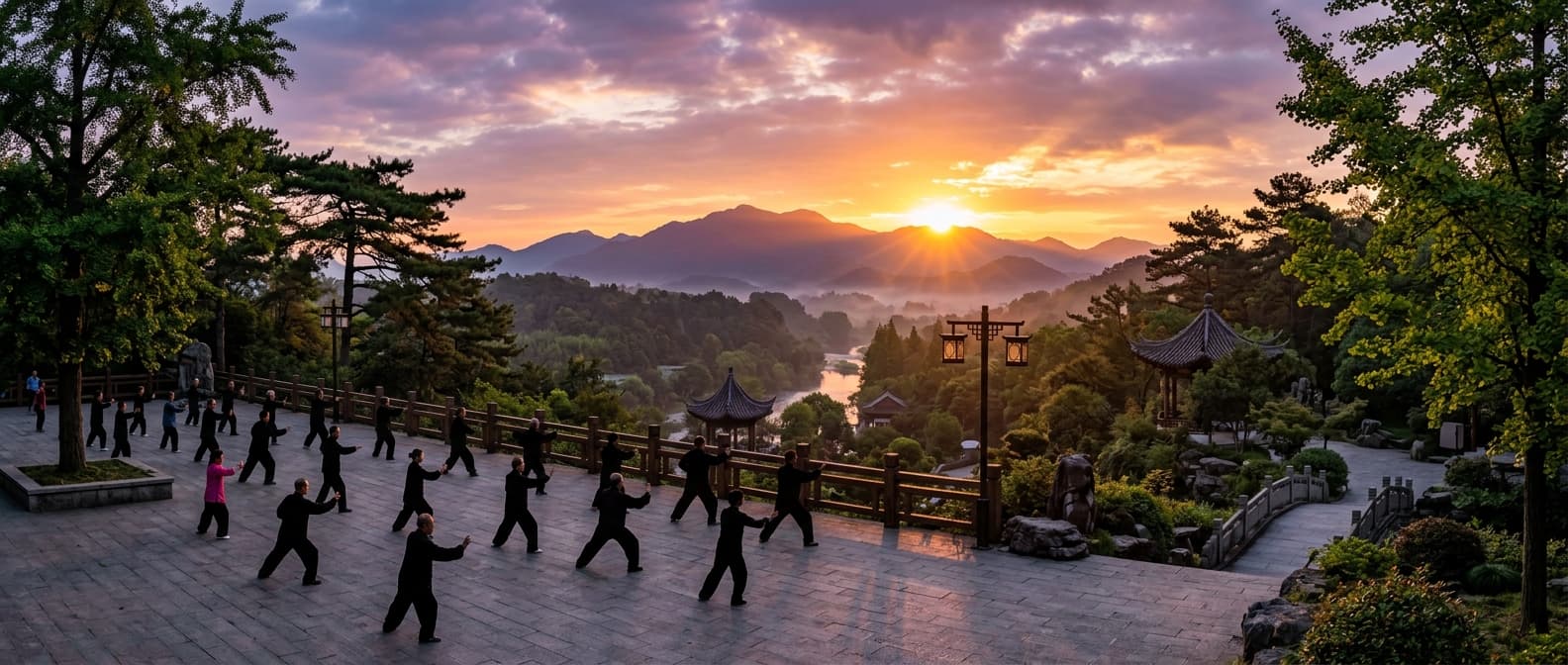
Explore Chinese martial arts from tai chi to kung fu. Learn history, where to experience it, and how to engage respectfully as a visitor.
Picture this: dawn breaks over a misty park in Beijing, and dozens of locals move in perfect synchronization, their bodies flowing like water through the ancient movements of tai chi. This isn't a performance—it's a daily ritual that has continued for centuries. Chinese martial arts represent far more than combat techniques; they embody philosophy, spirituality, and the very essence of Chinese culture. Whether you're watching a kung fu master demonstrate explosive power or joining a tai chi class in a public square, these traditions offer visitors an unparalleled window into the soul of China.
Key Takeaways
| Question | Answer |
|---|---|
| What is the best time to visit? | Spring (April-May) and autumn (September-October) offer ideal weather for outdoor classes and demonstrations |
| How much does it cost? | Group classes: 50-150 CNY ($7-20 USD); private lessons: 200-500 CNY ($28-70 USD); workshops: 300-1000 CNY ($42-140 USD) |
| How do I get there? | Most martial arts schools are accessible by metro in major cities; use Getting around China for transport tips |
| Is it safe? | Absolutely safe; these are legitimate cultural institutions with trained instructors welcoming international visitors |
| What should I book in advance? | Private lessons and multi-day workshops; drop-in group classes typically accept walk-ins |
1. The Ancient Roots: Understanding Chinese Martial Arts Philosophy
Chinese martial arts didn't emerge as fighting systems alone—they developed as expressions of Taoist and Buddhist philosophy, deeply intertwined with Chinese culture and the concept of balance between opposing forces. The earliest documented martial systems date back over 2,000 years, though their spiritual foundations run even deeper. When we visited the Shaolin Temple region in Henan Province, our guide explained that every movement in kung fu represents a principle: the crane stance embodies grace, the tiger form channels raw power, and the snake technique emphasizes flexibility and adaptation.
The philosophical underpinning of martial arts in China centers on the principle of yin and yang—the balance of opposing but complementary forces. This isn't about defeating an opponent through brute strength; it's about understanding energy flow (qi), redirecting force, and achieving harmony. Tai chi, in particular, emerged as a martial system that prioritizes these philosophical principles, making it accessible to people of all ages and physical abilities.
The Shaolin Tradition and Kung Fu Schools
Shaolin Temple, located in Central China, stands as the birthplace of many kung fu traditions and remains the most iconic martial arts institution globally. Founded in the 5th century, Shaolin monks developed systematic fighting techniques that combined physical conditioning with meditation and spiritual practice. The temple's influence spread throughout China, spawning hundreds of regional styles and schools.
Modern Shaolin has evolved into a major cultural institution. Today, visitors can observe monks training, attend demonstrations, and even enroll in short-term courses. The training regimen is rigorous—monks begin their practice before dawn, practicing forms for hours while maintaining strict discipline. When we spoke with instructors there, they emphasized that Shaolin isn't merely about martial prowess; it's a complete lifestyle integrating martial arts, Buddhism, and personal transformation.
Regional Styles and Their Characteristics
China's vast geography has given rise to distinct martial arts styles, each reflecting local culture and philosophy. Tai chi originated in Chen Village in Henan and emphasizes slow, flowing movements and internal energy cultivation. Wing Chun, developed in southern China, focuses on close-range combat and rapid hand techniques. Wudang martial arts, named after the sacred Wudang Mountains, blend Taoist philosophy with combat technique. Each style tells a story of its region and the people who refined it over generations.
Book Great Wall tours, cooking classes, and experiences in advance with instant confirmation.
Browse Activities on Klook → Scan me
2. Tai Chi: The Art of Flowing Movement and Inner Peace
When most Westerners think of tai chi, they picture elderly practitioners moving gracefully in parks—and while this is accurate, it barely scratches the surface of this profound martial art. Tai chi (also spelled taiji) is simultaneously a martial system, a meditation practice, and a health discipline. The slow, deliberate movements that appear effortless actually require tremendous body awareness, balance, and understanding of biomechanics.
During our time in Beijing, we joined an early morning tai chi session in a local park. What struck us most wasn't the physical movement but the mental clarity that emerged after just 30 minutes. The instructor explained that tai chi cultivates qi (life force energy) and promotes the flow of this energy through meridians in the body—a concept central to Traditional Chinese Medicine. Modern scientific research has validated many of tai chi's health benefits, including improved balance, reduced stress, and enhanced cardiovascular function.
Learning Tai Chi as a Visitor
Tai chi is remarkably accessible to visitors of all ages and fitness levels. Unlike kung fu, which requires significant physical conditioning and can be intimidating for beginners, tai chi welcomes everyone. Most parks in major Chinese cities host free or low-cost group classes in the early morning hours. The best approach is to arrive early, observe the class, and ask politely if you can join—most instructors are delighted to include visitors.
Best parks for tai chi in major cities:
- Morning sessions: Most public parks in Beijing, Shanghai, and Guangzhou host tai chi classes between 6-8 AM
- Beginner-friendly instruction: Look for classes labeled "24-form simplified tai chi," which is the most accessible version
- Private instruction: Hotels and cultural centers can arrange private lessons, typically costing 200-300 CNY per hour
- Multi-day workshops: Specialized centers offer immersive experiences ranging from weekend intensives to week-long retreats
The Eight Forms and Their Meanings
Tai chi comprises various forms, with the 24-form simplified version being most common for beginners. Each movement has poetic names reflecting nature and martial applications: "Grasp Sparrow's Tail," "White Crane Spreads Wings," "Snake Creeps Down." These aren't arbitrary—each name describes both the physical shape and the underlying martial principle. Understanding these meanings transforms tai chi from mere exercise into a rich cultural and philosophical practice.
Wear comfortable, loose-fitting clothing and soft shoes for tai chi practice. Avoid eating a heavy meal within two hours of practice, as tai chi emphasizes internal energy flow.
3. Kung Fu: The Way of Power and Discipline
Kung fu (gongfu) literally means "skill acquired through hard work" and encompasses hundreds of distinct fighting systems developed across China. Unlike tai chi's meditative approach, kung fu emphasizes dynamic power, speed, and explosive technique. The physical demands are significant—practitioners develop incredible strength, flexibility, and coordination through years of dedicated training. When we observed a kung fu demonstration at a Beijing martial arts school, the practitioners' control was astounding: a master could execute a devastating kick while maintaining perfect balance, or break wooden boards with a single strike.
Kung fu's diversity is staggering. Northern styles emphasize high kicks and long-range techniques, while southern styles favor hand techniques and lower stances. Animal-based systems—crane, tiger, snake, leopard, and dragon—each embody different fighting philosophies. This variety means there's genuinely something for everyone, whether you prefer graceful, flowing movements or powerful, direct techniques.
Major Kung Fu Styles and Their Characteristics
Compare hotels across China with free cancellation on most bookings.
Search Hotels on Booking.com → Scan me
| Style | Origin | Characteristics | Best For |
|---|---|---|---|
| Shaolin | Henan Province | Comprehensive, explosive, combines hard and soft techniques | Serious practitioners seeking complete training |
| Wing Chun | Southern China | Close-range combat, rapid hand techniques, economical movements | Those interested in practical self-defense |
| Tai Chi Chuan | Henan Province | Slow, flowing, internal energy focus, martial and health benefits | All ages and fitness levels |
| Wudang | Wudang Mountains | Taoist philosophy, circular movements, internal power | Spiritual seekers and advanced practitioners |
| Sanda | Modern China | Sport-oriented, kickboxing-style, competitive | Athletes interested in combat sports |
Training at a Kung Fu School
Enrolling in kung fu training as a visitor requires more commitment than dropping into a tai chi class, but it's absolutely possible. Most major cities have schools specifically welcoming international students for short-term programs. These typically range from one-week intensive courses to month-long immersions. The training day usually begins before dawn with conditioning exercises, followed by form practice, partner drills, and sparring.
What to expect in a typical kung fu class:
- Warm-up and conditioning: 20-30 minutes of stretching, running, and strength exercises
- Basic techniques: Stance training, punches, kicks, and blocks
- Form practice: Learning and refining traditional sequences
- Partner drills: Applying techniques with a training partner
- Cool-down and meditation: Ending with breathing exercises and mental focus
The physical demands are real—expect muscle soreness if you're not accustomed to intense training. However, instructors at schools catering to international visitors understand varying fitness levels and will modify training accordingly. The key is communicating your experience level honestly and being willing to work hard.
Did You Know? Kung fu was designated as a UNESCO Intangible Cultural Heritage of Humanity in 2020, recognizing its profound cultural significance and the need to preserve these ancient traditions for future generations.
Compare hotels across China with free cancellation on most bookings.
Search Hotels on Booking.com →
Scan me
4. Where to Experience Martial Arts in China
China offers numerous opportunities to engage with martial arts, from casual park classes to intensive training programs. The best choice depends on your interests, available time, and physical condition. During our extensive travels across China, we discovered that some of the most authentic experiences happen in unexpected places—not always at famous temples or expensive schools.
Shaolin Temple and Henan Province
Shaolin Temple remains the world's most famous martial arts institution. Located in Dengfeng, Henan Province, it attracts thousands of visitors annually. The temple offers various programs: day visits with demonstrations, three-day intensive courses, and longer training programs for serious students. The temple grounds are genuinely impressive, with ancient architecture and hundreds of monks in training. However, be aware that Shaolin has become quite commercialized—the experience is authentic but crowded, especially during peak seasons.
The surrounding Dengfeng area hosts numerous martial arts schools catering specifically to international visitors. These schools often provide better English instruction and more flexible scheduling than the temple itself. Many offer accommodation on-site, creating an immersive training environment. Prices vary widely, but expect to pay 1,500-3,000 CNY ($210-420 USD) for a week-long program including accommodation and meals.
Beijing's Martial Arts Schools and Parks
Beijing offers exceptional opportunities for martial arts engagement without requiring travel to remote areas. The city hosts numerous schools ranging from small, family-run operations to large institutions with international reputations. Many are located in accessible neighborhoods and welcome drop-in visitors. We particularly enjoyed training at schools in the Chaoyang and Haidian districts, where instructors were accustomed to international students and could adjust teaching methods accordingly.
Public parks throughout Beijing host tai chi and martial arts practice daily. Jingshan Park, Temple of Heaven Park, and Summer Palace grounds all feature early morning classes. These are typically free or cost just a few yuan. The atmosphere is wonderfully authentic—you're practicing alongside locals maintaining lifelong routines, not in a tourist-oriented setting.
Shanghai and Southern China
Shanghai has a thriving martial arts culture, though it's less famous than Beijing's. The city's schools often emphasize Wing Chun and other southern styles. Longhua Temple area and neighborhoods in Huangpu District host several respected schools. Shanghai's advantage is that it's more cosmopolitan, with schools accustomed to international students and often offering English instruction.
Southern China, particularly Guangzhou and the Fujian Province region, specializes in Wing Chun and other southern styles. These regions have deep martial arts traditions and less tourist infrastructure, meaning experiences are often more authentic and less expensive. If you're willing to venture beyond major cities, you'll find dedicated practitioners and schools that have operated for generations.
Discover guided tours in Beijing, Shanghai, Xi'an and beyond.
Browse Tours on GetYourGuide → Scan me
5. The Health and Wellness Benefits of Martial Arts
Beyond their cultural and historical significance, Chinese martial arts offer profound health benefits that have attracted scientific attention in recent years. Traditional Chinese Medicine views martial arts as tools for cultivating and balancing qi, while modern medicine recognizes measurable improvements in cardiovascular health, balance, flexibility, and mental wellbeing.
Tai chi has been extensively studied and shows consistent benefits for older adults: improved balance reducing fall risk, enhanced cardiovascular function, and reduced anxiety and depression. Kung fu training builds strength, flexibility, and coordination while developing mental discipline and confidence. Even short-term practice produces noticeable improvements. After just two weeks of daily tai chi practice during our Beijing stay, we noticed better sleep quality, reduced stress, and improved posture.
Mental and Spiritual Benefits
The meditative aspects of martial arts practice offer benefits beyond physical health. Both tai chi and kung fu require intense focus and body awareness—you cannot practice effectively while distracted. This meditative quality provides relief from the constant mental stimulation of modern life. Many practitioners describe martial arts training as a form of moving meditation, where the mind becomes still through focused physical practice.
The philosophical frameworks underlying these arts also provide mental benefits. Understanding concepts like wu wei (effortless action), yin-yang balance, and the flow of qi offers perspectives that help practitioners navigate life's challenges with greater equanimity. We've spoken with numerous long-term practitioners who credit martial arts with fundamental shifts in how they approach problems and relationships.
Integration with Traditional Chinese Medicine
Martial arts practice connects directly to Traditional Chinese Medicine (TCM) concepts. The meridian system through which qi flows, the importance of balance between opposing forces, and the relationship between physical practice and internal health are central to both systems. Many martial arts schools incorporate TCM principles, and some instructors have formal training in acupuncture or herbal medicine.
If you're interested in this integration, seek out schools or instructors with TCM backgrounds. They can explain how specific movements affect particular meridians and organs, deepening your understanding of why martial arts practice produces such comprehensive health benefits.
6. Martial Arts Philosophy and Its Modern Relevance
The philosophical foundations of Chinese martial arts remain profoundly relevant to contemporary life, even for those who never intend to use these arts for combat. The principles of balance, efficiency, adaptability, and harmony offer guidance applicable to work, relationships, and personal development.
Wu wei (effortless action) represents one of the most important concepts. It describes achieving goals through alignment with natural forces rather than through force and struggle. In martial arts, this means redirecting an opponent's energy rather than meeting force with force. In modern life, it suggests working with circumstances rather than against them—a principle increasingly recognized in business and psychology as essential for sustainable success and wellbeing.
The yin-yang principle teaches that apparent opposites are complementary and interdependent. Strength requires flexibility, action requires rest, aggression requires compassion. This framework helps practitioners understand that apparent contradictions can coexist and that balance between extremes is healthier than dominance of one pole. In our experience, practitioners who truly internalize this philosophy develop remarkable emotional resilience and interpersonal wisdom.
Martial Arts and Personal Development
Book Great Wall tours, cooking classes, and experiences in advance with instant confirmation.
Browse Activities on Klook →
Scan me
Many visitors come to martial arts training seeking personal transformation, not martial skill. The discipline required to practice consistently, the humility of being a beginner, the gradual progress through dedicated effort—these experiences reshape how people approach challenges. The hierarchical structure of martial arts schools, with clear progression from beginner to advanced levels, provides a framework for understanding growth and mastery.
The relationship between student and teacher in martial arts carries deep cultural significance in China. Teachers are respected as transmitters of ancient wisdom, and students commit to honoring this transmission through diligent practice. This relationship model differs significantly from Western educational approaches and offers insights into alternative ways of learning and knowledge transmission.
Did You Know? The concept of "kung fu" has expanded beyond martial arts in Chinese culture to describe any skill developed through dedicated practice—you can have "cooking kung fu" or "business kung fu," reflecting how deeply these principles permeate Chinese thought.
Source: China Daily
7. Practical Tips for Visitors: Etiquette and Engagement
Approaching martial arts as a visitor requires cultural sensitivity and respect. These aren't entertainment spectacles but living traditions maintained by dedicated practitioners. When we first visited a martial arts school in Beijing, we made several missteps before learning proper etiquette. Understanding and following these conventions ensures positive experiences and demonstrates respect for the culture.
Respectful Behavior in Martial Arts Spaces
Fundamental etiquette rules:
- Bow upon entering and leaving: This shows respect for the space and the tradition. A simple bow from the waist is appropriate.
- Remove shoes: Many schools require removing shoes before entering training areas, just as you would in a temple.
- Arrive early: Being punctual demonstrates respect for the instructor and other students.
- Ask permission before photographing: Many schools allow photos but prefer to be asked first. Never photograph during active training without permission.
- Follow instructor directions precisely: Even if you don't understand the language, watch carefully and mimic movements. Ask questions respectfully during breaks.
- Dress appropriately: Wear clean, modest clothing. Many schools provide or require martial arts uniforms (gi).
Communication and Language Considerations
Language barriers are real but manageable. Most martial arts schools in major cities have at least one English-speaking instructor, and many use international students regularly. However, learning a few key Chinese phrases dramatically improves your experience. "Xièxiè" (thank you), "duōshao qián?" (how much?), and "wǒ shì chūjīnzhě" (I'm a beginner) go a long way.
For more complex instruction, don't hesitate to ask instructors to demonstrate techniques slowly or repeat explanations. Good instructors expect this and will adjust their teaching. We found that showing genuine interest in understanding the philosophy and culture behind techniques, not just learning the physical movements, earned us respect and more personalized instruction.
Finding Legitimate Schools and Avoiding Tourist Traps
Not all martial arts schools are created equal. Some are legitimate institutions with qualified instructors; others are tourist-oriented operations prioritizing profit over authentic teaching. Look for schools that:
- Have been established for several years (check online reviews and local recommendations)
- Employ instructors with verifiable credentials and competition experience
- Maintain clean, well-equipped training facilities
- Offer structured curricula rather than ad-hoc classes
- Have local students, not just tourists
- Provide clear pricing without hidden fees
Ask your hotel concierge for recommendations, check online reviews on Chinese platforms like Dianping, and don't hesitate to visit a school before committing to classes. Legitimate schools welcome prospective students observing classes.
Get a China eSIM before you land. Some plans include [VPN](https://nordvpn.tpo.lv/ekHF1i55) access.
Get Saily eSIM for China → Scan me
8. Training Programs: From Day Visits to Month-Long Immersions
The range of available programs accommodates different time commitments and goals. Whether you have an afternoon or a month, you can engage meaningfully with martial arts training.
Day Visits and Demonstrations
If your schedule is limited, day visits to major temples and schools offer valuable cultural experiences. These typically include watching demonstrations, touring facilities, and sometimes participating in brief instruction. Shaolin Temple offers well-organized day programs, as do many schools in Beijing and Shanghai. Expect to pay 100-300 CNY ($14-42 USD) for a day visit with demonstrations.
The advantage of day visits is accessibility—you don't need to commit to training or travel far from major cities. The disadvantage is superficiality; you'll gain cultural understanding but won't experience the transformative aspects of actual practice. Day visits work well for travelers with limited time or those uncertain about their interest in martial arts.
Weekend and Week-Long Intensive Programs
These programs offer genuine training experiences without requiring extended time away. A typical weekend program includes 8-12 hours of instruction spread over two days, covering basic techniques, forms, and philosophy. Week-long programs provide 5-7 hours daily of training, allowing students to progress significantly and experience the rhythm of martial arts practice.
These intensives are ideal for serious visitors. You'll develop real skills, experience authentic training culture, and understand why martial arts practitioners are so dedicated. Expect to pay 2,000-4,000 CNY ($280-560 USD) for a week-long program including accommodation and meals at reputable schools.
Long-Term Training Programs
Some visitors commit to month-long or longer training periods. These programs allow genuine progression through ranks, development of real martial skill, and deep cultural immersion. Students typically live at or near the school, train daily, and develop relationships with instructors and fellow students. This is where transformation happens—the daily discipline, the gradual mastery of complex techniques, the integration of philosophy into daily life.
Long-term programs cost 5,000-15,000 CNY ($700-2,100 USD) monthly, depending on the school and location. While this seems expensive, it's actually quite affordable when you consider that it includes accommodation, meals, and comprehensive instruction. Many visitors find this investment worthwhile for the life-changing experience.
9. Seasonal Considerations and Best Times to Visit
Martial arts training is available year-round in China, but seasonal factors affect the experience. Spring and autumn offer ideal weather for outdoor training and park classes. Summer heat can be intense, particularly in southern China, making outdoor training challenging. Winter in northern China brings cold temperatures, though dedicated practitioners train regardless of weather.
Seasonal advantages:
- Spring (April-May): Mild temperatures, blooming flowers, parks are beautiful and less crowded
- Autumn (September-October): Clear skies, comfortable temperatures, ideal for intensive training
- Summer (June-August): Hot and humid, but fewer international tourists, potentially lower prices
- Winter (November-March): Cold in the north, but excellent for serious training (fewer distractions), and schools often offer special programs
Peak tourist season (July-August and December-January) means more crowded classes and higher prices. If you're flexible, visiting during shoulder seasons (April-May, September-October) offers better weather and less crowding.
Consider also that many schools close or reduce operations during Chinese New Year (late January or February), so plan accordingly if traveling during this period.
Compare car rental prices across China. Pick up at airports or city locations with flexible cancellation.
Compare Car Rentals →
Scan me
  </div>
  <p style="color:#4B5563;margin:0 0 12px 0;font-size:15px;line-height:1.5;">Book trains, buses across China easily online. Compare routes and prices.</p>
  <a href="https://12go.tpo.lv/tNA80urD" target="_blank" rel="noopener noreferrer sponsored" style="display:inline-block;background:#D97706;color:white;padding:10px 20px;border-radius:8px;text-decoration:none;font-weight:600;font-size:14px;">Book Transport on 12Go →</a>
</div>
<a href="https://12go.tpo.lv/tNA80urD" target="_blank" rel="noopener noreferrer sponsored" style="flex-shrink:0;text-align:center;text-decoration:none;">
  <img src="/images/qrcodes/qrcode-12go.jpeg" alt="Scan to visit Book Transport in China" style="width:72px;height:72px;border-radius:8px;border:1px solid #F59E0B33;" />
  <span style="display:block;font-size:10px;color:#6B7280;margin-top:4px;">Scan me</span>
</a>
10. Bringing Martial Arts Home: Continuing Practice After Your Visit
One of the most rewarding aspects of learning martial arts in China is the potential to continue practice after returning home. Many visitors find that their experiences inspire lifelong martial arts engagement. The challenge is maintaining practice and finding quality instruction outside China.
Finding Teachers and Schools in Your Home Country
The martial arts community is global, and quality instruction exists worldwide. However, standards vary significantly. Look for teachers who:
- Have trained extensively in China or under teachers with Chinese training
- Can explain the philosophy and cultural context, not just physical techniques
- Maintain connections to their lineage and tradition
- Teach in a way that respects the cultural origins of the art
Online instruction has improved dramatically and can supplement in-person training. Many teachers offer virtual classes, and some schools provide recorded instruction for students practicing at home. However, nothing fully replaces in-person instruction, particularly for correcting technique and receiving personalized feedback.
Maintaining Your Practice and Connection to China
Regular practice keeps your skills sharp and maintains your connection to the culture and philosophy you experienced in China. Even 20-30 minutes daily produces significant benefits. Many practitioners find that maintaining practice deepens their appreciation for their China experience and keeps them connected to the country and culture.
Consider joining a local martial arts community—not just for training but for the social connection. Martial arts schools are communities, and you'll find that practitioners worldwide share a common language and values rooted in these ancient traditions. Your China experience becomes a bridge to this global community.
Frequently Asked Questions
What's the difference between tai chi and kung fu?
Tai chi emphasizes slow, flowing movements, internal energy cultivation, and meditation, making it accessible to all ages and fitness levels. Kung fu encompasses hundreds of fighting styles emphasizing dynamic power, speed, and technique, requiring more physical conditioning. Both are martial arts with philosophical foundations, but they appeal to different practitioners and goals.
Do I need prior martial arts experience to train in China?
Absolutely not. Schools catering to international visitors welcome complete beginners. Instructors expect to teach fundamental techniques and adjust instruction to your level. In fact, many schools prefer teaching visitors without prior experience, as they haven't developed bad habits from other training.
Is it safe to train in martial arts as a visitor?
Yes. Legitimate schools prioritize safety, particularly with international students. Instructors understand that visitors are unfamiliar with the training environment and will modify intensity accordingly. Always communicate any injuries or physical limitations to your instructor.
How much Chinese language ability do I need?
Basic English is sufficient at schools in major cities catering to international students. Learning a few key phrases enhances the experience, but it's not essential. Instructors use demonstration and physical correction to teach, which transcends language barriers.
Can I visit Shaolin Temple without training?
Yes. Shaolin offers day visits with demonstrations and temple tours. However, if you're interested in actual training, the temple's programs are excellent but quite intense and expensive. Many nearby schools offer similar training in a more accessible format.
What should I bring for martial arts training?
Bring comfortable, loose-fitting clothing for classes. Most schools provide or require martial arts uniforms. Bring a towel, water bottle, and any personal medications. If you have specific injuries or health conditions, inform your instructor beforehand.
How do I know if a school is legitimate?
Check online reviews, ask your hotel for recommendations, visit the school before enrolling, and look for schools with local students (not just tourists). Legitimate schools have been established for years, maintain clean facilities, employ qualified instructors, and provide clear pricing.
Conclusion
Chinese martial arts represent one of humanity's most sophisticated systems for integrating physical training, philosophical wisdom, and spiritual development. Whether you spend an afternoon watching a demonstration, a week training intensively, or a month immersing yourself in daily practice, engaging with these traditions offers profound cultural understanding and personal benefits.
Your experience in China doesn't need to end when you leave. The skills you develop, the philosophy you absorb, and the connections you make become part of you. Many of our team members who trained in martial arts during our time in China continue practicing years later, finding that these traditions provide ongoing guidance and community.
Ready to begin your martial arts journey? Start by researching schools in your destination city, checking reviews, and reaching out to instructors with questions. Most are delighted to welcome respectful visitors interested in learning. For more information about planning your China trip and finding the best experiences, explore our comprehensive Beijing and Shanghai guides, which include detailed information about martial arts schools and cultural experiences.
The ancient masters who developed these traditions over centuries did so in the belief that martial arts could transform practitioners' lives. That wisdom remains as relevant today as ever.

About the Author
Go2China Team
The Go2China editorial team combines first-hand travel experience with deep cultural knowledge to bring you accurate, up-to-date guides for exploring China — from the Great Wall and Forbidden City to hidden gems off the tourist trail.
- ✓Lived and traveled extensively across China
- ✓Native & bilingual Mandarin speakers on team
- ✓Verified info from official Chinese tourism sources
Best Time to Visit the Great Wall: Season by Season Guide
Next →Best Time to Visit the Great Wall: Season by Season Guide
People Also Read
 culture
Traditional Chinese Medicine: What Travelers Should Know
Discover Traditional Chinese Medicine: history, where to experience it, practical tips for travelers, and how to engage respectfully.
 culture
Chinese Business Etiquette: The Essential Dos and Don'ts
Master Chinese business etiquette — from exchanging business cards and gift giving to banquet protocol and building guanxi. Essential for professionals.
 culture
Chinese Business Etiquette: The Essential Dos and Don'ts
Master essential Chinese business etiquette: from greetings and gift-giving to dining customs and the critical concept of "face." Navigate China's business cult
Plan Your China Trip
Book hotels, transport, activities, and get connected with an eSIM & VPN
Some links are affiliate links. We may earn a commission at no extra cost to you.