Eat authentic Chinese food for under $8/day. Real prices in CNY, local restaurant tips, street food secrets, and daily budgets from Beijing to Chengdu.
You can eat extraordinarily well in China without breaking the bank—in fact, eating like a local in China for under $8 a day is not just possible, it's the default experience for millions of Chinese travelers. During our three years living in Beijing and extensive travels through Yunnan and Sichuan, we've discovered that the best meals often cost just 15–30 CNY ($2–4 USD). The secret isn't finding tourist traps—it's abandoning them entirely and eating where locals actually eat.
Key Takeaways
| Question | Answer |
|---|---|
| What is the best time to visit for food? | Year-round; seasonal ingredients peak in spring (vegetables) and autumn (game meats). Regional cuisines shine in their home provinces. |
| How much does it cost per day? | 40–60 CNY ($5.50–8 USD) for three meals if you eat street food and local canteens; 100–150 CNY ($14–21 USD) for mid-range restaurants. |
| Where do locals eat? | Small noodle shops (面馆), dumpling stalls, wet markets, university canteens, and hole-in-the-wall restaurants in residential neighborhoods. |
| Is it safe? | Yes. Street food and local restaurants are generally safe; busy stalls with high turnover are safest. Avoid obviously unsanitary conditions. |
| What should I book in advance? | Nothing for budget eating—walk-in is the norm. For cooking classes or food tours, book 1–2 days ahead via local tour operators. |
| Which cities are cheapest? | Chengdu, Xi'an, and smaller cities in Southwest China are 30–40% cheaper than Beijing and Shanghai. |
1. The Real Cost of Eating in China: Breaking Down the Numbers
When we first arrived in Beijing, we were shocked at how little a meal cost. A bowl of hand-pulled noodles (兰州拉面) cost 8–12 CNY ($1.10–1.65 USD). A plate of mapo tofu with rice: 15–20 CNY ($2–2.75 USD). These weren't tourist prices—these were what locals paid every day. The economics are simple: labor is inexpensive, ingredients are cheap at wholesale, and profit margins are thin but volume is high.
The key to staying under $8 a day is understanding the price tiers. Street food and small noodle shops occupy the bottom tier (8–20 CNY per meal). Local canteens and casual sit-down restaurants sit in the middle (20–50 CNY). Mid-range restaurants where you might order multiple dishes start at 50–100 CNY per person. Tourist restaurants and hotel dining begin at 150+ CNY and climb steeply from there.
Understanding the Three-Tier Food System
China's food culture is stratified, and knowing which tier to shop in is essential. Street stalls and mobile vendors operate on razor-thin margins—a vendor selling jiaozi (dumplings) might sell 200 portions a day at 1–2 CNY profit per portion. This volume model means prices stay low. When we explored the morning markets in Chengdu, we found vendors selling steamed buns (baozi) at 1.5–3 CNY each—essentially the cost of ingredients plus minimal labor.
Local sit-down restaurants (often family-run) occupy the middle ground. These establishments have fixed overhead—rent, utilities, a few staff members—but still keep prices low because their customer base is local and price-sensitive. A typical meal here runs 20–40 CNY. In our experience, these are where you find the best quality-to-price ratio. The food is fresher than street stalls, portions are generous, and the environment is clean.
Real Daily Budget Examples
Let's walk through actual spending from our time in different cities:
Beijing (expensive city):
- Breakfast: Youtiao (fried dough) + soy milk from street vendor = 5 CNY ($0.70)
- Lunch: Bowl of noodles at local shop = 12 CNY ($1.65)
- Dinner: Rice + two vegetable dishes at canteen = 25 CNY ($3.45)
- Daily total: 42 CNY ($5.80)
Chengdu (budget-friendly city):
- Breakfast: Steamed buns + tea = 4 CNY ($0.55)
- Lunch: Mapo tofu with rice = 15 CNY ($2.05)
- Dinner: Hot pot (split with friend, your share) = 30 CNY ($4.15)
- Daily total: 49 CNY ($6.75)
Did You Know? According to the China National Tourism Administration, the average daily food budget for a budget traveler in China is 50–100 CNY, but locals eating at the same establishments spend 40–60 CNY daily.
Download a Chinese translation app (like Pleco) and photograph menus at local restaurants to understand prices before ordering. Most small restaurants don't have English menus.
2. Street Food: Where the Best Deals Live
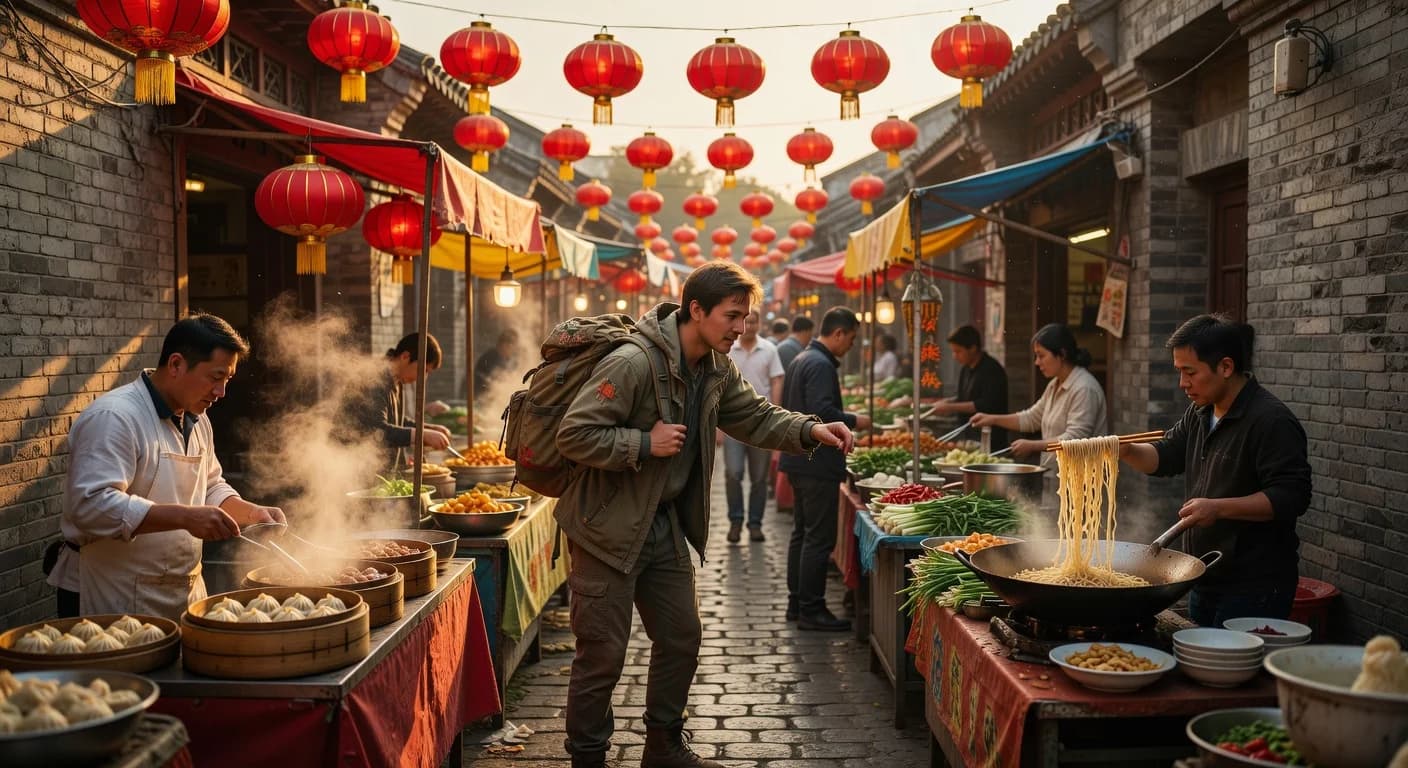
Street food in China is not a novelty—it's a lifestyle. When we spent time in the hutongs of Beijing and the alleys of Shanghai, we realized that street food represents the purest, most authentic expression of Chinese regional cuisine. It's also where you'll find the lowest prices and, paradoxically, some of the highest quality ingredients.
The street food ecosystem operates on speed and reputation. A vendor selling spring rolls at the same corner for five years has built a loyal customer base. They can't afford to serve bad food. Quality control is enforced by repeat customers, not health inspectors. During our time in Chengdu, we watched a vendor prepare dan dan noodles—hand-mixing the sauce, cooking noodles to order, adding toppings—all in under three minutes, for 8 CNY.
Best Street Food by Region and Price
| Item | City | Price (CNY) | Price (USD) | Why It's Worth It |
|---|---|---|---|---|
| Jiaozi (dumplings) | Beijing, Xi'an | 1–2 per piece | $0.14–0.27 | Freshly made, often filled to order |
| Malatang (spicy broth) | Chengdu, Chongqing | 15–25 | $2–3.45 | Build-your-own with vegetables, tofu, meat |
| Youtiao + soy milk | Any city | 5–8 | $0.70–1.10 | Perfect breakfast, takes 2 minutes |
| Baozi (steamed buns) | Any city | 1.5–3 | $0.20–0.41 | Pork, vegetable, or sweet bean fillings |
| Chuan (skewers) | Chengdu, Xi'an | 0.5–1 per skewer | $0.07–0.14 | Meat, vegetables, tofu—grill-to-order |
| Crepes (jianbing) | Beijing, Shanghai | 5–10 | $0.70–1.38 | Egg, crispy wonton, scallions, sauce |
Where to Find the Best Stalls
Morning markets (菜市场) open at 6–7 AM and are where locals buy breakfast. Street vendors set up outside wet markets with steamed buns, fried dough, and congee. In Beijing's Chaoyang District, we found a vendor selling perfect baozi for 2 CNY each—better than any tourist-facing shop. These markets are chaotic, loud, and absolutely worth the early wake-up.
Evening food streets (美食街) are designated areas where street vendors cluster. Chengdu's Kuanzhai Xiangzi (Wide and Narrow Alleys) has become touristy, but smaller cities have authentic versions. In Xi'an, the Muslim Quarter (回民街) is famous but crowded; we found better prices on side streets one block away.
University campuses have canteens (食堂) open to anyone. Prices are subsidized for students but available to all. A full meal—rice, two dishes, soup—costs 12–18 CNY. The food is simple but clean and filling. During our research in Beijing, we ate at Tsinghua University's canteen and paid less than a coffee shop would charge for a drink.
Book Great Wall tours, cooking classes, and experiences in advance with instant confirmation.
Browse Activities on Klook → Scan me
3. Noodle Shops: The Backbone of Budget Eating
If street food is the appetizer to Chinese budget dining, noodle shops are the main course. Every neighborhood in every city has at least one small noodle shop (面馆). These establishments are the backbone of how ordinary Chinese people eat lunch. A bowl of noodles costs 8–15 CNY in most cities, 12–20 CNY in expensive cities like Beijing and Shanghai.
The noodle shop model is brilliantly efficient. The owner makes stock overnight, cooks noodles to order in boiling water, adds toppings, and serves in under five minutes. Overhead is minimal—a small storefront, a few tables, maybe two employees. The menu is simple: perhaps five types of noodles, each available with different broths (chicken, beef, vegetable, spicy).
Types of Noodles and Their Prices
Compare hotels across China with free cancellation on most bookings.
Search Hotels on Booking.com → Scan me
Lanzhou hand-pulled noodles (兰州拉面): The most common budget noodle. A bowl with beef broth, noodles, and a few pieces of beef costs 10–12 CNY in most cities. The skill is in the hand-pulling—the cook stretches dough repeatedly until it becomes thin, uniform strands. We watched this process dozens of times and never tired of it.
Sichuan dan dan noodles (担担面): Sesame paste, chili oil, Sichuan peppercorns, and noodles. Spicy, complex, and addictive. Price: 8–12 CNY in Chengdu, 15–20 CNY in Beijing. This is the dish that made us understand why Sichuan cuisine has such devoted fans.
Wonton noodles (馄饨面): Thin noodles in broth with wontons (small dumplings). Common in southern China. Price: 10–15 CNY. The wontons are often made fresh in the shop.
Knife-cut noodles (刀削面): Thick, irregular noodles cut directly into boiling water. Hearty and filling. Price: 10–15 CNY. Popular in northern China.
How to Order and Communicate
Most noodle shops don't have English menus. Point at other customers' bowls, use your phone to show pictures, or learn five key phrases: "一碗面" (one bowl of noodles), "不要辣" (not spicy), "要辣" (make it spicy), "谢谢" (thank you), and "多少钱" (how much?). In our experience, noodle shop owners are patient with foreigners—they're used to tourists.
Did You Know? Noodles in China date back over 2,000 years. The earliest written reference appears in a book from the Han Dynasty (206 BCE – 220 CE). Today, China consumes more noodles per capita than any other country.
Source: Lonely Planet China
4. Wet Markets and DIY Eating: The Cheapest Option
If you have access to a kitchen—a hostel with a communal kitchen, an Airbnb, or a guesthouse—buying ingredients at wet markets (菜市场) is the cheapest way to eat in China. Prices are 50–70% lower than restaurants. A kilogram of tomatoes costs 3–5 CNY. Eggs are 4–6 CNY per kilogram. Rice is 2–3 CNY per kilogram.
Wet markets are also where you experience real China. During our time in Shanghai, we spent mornings at Jing'an District's wet market, watching vendors haggle, learning about seasonal produce, and buying ingredients for dinner. The experience is chaotic—vendors shouting, fish flopping, the smell of fresh herbs—but it's authentic and educational.
Shopping Strategy for Budget Travelers
Vegetables and fruits are cheapest. A week's worth of vegetables—bok choy, tomatoes, peppers, mushrooms—costs 15–25 CNY. Eggs are protein on a budget: 4–6 CNY per kilogram (roughly 10–12 eggs). Rice and noodles are staples: 2–3 CNY per kilogram of rice, 3–5 CNY per kilogram of noodles. Tofu (豆腐) is cheap protein: 2–4 CNY per block.
Meat is more expensive but still reasonable. Chicken is 12–18 CNY per kilogram, pork is 15–25 CNY per kilogram, beef is 25–40 CNY per kilogram. Buy small amounts—most vendors will sell you 100–200 grams. Seafood varies wildly by location. In coastal cities like Guangzhou, fresh fish is 15–25 CNY per kilogram. Inland, it's more expensive.
Simple Meals You Can Cook
With basic ingredients from a wet market, you can make meals for 5–10 CNY per person:
- Stir-fried vegetables with rice: 3–5 CNY (vegetables 2–3 CNY, rice 1–2 CNY, oil negligible)
- Egg fried rice: 5–8 CNY (rice 1–2 CNY, eggs 2–3 CNY, vegetables 1–2 CNY)
- Simple noodle soup: 4–6 CNY (noodles 1–2 CNY, broth 1–2 CNY, vegetables/egg 1–2 CNY)
- Tofu and vegetable stir-fry: 4–6 CNY (tofu 2–3 CNY, vegetables 1–2 CNY, oil negligible)
The advantage of wet market shopping is not just price—it's control. You know exactly what you're eating, you can buy organic produce (标注为有机, marked as organic), and you support local farmers directly.
Compare hotels across China with free cancellation on most bookings.
Search Hotels on Booking.com →
Scan me
5. Canteens and University Dining: Hidden Gems
One of our best discoveries during three years in Beijing was eating at university canteens (食堂). These subsidized dining facilities are open to anyone, not just students. A full meal—rice, two dishes, soup—costs 12–18 CNY. The food is simple, clean, and prepared in bulk, so quality is consistent.
University canteens operate on a different economic model than restaurants. The university subsidizes them to keep students fed affordably. This means prices are artificially low, but the trade-off is that the menu is limited and the environment is utilitarian. You're eating in a cafeteria, not a restaurant. But the food is genuine, the portions are generous, and you're eating exactly what Chinese students eat.
How to Access University Canteens
Most universities have multiple canteens on campus. Look for signs saying "食堂" or ask at the main gate. Some universities have restricted access (ID required), but many allow visitors. During our time in Beijing, we ate at canteens at Tsinghua University, Peking University, and Beijing Normal University without issue. Staff might ask if you're a student—a simple "游客" (tourist) or "访客" (visitor) usually suffices.
Typical canteen meal breakdown:
- Rice or noodles: 1–2 CNY
- Vegetable dish: 2–3 CNY
- Protein dish (egg, tofu, small amount of meat): 3–5 CNY
- Soup: 1–2 CNY
- Total: 12–18 CNY ($1.65–2.50)
The quality varies. Some canteens are modern with multiple stations; others are basic. But all are clean and safe. We never had a bad experience, and several meals were genuinely delicious—a stir-fried pork with garlic at Beijing Normal University's canteen was better than dishes we'd paid 40 CNY for at restaurants.
6. Regional Cuisines and Where to Eat Them Cheapest
China's regional cuisines are dramatically different. Sichuan food is spicy and numbing. Cantonese food is subtle and refined. Northern Chinese food is wheat-based and hearty. The best way to experience these cuisines affordably is to eat them in their home regions.
Sichuan: Chengdu and Chongqing
Book Great Wall tours, cooking classes, and experiences in advance with instant confirmation.
Browse Activities on Klook →
Scan me
Mapo tofu (麻婆豆腐) is the iconic dish—silken tofu in a spicy, numbing sauce. Price: 12–18 CNY in Chengdu, 20–25 CNY in Beijing. In Chengdu, we ate mapo tofu almost daily because it was cheap, delicious, and available everywhere. The "ma" (麻) refers to the numbing sensation from Sichuan peppercorns; the "la" (辣) is the heat from chili.
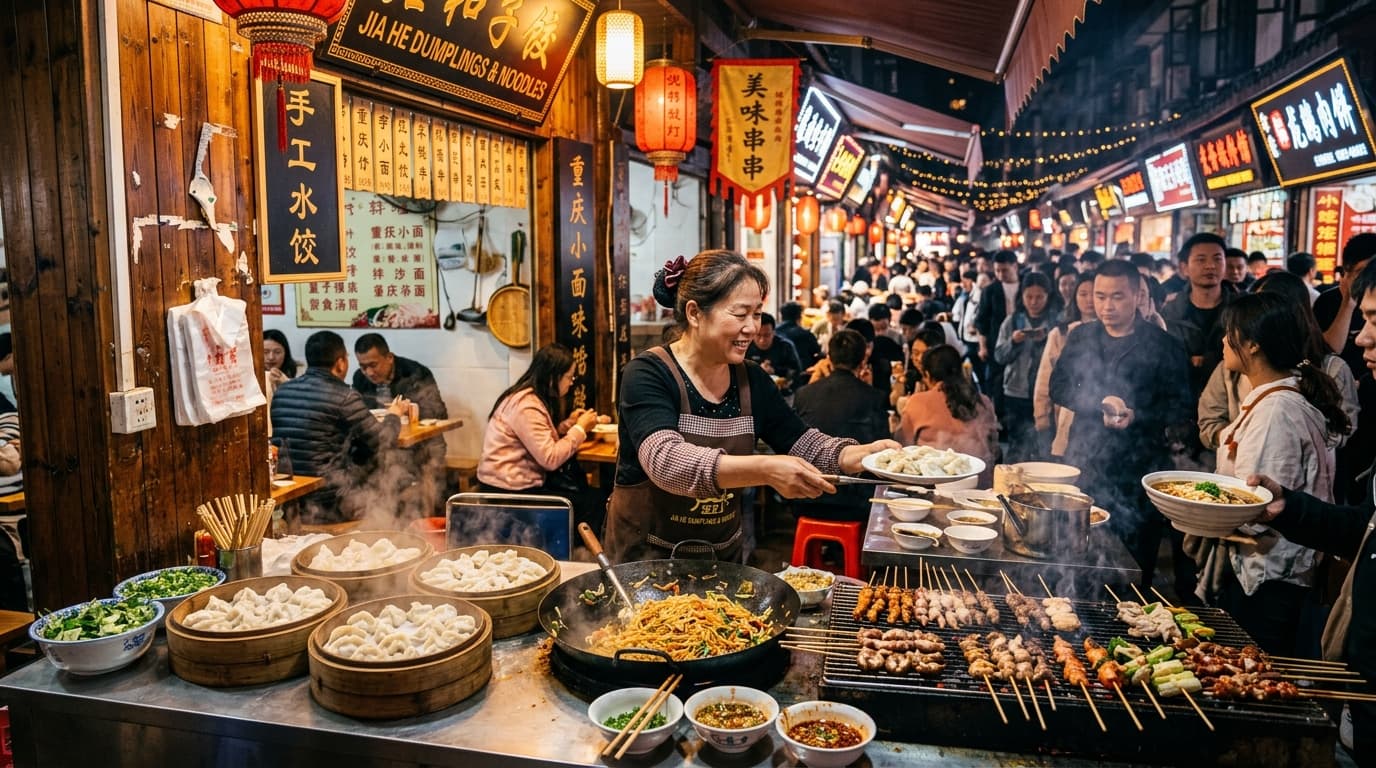
Chuan (串)—skewers grilled over charcoal—are the street food of choice. You pick items (meat, vegetables, tofu, organs), they're grilled, and you pay by the skewer. Price: 0.5–1 CNY per skewer. A meal of 20–30 skewers costs 15–30 CNY. In Chengdu's Kuanzhai Xiangzi, we found a vendor selling perfect lamb skewers for 0.8 CNY each.
Malatang (麻辣烫)—a DIY hot pot where you pick ingredients from a buffet and cook them in spicy broth. Price: 15–25 CNY for a full bowl. It's interactive, fun, and incredibly cheap.
Cantonese: Guangzhou and Hong Kong Border
Dim sum (点心) is Cantonese cuisine's signature. Small plates of dumplings, buns, and rolls arrive on carts. Price: 3–8 CNY per plate in Guangzhou, 15–25 CNY in Hong Kong. In Guangzhou's Liwan District, we ate dim sum for breakfast at a traditional teahouse and paid 30 CNY for five plates plus tea.
Char siu (叉烧)—barbecued pork—is served over rice. Price: 15–20 CNY in Guangzhou. The meat is glazed with a sweet-savory sauce and served with rice and a vegetable.
Northern Chinese: Beijing and Xi'an
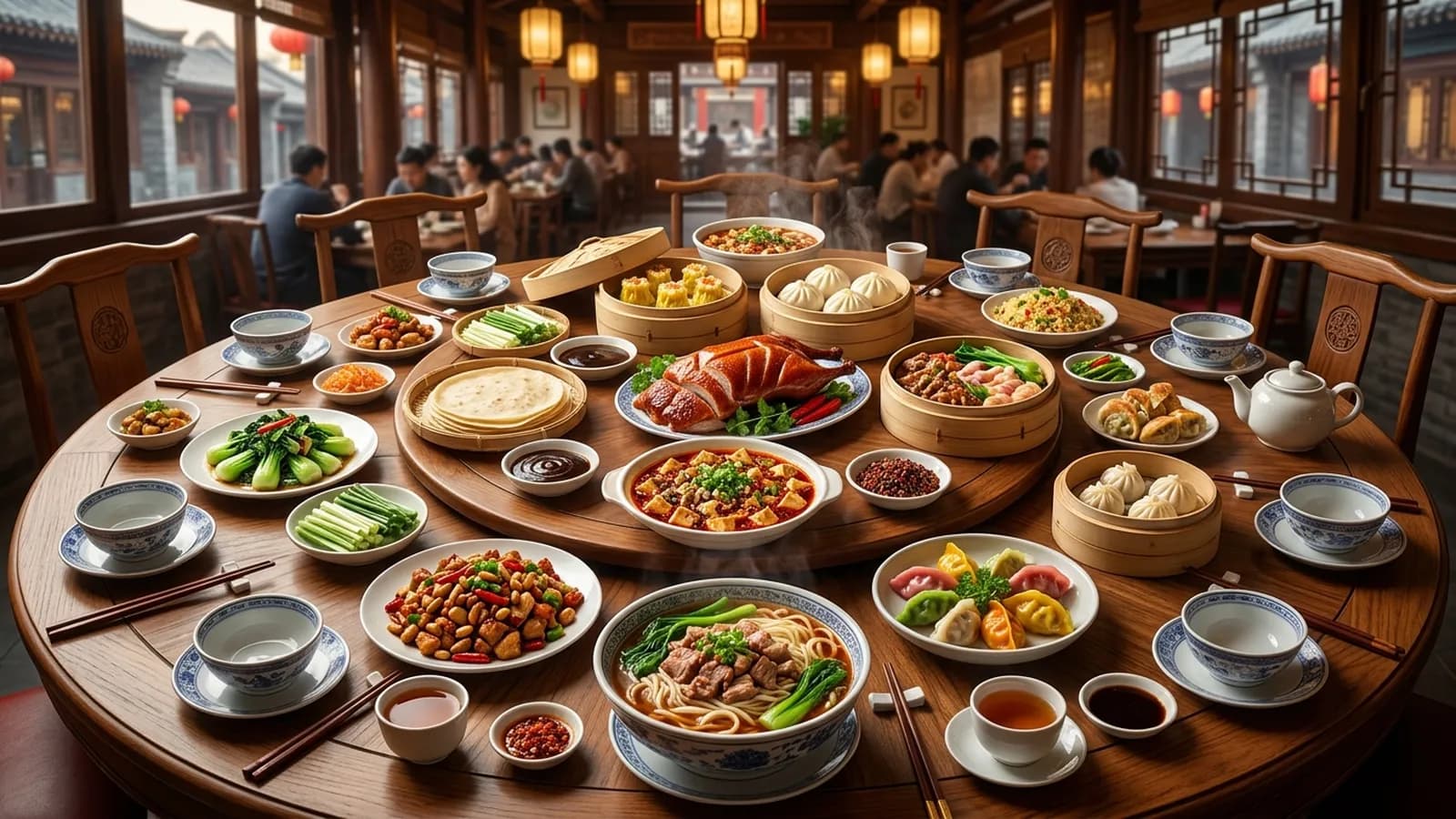
Peking duck (北京烤鸭) is Beijing's signature dish, but it's expensive at restaurants (100–200 CNY per person). However, small shops serve it for 40–60 CNY per person. During our time in Beijing, we found a hole-in-the-wall place in Chaoyang District serving excellent Peking duck for 45 CNY—half the price of tourist restaurants.
Jiaozi (饺子)—dumplings—are ubiquitous in northern China. A plate of 10 dumplings costs 5–10 CNY. In Xi'an, we ate dumplings for lunch almost every day. The variety is astounding: pork and chive, shrimp and vegetable, beef and cumin.
Roujiamo (肉夹馍)—meat in flatbread—is a Xi'an specialty. Slow-cooked pork is shredded and stuffed into a crispy flatbread. Price: 5–8 CNY. It's messy, delicious, and perfect street food.
Did You Know? Sichuan peppercorns (花椒) create a numbing sensation called "ma" (麻) that's distinct from heat. The compound responsible, hydroxy-alpha sanshool, activates touch receptors in your mouth, creating a tingling sensation similar to touching a 50-Hz electrical current.
Source: China Daily
Discover guided tours in Beijing, Shanghai, Xi'an and beyond.
Browse Tours on GetYourGuide → Scan me
7. Drinks: Tea, Coffee, and Beverages on a Budget
Beverages are where many budget travelers overspend. A coffee at a chain café costs 25–40 CNY. A bottle of imported juice costs 10–15 CNY. But Chinese drinks are cheap and delicious.
Traditional Chinese Tea
Chinese green tea, oolong, and jasmine tea are available everywhere. A cup of tea at a small shop costs 3–5 CNY. A pot of tea (enough for 2–3 people) costs 5–10 CNY. Many small restaurants include free tea with meals. During our time in Hangzhou, we spent afternoons in tea shops, nursing a pot of pu-erh tea for 8 CNY.
Street Beverages
Soy milk (豆浆) is sold at breakfast stalls for 2–3 CNY per cup. It's warm, filling, and nutritious. Fresh juice from street vendors—orange, sugarcane, watermelon—costs 3–5 CNY. We watched vendors feed whole oranges into electric juicers and fill cups with fresh juice in seconds.
Bubble tea (珍珠奶茶) has become ubiquitous. A basic bubble tea costs 5–10 CNY at small shops, 15–20 CNY at chains. It's sweet and fun, but not a daily budget item.
Alcohol on a Budget
Tsingtao beer (青岛啤酒) is China's most popular beer. A bottle costs 3–5 CNY at convenience stores, 8–12 CNY at restaurants. Baijiu (白酒)—a strong spirit—is cheap and potent. A bottle of mid-range baijiu costs 20–50 CNY. We learned quickly that baijiu is for special occasions, not casual drinking.
8. Where NOT to Eat: Tourist Traps and Overpriced Areas
Part of eating cheaply is knowing where to avoid. During our travels, we identified clear patterns of where prices spike and quality drops.
Tourist-facing restaurants near major attractions charge 3–5 times normal prices. A bowl of noodles that costs 10 CNY in a residential neighborhood costs 35–50 CNY near the Forbidden City. A plate of dumplings costs 3 CNY at a local shop, 15 CNY at a tourist restaurant. The food is often worse—mass-produced, reheated, made for volume rather than quality.
Hotel restaurants and cafés are expensive. A coffee costs 30–50 CNY. A simple sandwich costs 40–60 CNY. If you're staying in a hotel, eat breakfast at a local café or street stall instead.
Shopping mall food courts are mid-range priced (30–50 CNY per meal) but not budget. They're convenient if you're already shopping, but not worth seeking out.
Restaurants with English menus and pictures often mark up prices for foreign customers. A handwritten Chinese menu usually means lower prices than a laminated English menu.
How to Identify Authentic Local Restaurants
Look for crowds of Chinese people eating lunch. If a restaurant is packed with locals at noon, it's good and cheap. If it's empty except for tourists, avoid it.
Check if the menu is in Chinese only. This is a strong signal of a local establishment with local prices.
Observe the ordering system. If customers point at dishes or use a number system, it's local. If there's a waiter explaining dishes in English, it's tourist-oriented.
Look at the bill. If other customers' bills are 15–25 CNY and yours is 50 CNY, you've been overcharged.
Get a China eSIM before you land. Some plans include [VPN](https://nordvpn.tpo.lv/ekHF1i55) access.
Get Saily eSIM for China → Scan me
9. Sample Daily Budgets: Real Itineraries
Let's create realistic daily budgets for different cities and eating styles. These are based on actual spending from our travels.
Budget Option: Street Food and Canteens ($5.50–7 USD)
Compare car rental prices across China. Pick up at airports or city locations with flexible cancellation.
Compare Car Rentals →
Scan me
Beijing:
- Breakfast (6:30 AM): Youtiao + soy milk from street vendor = 5 CNY
- Mid-morning snack: Steamed bun from market = 2 CNY
- Lunch (12 PM): Noodles at local shop = 12 CNY
- Afternoon tea: Jasmine tea at small café = 3 CNY
- Dinner (6 PM): Rice + two dishes at university canteen = 16 CNY
- Daily total: 38 CNY ($5.20)
Chengdu:
- Breakfast: Baozi + tea = 4 CNY
- Lunch: Mapo tofu with rice = 14 CNY
- Snack: Fresh orange juice = 4 CNY
- Dinner: Chuan (15 skewers) = 12 CNY
- Daily total: 34 CNY ($4.70)
Mid-Range Option: Mix of Restaurants and Street Food ($7–10 USD)
Shanghai:
- Breakfast: Xiaolongbao (soup dumplings) = 8 CNY
- Lunch: Rice + protein dish at casual restaurant = 25 CNY
- Snack: Bubble tea = 8 CNY
- Dinner: Hot pot (split with friend) = 40 CNY (your share 20 CNY)
- Daily total: 61 CNY ($8.40)
Xi'an:
- Breakfast: Roujiamo + soy milk = 8 CNY
- Lunch: Jiaozi (dumplings) at dumpling restaurant = 20 CNY
- Snack: Street crepe = 6 CNY
- Dinner: Noodles with meat = 15 CNY
- Daily total: 49 CNY ($6.75)
Splurge Option: Nicer Restaurants and Famous Dishes ($10–15 USD)
Beijing:
- Breakfast: Café breakfast = 25 CNY
- Lunch: Peking duck at mid-range restaurant = 60 CNY
- Snack: Coffee = 20 CNY
- Dinner: Hot pot = 80 CNY
- Daily total: 185 CNY ($25.50) — This is splurging, not budget eating
10. Money-Saving Tips and Hacks
After years of eating cheaply in China, we've developed strategies that work consistently.
Eat lunch, not dinner. Lunch prices are 20–30% lower than dinner prices at the same restaurant. A dish that costs 25 CNY at lunch costs 35 CNY at dinner. Eat your biggest meal at lunch and a light dinner.
Eat with locals. Join coworkers, friends, or other travelers for meals. Group meals at restaurants are cheaper per person because you order family-style and share. A meal that costs 50 CNY alone costs 30 CNY when split among three people.
Learn to say "cheap" (便宜) and "less oil" (少油). Asking for less oil (少油) reduces calories and is a normal request. Asking if something is cheap or for recommendations often leads to better prices.
Carry snacks. Buy buns, fruit, and nuts at markets for 2–5 CNY. These fill gaps between meals and prevent overspending on expensive snacks.
Use your phone. Download Baidu Maps and search for "面馆" (noodle shop), "食堂" (canteen), or "菜市场" (wet market). You'll find dozens of options within walking distance.
Avoid convenience stores for meals. 7-Eleven and similar stores charge 15–25 CNY for basic items. Street vendors and restaurants are cheaper.
Drink tap water (with caution). Tap water in major cities is safe to drink but tastes chlorinated. Buy a water bottle and refill at your accommodation. Bottled water costs 2–3 CNY; buying it daily adds up.
Eat seasonal. Seasonal vegetables are 30–50% cheaper than out-of-season produce. Ask vendors "现在什么便宜?" (What's cheap right now?).
Frequently Asked Questions
How do I know if street food is safe?
Look for busy stalls with high turnover. If a vendor is selling 50 portions of dumplings an hour, they're using fresh ingredients. Avoid stalls that sit idle. Watch the preparation—if the vendor is handling food with bare hands and not washing them, move on. In our experience, the busiest stalls are the safest.
Can I eat vegetarian cheaply in China?
Yes. Vegetables are the cheapest ingredients at markets and restaurants. A vegetable stir-fry costs 8–12 CNY. Tofu dishes cost 10–15 CNY. However, many dishes contain meat stock or fish sauce. If you're vegetarian, learn to say "不要肉" (no meat) and "素食" (vegetarian).
What's the cheapest city to eat in China?
Based on our travels, Chengdu, Xi'an, and smaller cities in Southwest China are 30–40% cheaper than Beijing and Shanghai. A meal that costs 20 CNY in Chengdu costs 30 CNY in Beijing. Tier-2 and Tier-3 cities are consistently cheaper than tier-1 cities.
Do I need to tip in China?
No. Tipping is not expected in China and can be considered offensive in some contexts. Prices are final. If you want to leave a small amount (1–2 CNY), it's appreciated but not necessary.
How do I order if I don't speak Chinese?
Point at other customers' dishes, use your phone to show pictures, or use a translation app. Most vendors are patient with foreigners. Learning five key phrases helps: "一碗面" (one bowl of noodles), "不要辣" (not spicy), "要辣" (spicy), "谢谢" (thank you), and "多少钱" (how much?).
Are there food allergies I should know about?
Peanuts and tree nuts are common in Chinese cuisine, especially in sauces. Shellfish is common in coastal regions. Sesame is used in many dishes. If you have allergies, learn to say them in Chinese or carry a card explaining your allergies. Restaurants take allergies seriously once they understand.
Conclusion
Eating like a local in China for under $8 a day is not just possible—it's the default experience for millions of people. The secret is abandoning tourist restaurants and eating where locals eat: noodle shops, street stalls, wet markets, and university canteens. You'll spend less money, eat better food, and have more authentic experiences.
During our three years in Beijing and travels through Yunnan and Sichuan, we learned that the best meals often cost the least. A bowl of hand-pulled noodles made fresh in front of you is better than a tourist restaurant's reheated dish, and it costs a quarter of the price.
Start with the sample daily budgets in this guide, learn a few key phrases, and download a translation app. Within days, you'll find your favorite noodle shop, your favorite street vendor, and your favorite local restaurant. You'll be eating like a local—and your wallet will thank you.
Ready to plan your budget trip to China? Explore our city guides for Beijing, Shanghai, Chengdu, and beyond. Each guide includes detailed food sections, neighborhood recommendations, and local tips. For more on Chinese cuisine, check out our comprehensive food guide featuring dishes from every region.
Trust us: We've eaten thousands of meals in China, and the best ones cost the least.

About the Author
Go2China Team
The Go2China editorial team combines first-hand travel experience with deep cultural knowledge to bring you accurate, up-to-date guides for exploring China — from the Great Wall and Forbidden City to hidden gems off the tourist trail.
- ✓Lived and traveled extensively across China
- ✓Native & bilingual Mandarin speakers on team
- ✓Verified info from official Chinese tourism sources