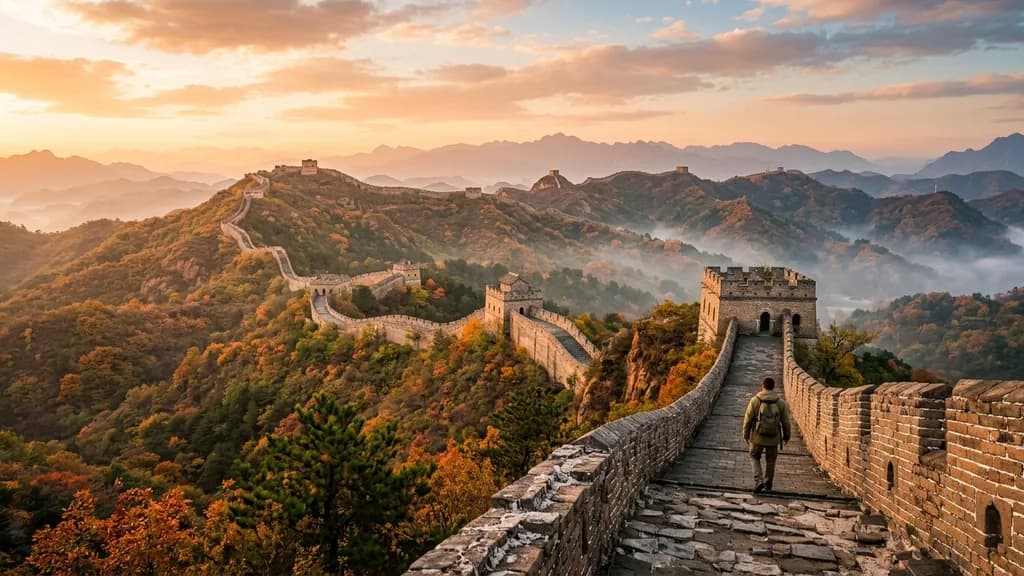
Is the Great Wall worth the trip in 2026? Honest comparison of Badaling vs Mutianyu vs Jinshanling, crowd-avoidance tactics, and which section suits your trip.
So you are flying halfway around the world and someone has already warned you that the Great Wall is overrated, overcrowded, and a tourist trap. Meanwhile Instagram keeps serving you empty ridge shots that look like another planet. Which version is real?
Both. The Great Wall in 2026 is the single best cultural experience in China if you pick the right section and the right day. It is also a miserable cattle-pen if you show up at Badaling on a Saturday in July. This guide is the decision piece, not the inspiration piece. We tell you exactly which section to book, when to go, and how to avoid the weekend nightmare that ruins the Wall for so many visitors.
TL;DR: Is the Great Wall Worth It?
Yes, 100 percent. It is one of the few man-made wonders that actually delivers on the hype in person. But the answer to the real question, which section should I visit, is almost never Badaling.
Pick Mutianyu if you want a balance of accessibility, restored Wall, a cable car, and a toboggan ride down (this is the right answer for most travelers).
Pick Jinshanling if you are a fit hiker who wants a 4-hour ridge walk with maybe 50 other people on the entire section.
Avoid Badaling unless you have no other option. It is the closest to Beijing and the cheapest to reach, which is exactly why every tour bus in the city dumps its passengers there.
Which Great Wall Section Should You Visit? Decision Table
This is the table you came for. The Wall near Beijing has six main sections tourists actually visit. Here is how they stack up in 2026.
| Section | From Beijing | Entry (USD / CNY) | Difficulty | Crowds | Best For |
|---|---|---|---|---|---|
| Badaling | 1 hour | $6 / ¥45 | Easy | Extreme | Zero-flex schedule, elderly visitors |
| Mutianyu | 90 min | $7 / ¥50 + cable car $15 | Easy to moderate | Moderate | First-timers, families, 80% of travelers |
| Jinshanling | 2.5 hours | $9 / ¥65 | Moderate to hard | Light | Hikers, photographers |
| Simatai | 2.5 hours | $7 / ¥55 (permit req'd) | Moderate | Light | Night visits, light show |
| Jiankou | 3 hours | Free (access via villages) | Expert only | Almost none | Experienced climbers, adventurers |
| Huanghua | 2 hours | $3 / ¥25 | Moderate to hard | Very light | Wild Wall curious on a budget |
Costs are ticket only. Add transport: public bus $4, tour bus package $15 to $40, private driver $80 to $150 for the day.
The 2026 Crowd Reality at Badaling
Let us be blunt. Badaling on a summer Saturday in 2026 is processing 60,000 to 80,000 visitors per day. Tour buses arrive in convoys from 9 am, each unloading 40 to 50 Chinese domestic tourists on package tours, and the main loop turns into a slow-moving human queue. You shuffle, you do not walk. Selfie stick real estate becomes a contact sport.
The Wall itself at Badaling is genuinely beautiful. It is also the most heavily restored section, with a cable car, a "Great Wall on rails" pulley ride down, souvenir shops every 200 meters, and a Starbucks near the entrance. If you are a Chinese domestic tourist ticking off a national landmark, it is perfect. If you are a foreign visitor who flew 12 hours for an authentic experience, it is a letdown.
When Badaling makes sense: elderly travelers, mobility-limited visitors, anyone with a half-day layover in Beijing, or weekday winter visits when the crowds thin out.
When to avoid it at all costs: summer Saturdays and Sundays, Chinese New Year (late January to mid February), the May Day holiday (May 1 to 5), and Golden Week (October 1 to 7). See our full seasonal guide for dates to dodge.
Mutianyu Deep Dive: Why It Wins for Most Visitors
If we could only recommend one section to one traveler, it would be Mutianyu, every time.
Mutianyu sits 90 minutes northeast of Beijing and has everything Badaling has (cable car up, snack stands, restored ramparts) but with a third of the crowds and a more dramatic setting. The Wall here winds through pine-covered mountains with 22 watchtowers in a 2.25 km restored stretch. You get actual ridge views instead of the parking-lot sightlines at Badaling.
The killer feature is the toboggan. From the top of Tower 14 you ride an alpine-style metal slide back down the mountain. Kids love it, parents pretend they are too cool for it and then love it too. The ride is $12 / ¥85 on top of your cable car ticket, and it is worth every cent.
Mutianyu Cost Breakdown (2026)
| Item | USD | CNY |
|---|---|---|
| Entry ticket | $7 | ¥50 |
| Cable car (one way) | $15 | ¥100 |
| Cable car (round trip) | $22 | ¥150 |
| Toboggan down | $12 | ¥85 |
| Private driver from Beijing (round trip) | $90-130 | ¥650-950 |
| Tour bus package (entry + transport) | $35-55 | ¥250-400 |
Plan on $70 to $100 per person for a well-executed Mutianyu day trip, or $130 to $180 if you split a private driver between two or three people. Book cable car and toboggan tickets via Klook to skip the window queue.
What to Expect on the Wall at Mutianyu
Arrive at the main parking lot, ride the shuttle up to the cable car base (10 minutes), take the cable car to Tower 14 (5 minutes), and walk either direction. Most visitors go east toward Tower 20 for the steeper, more dramatic sections, then loop back and toboggan down. Budget 3 to 4 hours on the Wall itself, plus 2 hours each way for transport.
The downside: food options on the Wall are limited to a couple of overpriced snack stands, so bring water and a picnic.
Jinshanling: The Hikers' Wall
If you are reading this and thinking "I want the Wall without the tourists," Jinshanling is your section. It sits 2.5 hours northeast of Beijing and most of its 10 km stretch is partially restored or fully wild, with crumbling watchtowers you can climb inside.
Jinshanling is where serious hikers go. The classic route is a 4-hour ridge walk from Jinshanling to the Simatai border (the crossing into Simatai itself is closed but the hike to the boundary remains the best thing you can do on the Wall). You see perhaps 30 to 80 other hikers in an entire day, compared to the thousands at Badaling.
Fitness required: moderate. There is continuous up and down on uneven stone, some restored stairs, and exposed sections with no guardrail. If you can handle a 10 km hill hike back home, you can handle Jinshanling.
Cost: entry $9 / ¥65, private driver round trip $110 to $150, optional cable car $7 / ¥50 one way. Guided hiking tours via GetYourGuide run $80 to $140 per person and include transport plus an English-speaking guide who knows the route.
Pro tip: overnight at a guesthouse in Jinshanling village. Sunrise on the Wall with nobody else on it is a top-five travel moment. You will never get that from a Beijing day trip.
For a deeper breakdown of hiking routes, see our Great Wall hiking routes guide.
Simatai: The Only Section Open at Night
Simatai is the single section of the Great Wall where you can visit after dark. The sunset-to-night light show runs from about 5:30 pm (earlier in winter) and lets you walk a floodlit stretch of Wall with the mountain silhouettes behind.
It is touristy in a completely different way than Badaling. Gubei Water Town at the base of Simatai is a reconstructed canal village with restaurants, bars, and boutique hotels, and the package usually includes the town plus the Wall. Entry is $7 / ¥55 plus the Gubei ticket at about $22 / ¥150. You need a permit, which your hotel or tour operator arranges.
When it is worth it: you are in Beijing for 4+ nights and want a completely different Wall experience. The night visit is genuinely magical and wholly unlike a daytime trip.
When to skip: tight schedule, you already did Mutianyu, or you hate manufactured "heritage" town vibes.
Jiankou: The Wild Wall for Adventurers Only
Jiankou is dangerous. It is also the section that appears in every epic Instagram shot of the Great Wall, with collapsed towers, tree roots growing through stone, and razor-thin ridgelines with 100 meter drops on both sides.
Technically Jiankou is closed to casual tourists. Access is via footpaths from Xizhazi village, 3 hours from Beijing, and there are no guardrails, no staff, no rescue. People fall every year, some fatally. If you are an experienced hiker with scrambling and exposure experience, go with a licensed local guide and the right footwear. If you are not, pick Jinshanling instead.
Do not: solo-hike Jiankou, attempt it in rain or after snow, or go without a guide your first time.
Huanghua: The Budget Wild Wall
Huanghuacheng (often shortened to Huanghua) is the underrated wild-Wall pick. It is 2 hours north of Beijing, has a uniquely photogenic flooded section where a reservoir cuts through the Wall, and costs only $3 / ¥25 to enter.
The trails are a mix of restored and wild. Difficulty is moderate, crowds are minimal, and the lake views make this section visually distinct. Pick it if you want a taste of wild Wall without the Jinshanling commute or the Jiankou danger.
Day Trip vs Overnight: Which Is Right for You?
Day trip from Beijing works fine for Badaling, Mutianyu, and (just barely) Jinshanling. You leave Beijing at 7 am, arrive at the Wall by 9 am, spend 3 to 4 hours on site, drive back, and are at dinner by 7 pm. This is what 90 percent of visitors do.
Overnight near the Wall opens up experiences day-trippers never see. Sunrise on Jinshanling with nobody else there. Dinner in a village guesthouse. Two full days of hiking if you are ambitious. Gubei Water Town at Simatai for a night-Wall visit. Expect $80 to $200 per night for a guesthouse or boutique hotel near Mutianyu, Jinshanling, or Simatai.
Our pick: if you have 5+ nights in the Beijing area on your China itinerary, stay one night near the Wall. If you only have 2 to 3 nights in Beijing, day-trip Mutianyu and move on.
Private Driver vs Tour Group: The Math
This is a question of money versus freedom.
Tour Group Package
- Cost: $15 to $40 per person (usually Badaling)
- Pros: cheapest, zero planning, picks you up at hotel
- Cons: forced shopping stops, rigid schedule, usually Badaling, large group of 20+
- Verdict: fine for solo backpackers on tight budgets who do not mind Badaling
Small Group Tour
- Cost: $50 to $100 per person
- Pros: English-speaking guide, Mutianyu or Jinshanling, smaller group of 6 to 12
- Cons: still a schedule, still shared van
- Verdict: sweet spot for solo travelers and couples, book via GetYourGuide
Private Driver
- Cost: $80 to $150 for the day, total (not per person)
- Pros: your schedule, any section, stops where you want, English not guaranteed
- Cons: expensive solo, language barrier possible
- Verdict: best value for groups of 3 to 4. Costs $25 to $50 per person and you control the day entirely.
DIY Public Bus
- Cost: $4 to $8 total
- Pros: cheapest, local experience
- Cons: Badaling or Mutianyu only, slow, Mandarin-only signage in places
- Verdict: only if you speak some Mandarin or travel often in China
Best Time to Visit the Great Wall in 2026
The short version: weekday, off-season, arrive at 8 am. Three rules, memorize them.
Best Months
- March to May (spring): flowers bloom, clear skies, moderate temperatures (10 to 22 C). Peak season starts late April.
- September to November (fall): crisp air, fall foliage, the most photogenic months. Our top pick. Temperatures 8 to 20 C.
- December to February (winter): almost empty, crystal-clear skies, occasional snow. Cold (minus 5 to minus 15 C) but unforgettable.
- June to August (summer): hot, humid, hazy, packed. Avoid weekends at all costs.
Avoid These Dates (2026)
- Chinese New Year / Spring Festival: February 17 to 23, 2026 (domestic tourism peaks)
- Qingming Festival: April 4 to 6, 2026
- Labor Day (May Day): May 1 to 5, 2026
- Golden Week / National Day: October 1 to 7, 2026
During these weeks, Badaling can hit 100,000 visitors in a single day. Every section gets busier. If you cannot avoid these dates, go to Jinshanling or Huanghua, which stay relatively calm even on holidays.
See our best time guide for a deeper season-by-season breakdown.
What to Wear and Bring
What to Wear
- Sturdy trainers or light hiking shoes. The stone is uneven at every section. Flip-flops and dress shoes are a guaranteed twisted ankle.
- Layers. Mountain weather shifts fast. T-shirt, fleece, windproof shell in shoulder season. In winter, add a down jacket, hat, and gloves.
- Sun hat and sunglasses. There is almost zero shade on the Wall itself.
- Long pants in summer. Protects against sunburn and the occasional mosquito at lower sections.
What to Bring
- Water (at least 1.5 L per person). Mutianyu has limited snack stands, Jinshanling has almost none, Jiankou has zero.
- Snacks. Trail mix, energy bars, fruit. Eating options on the Wall are sparse and overpriced.
- Sunscreen (SPF 30+). You are at altitude and exposed.
- Cash in small bills. Some shuttle buses and village stalls still prefer cash or WeChat Pay.
- Passport. You occasionally need it for permit-controlled sections like Simatai.
- Power bank. Phone battery drains fast in cold weather, and you will take 500 photos.
Crowd-Avoidance Tactics That Actually Work
- Go on a Tuesday, Wednesday, or Thursday. Weekends are 3x busier everywhere.
- Arrive at 8 am, not 10 am. The tour buses from Beijing arrive between 9:30 and 10:30 am. Beat them to the top cable car.
- Visit in November, December, February, or early March. You will have Mutianyu almost to yourself some days.
- Skip Chinese public holidays entirely. Check the 2026 dates above and do not book the Wall on those days.
- Walk away from the entrance. At Mutianyu, most tour groups cluster around Towers 10 to 14. Walk 20 minutes east or west and crowds thin dramatically.
- Choose Jinshanling or Huanghua. If you cannot avoid a weekend or holiday, the lesser-visited sections stay manageable.
Quick Reference: Which Section Fits Your Trip?
| Trip Style | Recommended Section | Time Needed |
|---|---|---|
| First China trip, limited time | Mutianyu | Half day |
| Family with kids under 12 | Mutianyu (for the toboggan) | Full day |
| Photographer, Instagram-focused | Jinshanling at sunrise | Overnight |
| Serious hiker | Jinshanling to Simatai border | Full day |
| Zero flexibility, Beijing layover | Badaling | 4 hours |
| Night experience | Simatai + Gubei Water Town | Overnight |
| Adventure junkie | Jiankou with a guide | Full day |
| Budget backpacker | Huanghua | Full day |
Final Word: Book Mutianyu, Go on a Tuesday, Arrive at 8 AM
The Great Wall of China in 2026 is absolutely worth the trip. It is the closest thing humans have built to a natural wonder, a 2,000-year-old snake of stone across mountain ridges that does not photograph as well as it stands there in person. Every traveler who sees it properly says the same thing: the photos undersell it.
The mistake is treating "the Great Wall" as one place. It is not. Badaling on a Saturday is a bad theme park. Mutianyu on a Tuesday morning is a spiritual experience. Jinshanling at sunrise is the travel memory you will tell people about for years.
Pick the right section. Pick the right day. Arrive at 8 am. That is the whole formula, and it turns a maybe-overrated landmark into a maybe-best-day-of-the-trip.
Heading to Beijing soon? Pair this guide with our Beijing vs Shanghai for tourists comparison and our full China itinerary to lock in your plan.
Sources & References
This article is based on editorial research and verified with the following sources:

About the Author
Go2China Team
The Go2China editorial team combines first-hand travel experience with deep cultural knowledge to bring you accurate, up-to-date guides for exploring China — from the Great Wall and Forbidden City to hidden gems off the tourist trail.
- ✓Lived and traveled extensively across China
- ✓Native & bilingual Mandarin speakers on team
- ✓Verified info from official Chinese tourism sources