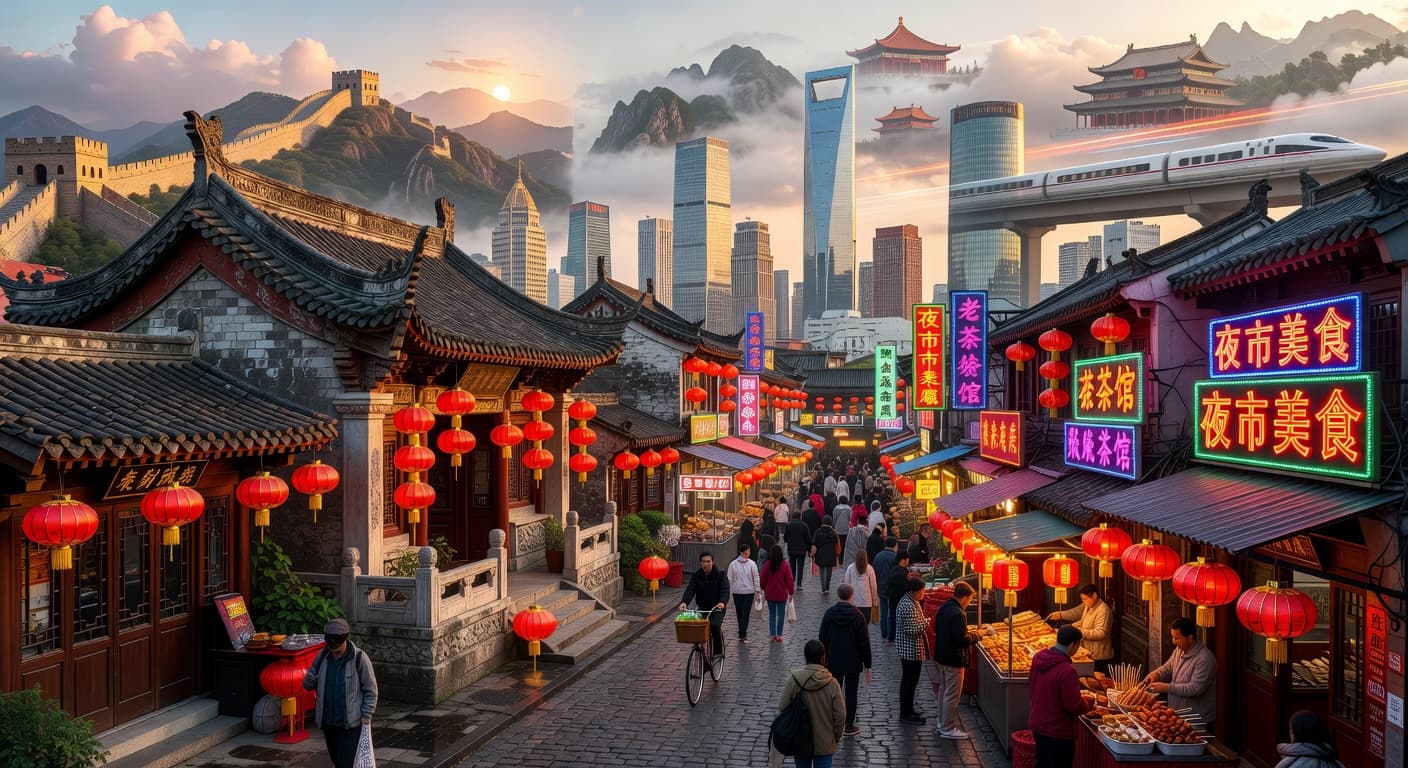
Skip the tourist crowds. Explore Shanghai's authentic neighborhoods, street food, hidden temples, and local life beyond the Bund with insider tips from our team.
The Bund glitters at sunset, but the real Shanghai lives in the lantern-lit alleys of Jing'an, the vintage cafés of Tianzifang, and the steaming noodle stalls of Huangpu. Shanghai beyond the Bund is where locals actually spend their evenings—not posing for photos, but living. After three years navigating this city's 27 million residents, we've learned that the most authentic Shanghai experiences happen far from the postcard views.
Key Takeaways
| Question | Answer |
|---|---|
| What is the best time to visit? | Spring (March–May) and autumn (September–November) offer mild weather and clear skies. Summer is hot and humid; winter is cold and grey. |
| How much does it cost? | Budget travelers: 200–400 CNY/day ($28–55 USD); mid-range: 600–1,200 CNY/day ($83–165 USD); luxury: 1,500+ CNY/day ($200+ USD). |
| How do I get there? | Fly into Pudong International Airport (PVG) or Hongqiao (SHA). Metro Line 2 connects both to the city center in 30–45 minutes. |
| Is it safe? | Extremely safe. Shanghai has low violent crime. Petty theft in crowded areas is rare but possible—keep valuables secure. |
| What should I book in advance? | Popular restaurants (especially in Jing'an and Huangpu), cooking classes, and accommodation during October Golden Week and Chinese New Year. |
| Do I need a visa? | Most visitors need a Tourist Visa. Some nationalities qualify for 144-hour visa-free transit if arriving via international flight. |
| What's the language barrier like? | English is spoken in hotels and major attractions. Download WeChat and Alipay for mobile payments. Language tips and a translation app are essential for street food exploration. |
1. The Neighborhoods That Define Shanghai
Shanghai isn't one city—it's a mosaic of distinct neighborhoods, each with its own rhythm and character. The Bund draws millions, but the soul of Shanghai lives elsewhere. When we explored beyond the postcard views, we discovered that the city's most compelling stories unfold in residential lanes where grandmothers haggle at wet markets and teenagers sip craft coffee in converted warehouses.
The city spans 6,341 square kilometers, but most visitors cluster in just three districts. Breaking free from this pattern reveals a Shanghai that feels genuinely Chinese—where modernism collides with tradition, and where you'll find yourself the only foreigner in a room full of locals sharing a meal.
Jing'an District: Where Old Shanghai Meets New Money
Jing'an is Shanghai's most contradictory neighborhood—a place where Art Deco villas sit in the shadow of luxury malls, and where you can breakfast on xiaolongbao in a 100-year-old teahouse, then browse contemporary art galleries by afternoon. During our time here, we noticed that locals treat Jing'an as their playground, not tourists. The tree-lined streets around Jing'an Temple feel European, yet the energy is unmistakably Shanghai.
This district is home to some of Shanghai's most interesting cultural institutions and dining scenes. The neighborhood's western section, near Changping Road, has become a hub for independent bookstores, vintage shops, and experimental restaurants. We spent an entire afternoon wandering these streets and barely scratched the surface.
- Must-Try Experience: Visit Jing'an Temple early morning (before 8 AM) to see locals practicing tai chi in the courtyard. The temple itself dates to the 3rd century and offers a serene contrast to the shopping district surrounding it.
- Foodie Hotspot: The alleys around Wujiang Road host some of Shanghai's best street food—steamed buns, scallion pancakes, and hand-pulled noodles served from hole-in-the-wall stalls.
- Hidden Gem: M50 Creative Park, a converted warehouse complex hosting artist studios, independent galleries, and quirky cafés.
Huangpu District: The Authentic Heart
Huangpu is where Shanghai's working class actually lives. This is the neighborhood of wet markets, family-run restaurants, and narrow alleyways where laundry flutters from clotheslines strung between buildings. When we visited the Yuyuan Garden area, we found ourselves in a Shanghai that most tourists never see—crowded, chaotic, utterly authentic, and absolutely worth the sensory overload.
The district encompasses the Old City (Laocheng), a warren of Ming Dynasty streets that survived modernization. It's touristy, yes, but it's also genuinely old. The Yuyuan Bazaar can feel like a theme park, but step into the side alleys and you'll find locals shopping for silk, tea, and fresh produce exactly as they have for centuries.
- Authentic Meal: Seek out family-run dumpling restaurants in the alleys surrounding Yuyuan. Prices are 15–30 CNY ($2–4 USD) for a basket of xiaolongbao.
- Market Experience: Visit Wujiang Road Wet Market in the early morning to see locals selecting vegetables, fish, and meat for the day's meals.
- Temple Visit: Confucius Temple (Kong Miao) offers a quieter spiritual experience than the crowded Yuyuan area, with genuine worshippers rather than tour groups.
Did You Know? Shanghai's Yuyuan Garden was built in 1559 during the Ming Dynasty and was designed as a private retreat for a wealthy merchant's family. It remains one of the finest examples of classical Chinese garden design, featuring 130 scenic spots within just 2 hectares.
2. Tianzifang: The Bohemian Alley That Locals Actually Love
Tianzifang has become famous—perhaps too famous. Yet unlike the Bund, this neighborhood still feels alive because locals actually live and work here. The narrow alleyways (called "shikumen") are lined with art galleries, boutique cafés, and design studios that occupy what were once residential lanes. When we first visited Tianzifang three years ago, it was quieter; now it's a pilgrimage site for Instagram photographers. But go early (before 10 AM) or late (after 5 PM), and you'll experience what made this neighborhood special in the first place.
The neighborhood's charm lies in its contradiction: it's simultaneously a tourist destination and a functioning residential area where families still hang laundry and cook dinner. The architecture is distinctly Shanghai—a blend of traditional Chinese lanes with French colonial influences, creating something that exists nowhere else in the world.
Galleries and Design Studios
The alleyways host over 200 independent galleries, studios, and boutiques. Many are run by artists who actually live upstairs. We spent hours chatting with a ceramic artist in one studio, watching her work while sipping tea—a far more authentic experience than any organized tour could offer.
- Gallery Crawl: Start at the main entrance and work through the side lanes. Most galleries are free to enter and welcome browsers.
- Café Culture: Tiny cafés tucked into alley corners serve excellent coffee and pastries. Prices are higher than street food (30–60 CNY/$4–8 USD per drink) but the atmosphere justifies it.
- Shopping: Look for independent fashion designers, handmade jewelry, and local art. Prices are negotiable in smaller shops.
The Shikumen Architecture
Shikumen refers to the traditional Shanghai lane houses with their distinctive stone-framed doors. Tianzifang preserves this architecture while adapting it for modern use. Walking through these lanes, you're experiencing the residential style that defined Shanghai for over a century. The narrow passages create natural shade and community—neighbors know each other, children play in the lanes, and the pace feels human-scaled despite the tourist crowds.
3. French Concession: Where History Lives in the Streets
The French Concession (Huaihai Road area) is where Shanghai's colonial past is most visible—and where it's been most thoroughly gentrified. Tree-lined avenues, Art Deco buildings, and villa-lined streets create an atmosphere that feels more European than Chinese. Yet this is precisely what makes it fascinating: it's a living museum of Shanghai's complex history.
During our explorations, we realized that the French Concession works best when you ignore the main shopping streets and focus on the residential lanes. Wander off Huaihai Road into the side streets, and you'll find family-run restaurants, vintage bookstores, and quiet parks where locals actually spend time.
Fuxing Park and the Surrounding Lanes
Fuxing Park is where Shanghainese come to relax, not tourists seeking Instagram moments. On weekend mornings, you'll see tai chi practitioners, ballroom dancers, and elderly residents playing cards. The park itself is small but perfectly maintained, with tree-lined paths and a genuine neighborhood atmosphere.
The lanes surrounding the park—particularly around Jianguo Road and Changle Road—host some of Shanghai's best independent restaurants, vintage shops, and design studios. We discovered a tiny bookstore specializing in 1920s Shanghai photography, run by a retired journalist who spent two hours sharing stories about the city's colonial era.
- Breakfast Spot: Find a local café serving coffee and pastries. Prices: 25–45 CNY ($3–6 USD).
- Lunch Recommendation: Seek out family-run noodle shops on the side streets. Expect to pay 15–25 CNY ($2–3 USD) for a bowl of hand-pulled noodles.
- Afternoon Activity: Browse the vintage and antique shops along Changle Road. Many pieces are authentic Shanghai memorabilia from the 1920s–1940s.
Did You Know? The French Concession was established in 1849 and remained a semi-autonomous territory until 1943. At its peak, it was home to over 300,000 residents and was considered one of the most cosmopolitan cities in Asia.
Source: China Daily
4. Authentic Shanghai Food: Beyond Xiaolongbao
Shanghai cuisine is often reduced to one dish: xiaolongbao (soup dumplings). But the city's food culture is far richer and more complex. When we ate our way through Shanghai's neighborhoods, we discovered that the best meals happen in unmarked restaurants where no English menu exists and where locals queue out the door.
Shanghai's food scene reflects its history as a trading port and its position at the intersection of Chinese regional cuisines. You'll find Sichuan heat, Cantonese dim sum, and Jiangsu river fish alongside Shanghai's own specialties: fatty pork, sweet soy sauce, and freshwater seafood.
Street Food and Night Markets
The most authentic food experiences happen on the street. Wujiang Road, Huimin Road, and the alleys around Yuyuan Bazaar host food stalls that have operated for decades. We ate our way through these streets and never spent more than 100 CNY ($14 USD) for a full meal.
Essential street foods to try:
- Shengjianbao: Pan-fried dumplings with soup inside (8–12 CNY/$1–1.50 USD for a basket)
- Scallion pancakes: Crispy, flaky, and addictive (3–5 CNY/50¢–70¢ USD each)
- Stinky tofu: Fermented tofu that smells worse than it tastes (5–10 CNY/70¢–$1.40 USD)
- Hand-pulled noodles: Watch vendors stretch dough into noodles, then eat them in a fragrant broth (12–18 CNY/$1.50–2.50 USD)
Sit-Down Dining: Where Locals Eat
Skip the tourist-oriented restaurants and seek out family-run establishments in residential neighborhoods. These places have no English menus, minimal décor, and absolutely authentic food. In our experience, the best meals cost 30–80 CNY ($4–11 USD) per person.
| Restaurant Type | Best For | Cost | Rating |
|---|---|---|---|
| Street stalls | Quick meals, authentic flavors | 5–20 CNY | ⭐⭐⭐⭐⭐ |
| Family-run noodle shops | Breakfast or lunch, local atmosphere | 15–30 CNY | ⭐⭐⭐⭐⭐ |
| Dim sum restaurants | Brunch, variety of small dishes | 40–80 CNY | ⭐⭐⭐⭐ |
| Upscale Shanghai cuisine | Dinner, refined traditional dishes | 150–300 CNY | ⭐⭐⭐⭐ |
Tea Culture and Breakfast
Shanghai's tea culture is integral to daily life. Visit a traditional teahouse in the morning and you'll see locals sipping Chinese green tea or oolong tea while reading newspapers or conducting business. These spaces feel timeless—unchanged for decades.
For breakfast, seek out small restaurants serving congee (rice porridge), youtiao (fried dough), and steamed buns. Most cost 10–20 CNY ($1.40–2.80 USD). We made a habit of eating breakfast at a different neighborhood spot each morning, and each revealed something new about Shanghai's food culture.
5. Where to Stay: Neighborhoods Over Hotels
Most visitors book hotels in Pudong or near the Bund, which means they miss the neighborhoods where Shanghai actually lives. We recommend choosing accommodation based on which neighborhood appeals to you, rather than selecting a hotel by brand name.
Jing'an District: Best for Culture and Dining
Staying in Jing'an puts you near excellent restaurants, galleries, and cultural institutions. The neighborhood is well-connected by metro and feels genuinely local, even with tourist presence. Accommodation ranges from budget hostels (80–150 CNY/$11–20 USD per night) to mid-range hotels (400–800 CNY/$55–110 USD) to luxury properties (1,500+ CNY/$200+ USD).
French Concession: Best for Atmosphere
The French Concession offers tree-lined streets, villa accommodations, and a slower pace than central Shanghai. It's further from major attractions but closer to how locals actually live. Budget options are limited here; expect to pay 300–600 CNY ($41–82 USD) for mid-range accommodation.
Huangpu District: Best for Authenticity
Staying in Huangpu—particularly in the Old City area—immerses you in Shanghai's working-class neighborhoods. Hotels are basic but clean, and prices are lower (200–400 CNY/$27–55 USD for mid-range options). You'll be surrounded by wet markets, street food, and genuine local life.
6. Getting Around: Metro, Taxis, and Bikes
Shanghai's metro system is extensive, clean, and efficient—the best way to navigate the city. A single journey costs 3–9 CNY (40¢–$1.25 USD) depending on distance. Purchase a metro card (rechargeable) at any station for convenience. When we lived in Shanghai, we used the metro for 90% of our transportation.
Taxis are abundant and inexpensive (starting fare: 16 CNY/$2.20 USD), but traffic can be brutal during rush hours (7–9 AM and 5–7 PM). Ride-hailing apps like Didi (China's Uber equivalent) are reliable and often cheaper than taxis. Bike-sharing is popular for short distances; apps like Mobike and Ofo cost 1–2 CNY (15–30¢ USD) per ride.
For trips outside Shanghai—to Suzhou, Hangzhou, or Nanjing—high-speed rail is fast, comfortable, and affordable. Trains depart every 15–30 minutes and take 30 minutes to 2 hours depending on destination.
  <span style="display:block;font-size:10px;color:#6B7280;margin-top:4px;">Scan me</span>
</a>
7. Practical Information: Money, Internet, and Safety
Money and Payments
China is increasingly cashless. WeChat Pay and Alipay dominate, and most restaurants, shops, and taxis accept mobile payments. However, some street vendors and small shops still prefer cash. ATMs are ubiquitous; withdraw CNY (Chinese Yuan Renminbi) at arrival.
Budget breakdown (per person, per day):
- Budget traveler: 200–400 CNY ($27–55 USD) — street food, budget hotels, metro
- Mid-range: 600–1,200 CNY ($82–165 USD) — decent restaurants, mid-range hotels, occasional activities
- Luxury: 1,500+ CNY ($200+ USD) — upscale dining, 4-star hotels, paid attractions
For more details, see our money and currency guide.
Internet and Staying Connected
Free WiFi is available in most hotels, cafés, and malls. However, many Western websites and apps (Google, Facebook, Instagram) don't work without a VPN. Purchase a local SIM card at the airport (China Mobile, China Unicom, or China Telecom) or use an eSIM service. Data is cheap—typically 30–50 CNY ($4–7 USD) for 5GB monthly.
Safety
Shanghai is one of China's safest cities. Violent crime is extremely rare. Petty theft in crowded areas (metro, markets, tourist sites) is possible but uncommon. Keep valuables secure and avoid displaying expensive items. Police presence is visible but unobtrusive. See our safety guide for more information.
8. Cultural Experiences Beyond the Obvious
Temples and Spiritual Life
Shanghai has several active temples where locals actually worship, not just tourists visit. Jing'an Temple, Longhua Temple, and Jade Buddha Temple are the most famous, but smaller neighborhood temples offer more authentic experiences. Visit early morning to see locals burning incense and making offerings.
During our explorations, we discovered that the best temple experiences happen when you arrive before 8 AM, when tourist groups are still sleeping. You'll see genuine worshippers, smell incense, and feel the spiritual atmosphere that these spaces are meant to convey.
Art and Design Districts
Beyond M50, Shanghai has several creative spaces worth exploring. Moganshan Road (in Huangpu) hosts artist studios and galleries in converted warehouses. Many artists welcome visitors; some even offer informal studio tours. Prices for artwork vary wildly, but browsing is free.
Markets and Shopping
Forget luxury malls. The real Shanghai shopping happens at wet markets, antique markets, and neighborhood shops. Dongtai Road Antique Market (in Huangpu) is famous but touristy; better experiences await in neighborhood markets where locals actually shop for household goods, clothing, and produce.
9. Day Trips from Shanghai
Shanghai's location makes it an excellent base for exploring the Yangtze River Delta region. High-speed rail connects to several worthwhile destinations within 1–2 hours.
Suzhou: Classical Gardens and Silk
Suzhou is famous for its classical gardens—UNESCO World Heritage sites that represent the pinnacle of Chinese landscape design. The city is also known for silk production. A day trip is possible, but staying overnight allows for a more relaxed experience. Train: 30 minutes, 25–35 CNY ($3.50–5 USD).
Hangzhou: West Lake and Tea
Hangzhou is home to West Lake, one of China's most beautiful natural sites, and is the center of Longjing (Dragon Well) tea production. The city is less crowded than Shanghai and offers a more relaxed pace. Train: 1 hour, 35–50 CNY ($5–7 USD).
Zhujiajiao: Water Town
Zhujiajiao is a traditional water town just 45 minutes from Shanghai by bus. It's touristy but genuinely charming, with canals, arched bridges, and traditional architecture. It's an easy half-day trip from Shanghai and costs minimal money to visit (though restaurants and shops are pricey).
10. Sample Itineraries
1-Day Shanghai Itinerary (Neighborhood-Focused)
Morning (7–10 AM): Breakfast in Jing'an District. Visit a local teahouse or small restaurant serving congee and youtiao. Explore the quiet morning streets before tourist crowds arrive.
Late Morning (10 AM–12 PM): Visit Jing'an Temple. Arrive early to see locals practicing tai chi in the courtyard. Spend 45 minutes exploring the temple grounds.
Lunch (12–1 PM): Eat at a family-run restaurant near Wujiang Road. Try hand-pulled noodles or xiaolongbao.
Afternoon (1–5 PM): Explore Tianzifang. Wander the alleyways, visit galleries, and sip coffee at a small café. Avoid the main entrance; enter through side streets.
Evening (5–8 PM): Dinner in the French Concession. Walk through Fuxing Park and surrounding lanes. Eat at a local restaurant (no English menu).
Night (8 PM+): Return to your neighborhood and explore local street food stalls or small bars.
3-Day Shanghai Itinerary (Neighborhoods and Culture)
Day 1: Jing'an and French Concession
- Morning: Breakfast and temple visit in Jing'an
- Late morning: M50 Creative Park
- Lunch: Wujiang Road street food
- Afternoon: French Concession exploration, Fuxing Park
- Evening: Dinner in French Concession
Day 2: Huangpu and Tianzifang
- Morning: Wet market visit in Huangpu
- Late morning: Yuyuan Garden and Old City
- Lunch: Xiaolongbao in a local restaurant
- Afternoon: Tianzifang galleries and cafés
- Evening: Dinner and street food in Huangpu
Day 3: Day Trip and Relaxation
- Morning: Train to Suzhou or Hangzhou (1 hour)
- Afternoon: Explore classical gardens or West Lake
- Evening: Return to Shanghai, dinner in your neighborhood
Frequently Asked Questions
When is the best time to visit Shanghai?
Spring (March–May) and autumn (September–November) offer the best weather—mild temperatures, low humidity, and clear skies. Summer is hot and humid (25–35°C/77–95°F); winter is cold and grey (0–10°C/32–50°F). Avoid Chinese New Year (late January/early February) and October Golden Week when prices spike and crowds surge.
How much does a typical meal cost?
Street food: 5–20 CNY ($0.70–2.80 USD). Family-run restaurants: 30–80 CNY ($4–11 USD) per person. Mid-range restaurants: 100–200 CNY ($14–27 USD) per person. Upscale dining: 300+ CNY ($40+ USD) per person.
Do I need to speak Chinese?
English is spoken in hotels, major attractions, and upscale restaurants. For street food and neighborhood exploration, download a translation app (Google Translate, Baidu Translate). Learning a few basic phrases in Mandarin is helpful and appreciated by locals.
Is it easy to get a visa for China?
Most visitors need a Tourist Visa, which requires applying at a Chinese embassy or consulate in your home country. Some nationalities qualify for 144-hour visa-free transit if arriving via international flight and staying within the designated area. Processing typically takes 4–10 business days.
What's the best way to book accommodation?
Use international booking sites (Booking.com, Agoda) for international hotel chains, or use Chinese apps (Meituan, Airbnb) for local guesthouses and apartments. Booking in advance is recommended, especially during peak seasons (spring and autumn) and Chinese holidays.
Can I use my credit card in Shanghai?
Credit cards are accepted in hotels, restaurants, and major shops, but cash and mobile payments (WeChat Pay, Alipay) are more widely accepted. Withdraw CNY at ATMs upon arrival.
Conclusion
Shanghai's reputation as a futuristic megacity is well-earned, but the city's true magic lies in its neighborhoods—where history, tradition, and modernity collide in unexpected ways. By venturing beyond the Bund and exploring Jing'an, Tianzifang, the French Concession, and Huangpu, you'll discover a Shanghai that most visitors never experience: authentic, complex, and utterly captivating.
The best Shanghai experiences cost almost nothing—a bowl of noodles from a street vendor, tea in a neighborhood teahouse, wandering alleyways where locals live their daily lives. These moments reveal the city's true character far better than any postcard view.
Ready to explore Shanghai like a local? Start with our Shanghai attractions guide for more specific recommendations, or check out our East China region guide to plan trips to nearby cities. And if you're planning a broader China journey, our complete China travel guide has everything you need to make the most of your adventure.
Trust us: We've lived in Shanghai, eaten at hundreds of restaurants, and explored every neighborhood in this guide. These recommendations come from genuine experience, not guidebooks. Your Shanghai adventure awaits—go find it in the alleyways, not the postcards.
Sources & References
This article is based on editorial research and verified with the following sources:

About the Author
Go2China Team
The Go2China editorial team combines first-hand travel experience with deep cultural knowledge to bring you accurate, up-to-date guides for exploring China — from the Great Wall and Forbidden City to hidden gems off the tourist trail.
- ✓Lived and traveled extensively across China
- ✓Native & bilingual Mandarin speakers on team
- ✓Verified info from official Chinese tourism sources