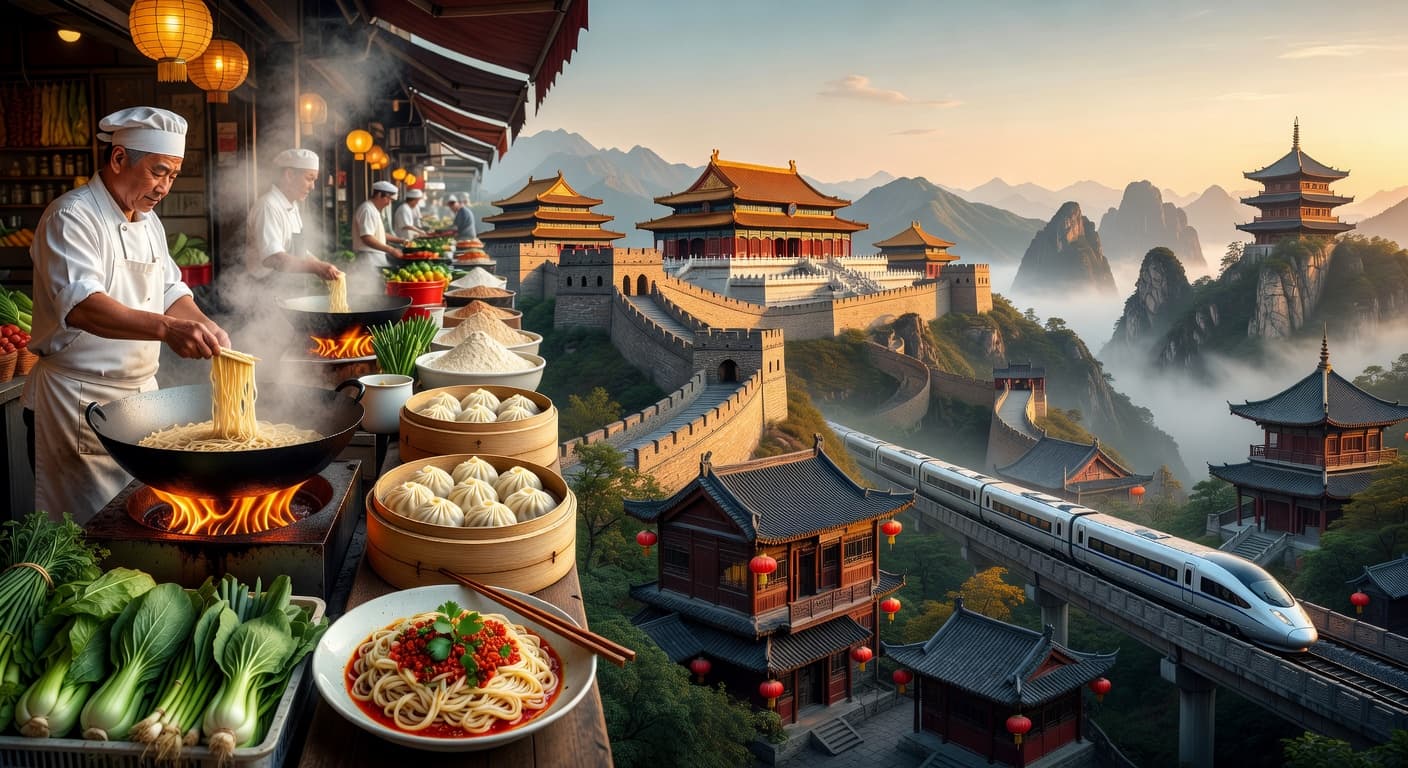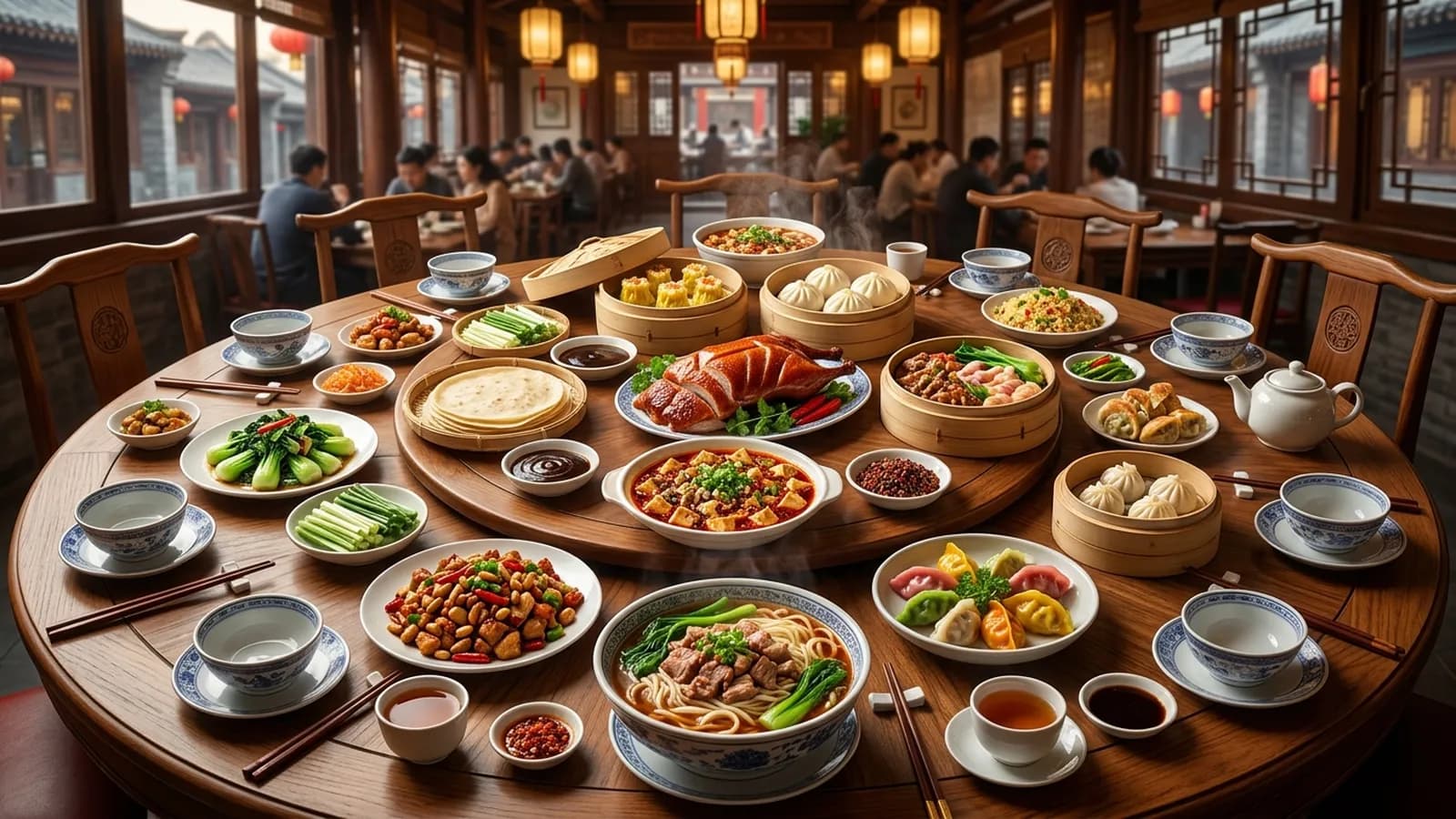
The top 25 must-try dishes in China — from Peking Duck and Xiaolongbao to Mapo Tofu and Lanzhou noodles. With prices, where to eat, and what to expect.
Choosing the most popular food in China is like choosing the best star in the sky -- there are simply too many, and everyone has a different favorite. China's culinary landscape spans eight officially recognized regional cuisines, each so distinct that traveling from Guangzhou to Chengdu to Beijing is as dramatic a food shift as crossing from Naples to Istanbul. During our years of eating across China -- at roadside stalls, Michelin-recommended restaurants, and family kitchens in rural villages -- we have narrowed it down to 25 dishes that define Chinese food for travelers, with real prices, the best cities to try them, and honest notes on what to expect.
No generic hotel buffets. No watered-down tourist menus. Just the dishes that locals argue about, line up for, and take genuine pride in.
Tip: Prices listed below are based on local restaurants and street vendors -- not hotel or tourist-zone pricing. Tier 1 cities like Beijing and Shanghai run 20-40% higher than smaller cities. For a full breakdown of daily food costs, see our guide on eating like a local in China for under $8 a day.
Main Dishes
These are the centerpiece dishes -- the ones that anchor a meal, draw crowds to restaurants, and have earned China its global culinary reputation.
1. Peking Duck (北京烤鸭 -- Beijing Kaoya)
Region: Beijing | Best city: Beijing | Price: 180-320 CNY / $25-45 USD (half duck)
Peking Duck is arguably the most famous dish in all of Chinese cuisine. The duck is air-dried, glazed with maltose syrup, and roasted until the skin turns impossibly thin and crispy while the meat stays juicy. It is carved tableside into over 100 pieces, each wrapped in thin pancakes with hoisin sauce, scallions, and cucumber.
At Beijing's best restaurants -- Quanjude (established 1864) and Da Dong -- it is served in courses: skin first, then meat, then soup from the carcass. Not a quick meal. A ritual.
Flavor profile: Savory, subtly sweet, with crispy-fatty contrast. Not spicy.
2. Mapo Tofu (麻婆豆腐 -- Mapo Doufu)
Region: Sichuan | Best city: Chengdu | Price: 18-35 CNY / $2.50-5 USD
Mapo Tofu is a cornerstone of Sichuan cuisine: silken tofu cubes simmered in chili bean paste, fermented black beans, chili oil, and Sichuan peppercorns, topped with minced pork. Invented in 19th-century Chengdu by a pock-marked (ma) grandmother (po) -- the name stuck.
What makes this dish extraordinary is the mala sensation -- the numbing tingle from Sichuan peppercorns combined with chili heat. When we first tried authentic mapo tofu in Chengdu, we understood why versions outside China taste like distant echoes. The tofu should tremble on the spoon, barely holding together, saturated with electric red oil.
Flavor profile: Numbing, spicy, savory, with a slight fermented depth. Intensely hot.
3. Kung Pao Chicken (宫保鸡丁 -- Gongbao Jiding)
Region: Sichuan | Best city: Chengdu | Price: 25-45 CNY / $3.50-6 USD
Kung Pao Chicken is diced chicken stir-fried with peanuts, dried chilies, and Sichuan peppercorns in a sweet, tangy sauce. Named after a Qing Dynasty governor, the version in Chengdu differs markedly from what you find abroad. Moderate heat makes it a comfortable introduction to Sichuan flavors.
Flavor profile: Savory-sweet, lightly spicy, nutty. Moderate heat.
4. Sweet and Sour Pork (糖醋里脊 -- Tangcu Liji)
Region: Jiangsu/Cantonese | Best city: Guangzhou or Shanghai | Price: 30-55 CNY / $4-7.50 USD
Authentic sweet and sour pork in China is nothing like the takeaway version. Tender pork loin is coated in a light batter, deep-fried until golden, then tossed in a sauce of black vinegar, sugar, and ketchup (yes, the authentic version uses it). The result is crackling and tangy -- a revelation.
Flavor profile: Tangy, sweet, crispy. Not spicy.
5. Red Braised Pork Belly (红烧肉 -- Hongshao Rou)
Region: Hunan/Shanghai | Best city: Shanghai or Changsha | Price: 35-60 CNY / $5-8 USD
Reportedly Mao Zedong's favorite dish, this remains a staple across China. Thick cubes of pork belly are slowly braised in soy sauce, sugar, Shaoxing wine, star anise, and cinnamon until the fat turns translucent and the meat falls apart. Shanghai's version is sweeter; Hunan's is spicier. Either way, the pork should be so tender it barely requires chewing.
Flavor profile: Rich, sweet-savory, caramelized. Meltingly tender.
6. Twice-Cooked Pork (回锅肉 -- Huiguo Rou)
Region: Sichuan | Best city: Chengdu | Price: 22-40 CNY / $3-5.50 USD
A quintessential Sichuan home dish. Pork belly is first boiled whole, then sliced and stir-fried with doubanjiang (fermented chili bean paste), garlic shoots, and fermented black beans. The "twice-cooked" method gives the pork curled, slightly charred edges while keeping the interior succulent. This is what Sichuan locals eat most often -- far more than hot pot.
Flavor profile: Salty, savory, mildly spicy, with umami depth from the fermented paste.
7. Scrambled Eggs with Tomatoes (番茄炒蛋 -- Fanqie Chaodan)
Region: Nationwide | Best city: Any city | Price: 12-25 CNY / $1.50-3.50 USD
The dish every Chinese person learns to cook first. Fluffy eggs scrambled with fresh tomatoes in a slightly sweet, tangy sauce. It appears on nearly every restaurant menu in China. For travelers, it is a reliable, safe, and genuinely delicious option when you are overwhelmed by unfamiliar menus. Do not underestimate it.
Flavor profile: Sweet-tangy, eggy, comforting. Never spicy.
Noodles and Rice
China's noodle traditions are ancient and fiercely regional. Each city claims its noodle dish is the best, and they are all correct.
8. Lanzhou Beef Noodles (兰州牛肉面 -- Lanzhou Niurou Mian)
Region: Gansu | Best city: Lanzhou | Price: 10-18 CNY / $1.50-2.50 USD
Hand-pulled noodles in a clear, aromatic beef broth, garnished with thin slices of braised beef, chili oil, fresh cilantro, and white radish. The noodle-pulling is a performance -- the cook stretches and folds the dough repeatedly, producing noodles of your chosen thickness. Lanzhou has over 1,000 noodle shops, and locals eat this for breakfast.
You will find Lanzhou noodle shops (labeled 兰州拉面) across all of China, but the best bowls are in Lanzhou itself. At under 15 CNY, this may be the best value meal in the country.
Flavor profile: Clean, beefy, aromatic. Mildly spicy from chili oil (adjustable).
9. Dan Dan Noodles (担担面 -- Dandan Mian)
Region: Sichuan | Best city: Chengdu | Price: 8-18 CNY / $1-2.50 USD
Dan Dan Noodles are thin wheat noodles served in a spicy sauce of chili oil, Sichuan pepper, minced pork, and preserved mustard greens (yacai). Named after the carrying poles (dan) used by vendors in Chengdu's alleys. A perfect balance of heat, nuttiness from sesame paste, and savory depth. A small bowl is traditional -- this is a snack, though many travelers order two.
Flavor profile: Spicy, nutty, savory. Numbing heat from Sichuan pepper.
10. Zhajiangmian (炸酱面 -- Zhajiang Mian)
Region: Shandong/Beijing | Best city: Beijing | Price: 15-30 CNY / $2-4 USD
Thick wheat noodles topped with a rich sauce of minced pork fried with sweet bean paste (tianmianjiang), served with shredded cucumber, radish, edamame, and bean sprouts. This is Beijing's everyday noodle. The sauce is the star: dark, glossy, and deeply savory. You mix everything together at the table, and the cold, crunchy vegetables contrast beautifully with the warm noodles.
Flavor profile: Savory, slightly sweet, rich. Not spicy.
11. Crossing-the-Bridge Noodles (过桥米线 -- Guoqiao Mixian)
Region: Yunnan | Best city: Kunming | Price: 15-40 CNY / $2-5.50 USD
A signature dish from Yunnan: a piping-hot bowl of chicken broth arrives covered in a thin layer of oil that traps the heat. On the side, you receive plates of thinly sliced raw meat, vegetables, quail eggs, and herbs that you add yourself -- the retained heat cooks them instantly. Named after a legend about a wife who carried noodles across a bridge to her studying husband, using the oil layer to keep the soup hot.
Flavor profile: Clean, light, aromatic broth. Not spicy (chili oil available on the side).
12. Yangzhou Fried Rice (扬州炒饭 -- Yangzhou Chaofan)
Region: Jiangsu | Best city: Yangzhou | Price: 15-30 CNY / $2-4 USD
The original fried rice. Yangzhou's version is the gold standard: day-old rice stir-fried over high heat with shrimp, char siu pork, egg, peas, and scallions. Each grain should be separate, coated in egg, and slightly smoky from "wok hei" -- the breath of the wok.
Flavor profile: Savory, lightly smoky, balanced. Not spicy.
Dumplings and Buns
Dumplings are arguably China's greatest gift to world cuisine. Every region has its own style, filling, and cooking method.
13. Xiaolongbao (小笼包 -- Xiao Long Bao)
Region: Jiangsu/Shanghai | Best city: Shanghai | Price: 15-40 CNY / $2-5.50 USD (per steamer basket)
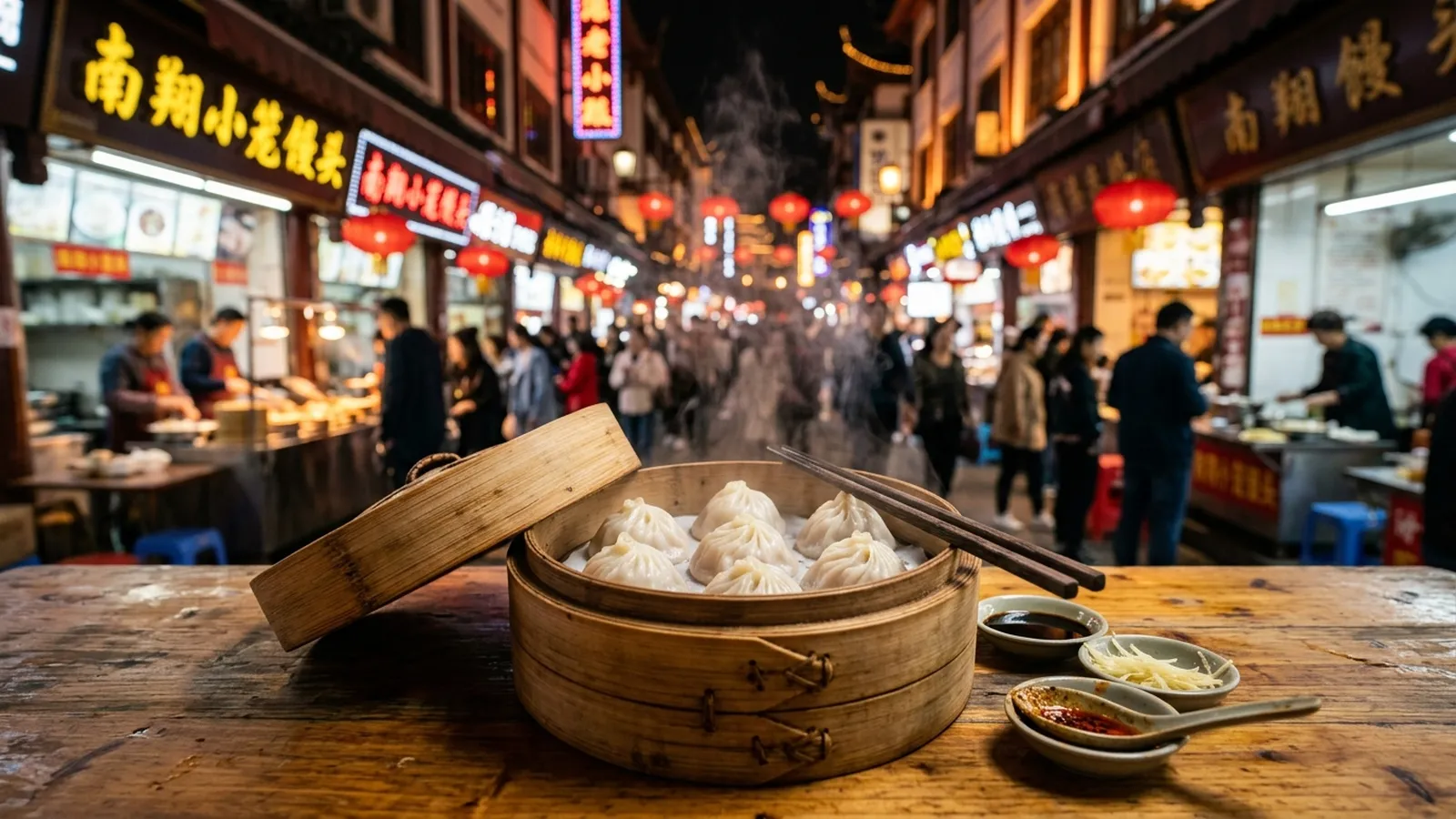
Xiaolongbao -- soup dumplings -- are delicate parcels of thin dough filled with seasoned pork and a gelatinized broth that liquefies when steamed, creating a pocket of hot soup inside each dumpling. Eating technique: place the dumpling on a spoon, bite a small hole, sip the soup, then eat the rest. Burn your mouth on the first one -- everyone does.
In Shanghai, Din Tai Fung is the international standard, but local spots like Jia Jia Tang Bao offer arguably superior versions at half the price. The best xiaolongbao have exactly 18 folds on top.
Flavor profile: Rich, porky, savory broth. Delicate skin. Not spicy.
14. Jiaozi (饺子 -- Jiaozi)
Region: Northern China | Best city: Beijing or Xi'an | Price: 15-30 CNY / $2-4 USD (per plate)
Jiaozi are the quintessential Chinese dumpling -- crescent-shaped parcels filled with minced pork, cabbage, chives, or other combinations. They can be boiled (shuijiao), pan-fried (guotie), or steamed (zhengjiao). In northern China, making jiaozi is a family tradition during Chinese New Year, when families wrap hundreds together. Pan-fried jiaozi (guotie, or "pot stickers") with a crispy golden bottom are particularly addictive.
Flavor profile: Varies by filling. Classic pork and cabbage is savory, juicy, mild. Dipped in black vinegar with chili oil.
15. Char Siu Bao (叉烧包 -- Chashao Bao)
Region: Guangdong | Best city: Guangzhou or Hong Kong | Price: 8-18 CNY / $1-2.50 USD (3 pieces)
Fluffy steamed buns filled with sweet, barbecued pork in a thick sauce. The bun should be cloud-soft with a slight split on top revealing the glistening filling. A staple of dim sum in Cantonese restaurants, served alongside har gow (shrimp dumplings) and siu mai. In Guangzhou, dim sum is not just breakfast -- it is a social institution where families spend hours ordering dish after dish.
Flavor profile: Sweet-savory, soft, pillowy. Not spicy.
16. Sheng Jian Bao (生煎包 -- Shengjian Bao)
Region: Shanghai | Best city: Shanghai | Price: 10-20 CNY / $1.50-3 USD (4 pieces)
Shanghai's answer to the soup dumpling, but pan-fried instead of steamed. Thick-skinned buns filled with pork and soup, cooked until the bottom is golden and crispy while the top stays soft, finished with sesame seeds and scallions. The contrast between the crunchy base and soupy interior is irresistible. Locals eat them for breakfast, standing at tiny shop counters, dipping each bun in black vinegar.
Flavor profile: Crispy-bottom, soupy interior, savory-sweet. Not spicy.
Street Snacks
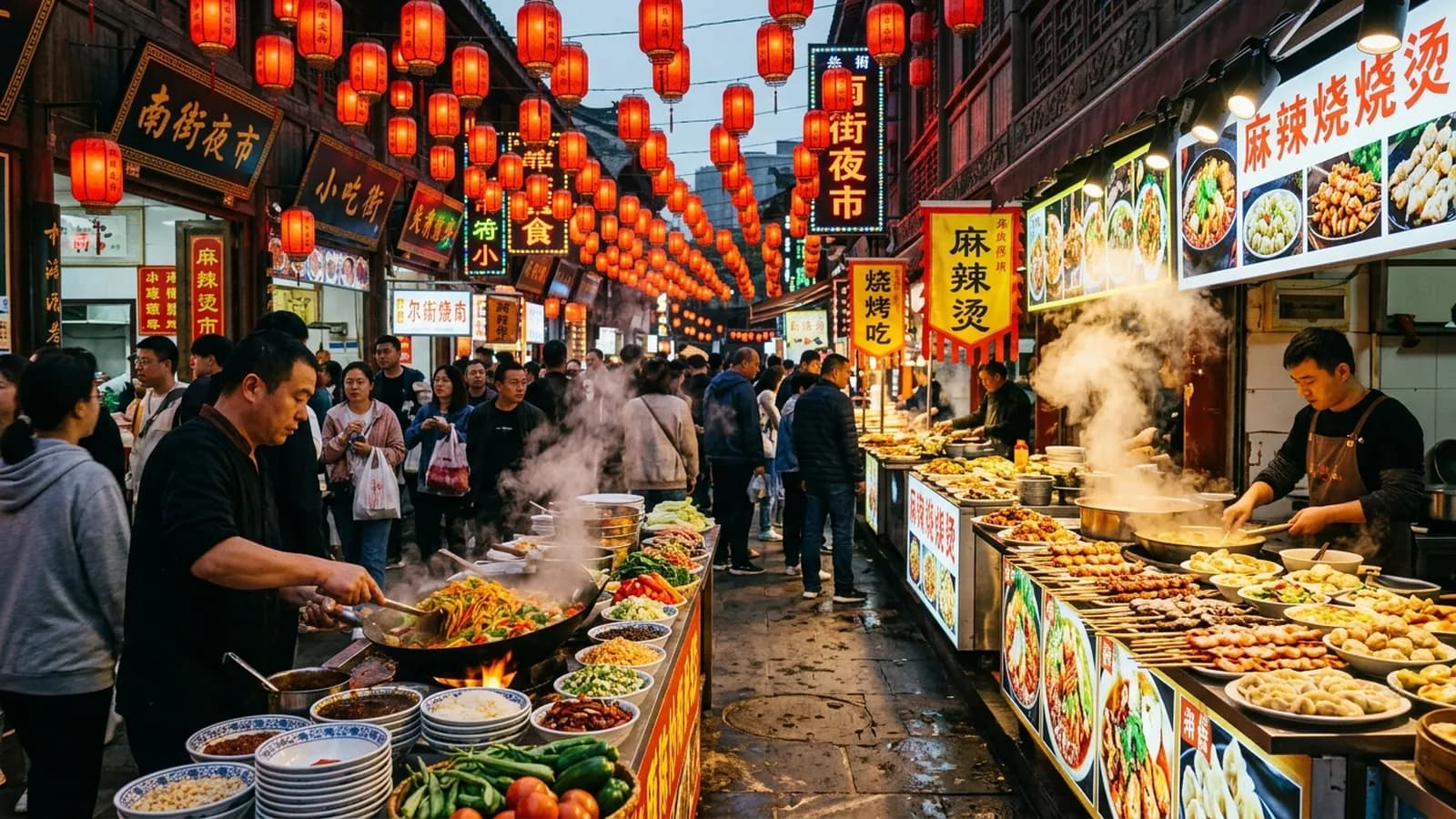
Street food is where China's culinary creativity truly explodes. These are the dishes you find at night markets, on sidewalk corners, and in bustling food streets across the country.
17. Jianbing (煎饼 -- Jianbing)
Region: Northern China | Best city: Beijing or Tianjin | Price: 8-15 CNY / $1-2 USD
China's breakfast crepe. A thin batter is spread on a round griddle, an egg cracked on top, then brushed with sweet bean sauce and chili sauce, topped with crispy fried wonton skin (baocui), cilantro, and scallions, then folded into a portable package. The whole process takes 90 seconds. Jianbing vendors appear at dawn across northern China. The morning queue is your quality indicator: no queue, walk past; long queue, get in line.
Flavor profile: Savory, crispy, eggy, with sweet and spicy sauce. Mild heat.
18. Roujiamo (肉夹馍 -- Rou Jia Mo)
Region: Shaanxi | Best city: Xi'an | Price: 8-15 CNY / $1-2 USD
Often called "China's hamburger," roujiamo is a flatbread bun (mo) stuffed with slow-braised, chopped pork simmered in star anise, cinnamon, cloves, and soy sauce. The bread is baked in a clay oven until slightly crispy outside and chewy inside. In Xi'an's Muslim Quarter, you will also find beef and lamb versions at halal stalls. One of China's oldest fast foods, with origins dating back over 2,000 years.
Flavor profile: Rich, meaty, aromatic with warm spices. Not spicy (chili optional).
19. Chuanr (串儿 -- Chuan'r)
Region: Xinjiang/Northern China | Best city: Beijing or Urumqi | Price: 3-10 CNY / $0.50-1.50 USD per skewer
Lamb skewers grilled over charcoal and dusted with cumin, chili flakes, and salt. Originally from Xinjiang in China's far northwest, chuanr has become a national obsession, particularly as late-night food alongside cold beer. In Beijing, outdoor chuanr stalls appear after dark in hutong alleyways, and the smell of charcoal and cumin is an instant appetite trigger. Beyond lamb, you will find chicken wings, squid, vegetables, and bread on skewers.
Flavor profile: Smoky, cumin-heavy, salty, slightly spicy. Charcoal-grilled.
20. Tanghulu (糖葫芦 -- Tang Hulu)
Region: Northern China | Best city: Beijing | Price: 5-15 CNY / $0.70-2 USD per stick
Skewered hawthorn berries dipped in hardened sugar syrup that cracks like glass when you bite through it. The contrast between the crackly sweet shell and the tart fruit inside is what makes tanghulu so satisfying. Traditional versions use only hawthorn (shanzha), but modern vendors offer strawberries, grapes, kiwi, and tangerine segments. In winter, Beijing vendors carry massive displays of tanghulu -- one of the most quintessentially Chinese street scenes you will encounter.
Flavor profile: Sweet crackly shell, tart fruit interior. A candy-like snack.
21. Stinky Tofu (臭豆腐 -- Chou Doufu)
Region: Hunan/Zhejiang | Best city: Changsha or Shaoxing | Price: 8-15 CNY / $1-2 USD
You will smell it before you see it. Stinky tofu is fermented tofu deep-fried until golden and crispy outside while remaining soft and creamy inside. The flavor is far milder than the smell suggests -- savory, slightly funky, and deeply satisfying when drizzled with chili sauce and pickled vegetables. Think of it as China's blue cheese: the smell is the barrier, the flavor is the reward. Changsha's Huogongdian night market is ground zero.
Flavor profile: Savory, mildly funky, crispy outside, creamy inside. Usually served with chili sauce.
22. Spring Rolls (春卷 -- Chunjuan)
Region: Eastern China | Best city: Shanghai or Guangzhou | Price: 5-12 CNY / $0.70-1.50 USD (2-3 pieces)
Spring Rolls in China bear little resemblance to the heavy versions served abroad. Authentic versions use paper-thin wrappers fried to a shattering crispness, filled with shredded vegetables, pork, or shrimp. In Shanghai, sweet spring rolls with red bean paste appear during the Spring Festival. In Guangdong, fresh (unfried) rice paper rolls are a dim sum staple.
Flavor profile: Crispy, light, savory (or sweet, depending on filling). Not spicy.
Soups and Hot Pot
23. Sichuan Hot Pot (四川火锅 -- Sichuan Huoguo)
Region: Sichuan/Chongqing | Best city: Chongqing or Chengdu | Price: 60-150 CNY / $8-21 USD per person
Hot pot is as much a social event as a meal. A bubbling pot of fiery, deep-red broth sits at the center of the table. You order plates of raw ingredients -- thinly sliced beef, lamb, mushrooms, tofu, leafy greens, noodles -- and cook them yourself. Most restaurants offer a split pot (yuanyang) with one spicy and one mild side for groups with mixed heat tolerance.
Chongqing hot pot is famously the spiciest (see our Chongqing hotpot city guide), while Chengdu's version is more refined and aromatic. Either way, expect to leave smelling like chili oil -- locals consider this a badge of honor.
Flavor profile: Intensely spicy, numbing, aromatic, rich. Mild options available.
24. Wonton Soup (馄饨汤 -- Huntun Tang)
Region: Guangdong/Sichuan | Best city: Guangzhou or Chengdu | Price: 12-25 CNY / $1.50-3.50 USD
Thin-skinned dumplings filled with minced pork and shrimp, served in a light broth. Cantonese wontons are known for delicate wrappers and generous shrimp, while Sichuan-style wontons (chaoshou) come in a pool of fiery chili oil. A bowl of wonton soup -- clean broth, bouncy wontons, a few greens -- is one of the most comforting meals in China.
Flavor profile: Light and savory (Cantonese) or spicy and rich (Sichuan). Depends on regional style.
Desserts and Sweets
Chinese desserts tend to be subtler and less sugar-heavy than Western ones, often featuring beans, sesame, and glutinous rice.
25. Mango Pomelo Sago (杨枝甘露 -- Yangzhi Ganlu)
Region: Guangdong/Hong Kong | Best city: Guangzhou or Hong Kong | Price: 18-35 CNY / $2.50-5 USD
A chilled dessert of fresh mango puree, coconut milk, small sago pearls (similar to tapioca), and pomelo segments. Creamy, fruity, and refreshing -- the perfect ending to a Cantonese meal or a standalone snack on a hot afternoon. Originated in Hong Kong in the 1980s and has since become a staple at dessert shops across mainland China.
Flavor profile: Sweet, creamy, tropical, refreshing. Not spicy.
Quick Reference: All 25 Dishes at a Glance
| # | Dish | Chinese Name | Region | Price (CNY) | Spice Level |
|---|---|---|---|---|---|
| 1 | Peking Duck | 北京烤鸭 | Beijing | 180-320 | None |
| 2 | Mapo Tofu | 麻婆豆腐 | Sichuan | 18-35 | Hot |
| 3 | Kung Pao Chicken | 宫保鸡丁 | Sichuan | 25-45 | Medium |
| 4 | Sweet and Sour Pork | 糖醋里脊 | Jiangsu | 30-55 | None |
| 5 | Red Braised Pork Belly | 红烧肉 | Hunan/Shanghai | 35-60 | None |
| 6 | Twice-Cooked Pork | 回锅肉 | Sichuan | 22-40 | Mild |
| 7 | Scrambled Eggs with Tomatoes | 番茄炒蛋 | Nationwide | 12-25 | None |
| 8 | Lanzhou Beef Noodles | 兰州牛肉面 | Gansu | 10-18 | Mild |
| 9 | Dan Dan Noodles | 担担面 | Sichuan | 8-18 | Hot |
| 10 | Zhajiangmian | 炸酱面 | Beijing | 15-30 | None |
| 11 | Crossing-the-Bridge Noodles | 过桥米线 | Yunnan | 15-40 | None |
| 12 | Yangzhou Fried Rice | 扬州炒饭 | Jiangsu | 15-30 | None |
| 13 | Xiaolongbao | 小笼包 | Shanghai | 15-40 | None |
| 14 | Jiaozi | 饺子 | Northern China | 15-30 | None |
| 15 | Char Siu Bao | 叉烧包 | Guangdong | 8-18 | None |
| 16 | Sheng Jian Bao | 生煎包 | Shanghai | 10-20 | None |
| 17 | Jianbing | 煎饼 | Northern China | 8-15 | Mild |
| 18 | Roujiamo | 肉夹馍 | Shaanxi | 8-15 | None |
| 19 | Chuanr | 串儿 | Xinjiang | 3-10/skewer | Medium |
| 20 | Tanghulu | 糖葫芦 | Northern China | 5-15 | None |
| 21 | Stinky Tofu | 臭豆腐 | Hunan | 8-15 | Mild |
| 22 | Spring Rolls | 春卷 | Eastern China | 5-12 | None |
| 23 | Sichuan Hot Pot | 四川火锅 | Sichuan | 60-150/person | Hot |
| 24 | Wonton Soup | 馄饨汤 | Guangdong | 12-25 | Varies |
| 25 | Mango Pomelo Sago | 杨枝甘露 | Guangdong | 18-35 | None |
Tips for Eating in China as a Traveler
Ordering without Chinese. Most restaurants have picture menus. In smaller cities, use your phone's camera translation to scan the menu. Pointing at other diners' plates is socially acceptable.
Payment. Cash is increasingly rare. Most vendors accept WeChat Pay and Alipay -- set these up before your trip.
Spice tolerance. Learn "bu la" (不辣 -- not spicy). In Sichuan and Hunan, even "mild" dishes carry real heat. Start with Cantonese or Jiangsu cuisine if you are heat-sensitive.
Hygiene. Busy stalls with high turnover are safest. If a vendor has a queue of locals, the food is fresh.
Tipping. Do not tip. Tipping is not customary in mainland China.
Frequently Asked Questions
What is the most popular food in China overall?
China is too large and diverse for a single answer. Jiaozi (dumplings), hot pot, and fried rice are among the most universally eaten. If forced to name one dish every Chinese person has eaten, it would be scrambled eggs with tomatoes (fanqie chaodan).
Is Chinese street food safe for foreigners?
Generally yes. Millions of Chinese people eat street food daily. Choose vendors with high turnover and freshly cooked food. Avoid items that have been sitting out. Carry hand sanitizer and start with cooked (not raw) items if your stomach is adjusting.
How much should I budget for food per day in China?
Street food: 40-80 CNY ($5.50-11 USD) per day. Mid-range: 100-200 CNY ($14-28 USD). Fine dining: 500+ CNY ($70+ USD). See our budget food guide for daily breakdowns.
What should I eat if I cannot handle spicy food?
Cantonese cuisine (Guangzhou, Shenzhen, Hong Kong) is almost never spicy. Shanghai and Jiangsu cuisines are mild and sweet. Safe bets: xiaolongbao, jiaozi, Peking duck, fried rice, wonton soup, and scrambled eggs with tomatoes.
Are vegetarian options available?
Yes, but communicate clearly. Many dishes that appear vegetarian contain meat stock or oyster sauce. Buddhist restaurants (素食餐厅) serve fully vegetarian meals and exist in most cities. Learn the phrase "wo chi su" (我吃素 -- I eat vegetarian).
What is the best city in China for food?
It depends on your preferences. Chengdu and Chongqing for spicy Sichuan food. Guangzhou for dim sum and Cantonese cuisine. Shanghai for xiaolongbao and Jiangnan flavors. Xi'an for street food. Beijing for Peking duck and northern noodles.
When is the best time to visit China for food?
Year-round. Autumn (September-November) is especially rewarding for seasonal produce and hairy crab in Shanghai. Chinese New Year (January/February) features special holiday dishes. Summer night markets are at their busiest and most vibrant.
Ready to eat your way through China? Explore our city guides for restaurant recommendations in every major destination, or dive into our complete food guide for deeper coverage of regional cuisines, cooking techniques, and where to find the best versions of every dish on this list.

About the Author
Go2China Team
The Go2China editorial team combines first-hand travel experience with deep cultural knowledge to bring you accurate, up-to-date guides for exploring China — from the Great Wall and Forbidden City to hidden gems off the tourist trail.
- ✓Lived and traveled extensively across China
- ✓Native & bilingual Mandarin speakers on team
- ✓Verified info from official Chinese tourism sources